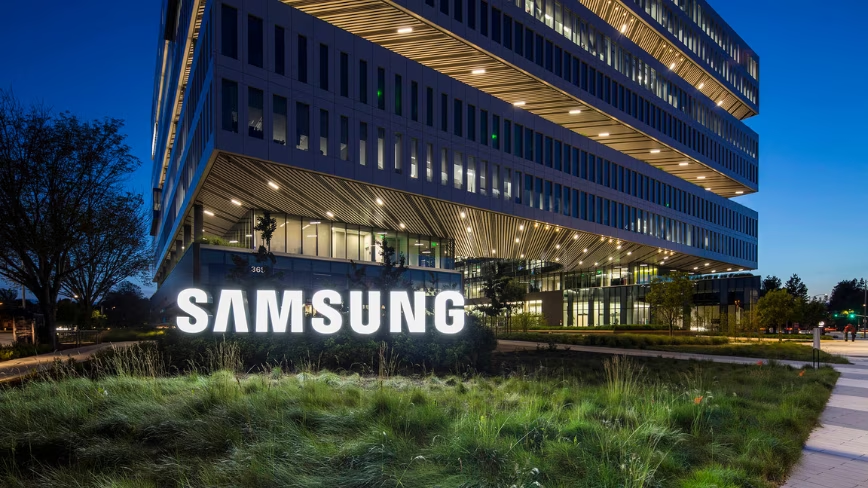
 Credit: Samsung
Samsung’s stock has more than quadrupled in a year. The KOSPI broke 7,000 for the first time. Two Korean chipmakers now account for 42% of the index. The supercycle that built this rally is, by Samsung’s own forecast, not yet at its peak.
There is a particular type of market moment that does not happen often, and one of them happened in Seoul on Wednesday morning. Reuters reported that Samsung Electronics’ market capitalisation crossed $1tn for the first time in the company’s 57-year history, with shares trading up roughly 12 per cent in early dealings before closing higher still.
Samsung’s stock has more than quadrupled over the past 12 months, and the company has now joined TSMC as the only other Asian operator to cross the $1tn threshold. The KOSPI, the South Korean benchmark, broke 7,000 for the first time on the same trading session, hitting an intraday high of 7,338.61.
It is, by any reasonable read of the post-pandemic semiconductor cycle, the largest single re-rating event Korean equities have seen. It is also a milestone that the company has spent considerably less time celebrating than the moment might suggest, because the operating story beneath the rally is, in the company’s own framing, not yet at its peak.
Two pieces of news in the past two weeks have effectively explained Wednesday’s move. The first is the Q1 2026 earnings result Samsung delivered last week. Samsung’s revenue for the quarter reached ₩133.9 trillion (about $90bn), with operating profit of ₩57.2 trillion, an eightfold year-on-year increase and the highest quarterly profit in the company’s history. The semiconductor division alone produced ₩53.7 trillion in operating profit, roughly 94 per cent of the total. The growth was almost entirely attributable to high-bandwidth memory and tightly priced server-grade DRAM.
The second is the supply outlook the company has been signalling consistently. Tom’s Hardware reported in late April on Samsung’s and SK Hynix’s joint warning that AI-driven memory shortages are expected to persist through 2027 and beyond, with customers already booking supply years ahead and the wider DRAM market tightening alongside HBM.
Add the Q1 numbers and the supply outlook together, and the equity-market reaction is, in retrospect, mathematical: a company producing record profit on a product whose supply is structurally short and whose price is rising every quarter is precisely the kind of asset public investors are willing to re-price at scale. The 12 per cent intraday move on Wednesday was not an isolated rally. It was the cumulative re-pricing that finally crossed a particular psychological line.
Samsung is now the second Asian company to cross $1tn, after TSMC reached the milestone first in mid-2025. TSMC has since extended that lead substantially, currently trading at roughly $2tn in market capitalisation. The framing of “joining the elite club” matters less than the structural difference between the two companies’ positions. TSMC’s $2tn is built on its near-monopoly in leading-edge logic foundry, the manufacturing capability that produces every advanced AI accelerator from Nvidia, AMD, Apple, and the major hyperscalers. Samsung’s $1tn is built primarily on memory.
The two companies are, in the AI build-out’s commercial geometry, complements rather than competitors at the silicon level. AI accelerators need both leading-edge logic, which is overwhelmingly TSMC’s, and high-bandwidth memory stacks, which Samsung shares with SK Hynix and Micron. The Korean memory pair are, between them, the supply side of the AI accelerator that is currently constraining how fast Big Tech’s $725bn of 2026 capex can be deployed.
Why Samsung is not, on its own framing, at peak
The most informative thing about Samsung’s recent commentary is what it has not said. The company has not signalled that pricing power is moderating. It has not flagged customer demand fulfilment improving.
Samsung’s chief financial officer told analysts that the demand-fulfilment rate is now at a record low, with customers actively bringing forward 2027 demand into 2026 to lock in supply. The company is guiding to a tighter supply-demand balance in 2027 than in 2026, not a looser one.
That guidance is unusual. Most cyclical-industry CFOs, after a year in which their stock has quadrupled, soften forward signals to manage expectations. Samsung’s commentary has done the opposite. The implicit message to public investors is that the run-up reflected, if anything, a delayed re-rating against fundamentals that continue to strengthen.
There is, of course, a counter-argument. TNW has tracked the wider AI-equity-multiple debate through this spring, with the US CAPE ratio sitting at dot-com-era levels and several AI-software names retracing aggressively in April. Memory is structurally different from AI software, but it is not immune to the same broader risk-appetite cycle. If hyperscaler capex moderates from the projected $725bn 2026 figure, even modestly, Samsung’s pricing power compresses with it. The same operating leverage that produced the eightfold profit jump in Q1 works in reverse with comparable speed.
What the milestone signals beyond Korea
Three things follow from Wednesday’s move that go beyond the Samsung headline. The first is the structural validation of the AI memory supercycle. Investors have been debating, since late 2024, whether HBM demand would persist at the rate analyst models implied or moderate as customers’ procurement plans normalised. The Samsung milestone, on top of SK Hynix’s parallel rally, suggests the market has decided in favour of the persistence thesis.
The second is what it implies for the broader infrastructure economics. The same week that Samsung crossed $1tn, Blackstone’s IPO of its data-centre REIT (BXDC), and the surge of AI tie-ups between major PE firms and frontier model labs.
That whole stack of activity, hyperscaler capex, project-level data-centre financing, model-deployment partnerships, runs on memory pricing that Samsung and SK Hynix substantially set. The trillion-dollar valuation is, in that sense, an index of the supply side’s bargaining power, not just a milestone of company performance.
The third is the reset of how Korea is positioned within the global AI economy. TNW has tracked the broader European tech-sovereignty conversation over the past year; the Korean version of the same conversation now has a different shape. The country is no longer trying to find a way into the AI economy. It is, on Wednesday’s evidence, one of the structural choke-points the rest of the AI economy depends on. That changes the diplomatic, regulatory, and industrial-policy posture of Korea’s government, and it changes how other governments treat Korean export-control questions, particularly around HBM technology transfer to non-aligned customers.
There is also a smaller, internal Samsung dimension worth noting. The company has been working through a substantial leadership reshuffle this year, including the recent change at the head of its Visual Display business. The trillion-dollar milestone arrived during a period in which the company’s top-line story is dominated by memory and its consumer-electronics businesses are being repositioned around AI integration. The two storylines are, by Wednesday’s market valuation, decisively intertwined.
Get the TNW newsletter
Get the most important tech news in your inbox each week.
Also tagged with


