Recruiters spend hours a day calling, leaving voicemails, and asking the same questions. Ringtime automates the whole thing, and has already found a second home in real estate.
There is a well-worn frustration in blue-collar recruitment. A warehouse operative applies on Monday, hears nothing by Tuesday, and has accepted a job somewhere else by Wednesday. The recruiter, meanwhile, has spent the morning leaving voicemails and running through identical screening questions with a list of candidates who may or may not pick up.
Neither side is well served by the process. Ringtime, a Ghent-based AI startup founded in September 2025, thinks it can fix the recruiter’s end of that equation.
Today the company announced a €1.8 million seed round led by Volta Ventures, the Ghent and Amsterdam-based VC firm that backs early-stage B2B software companies across the Benelux. Syndicate One, JK Invest, New School VC, and Allusion also participated.
The capital will go towards expanding the product team, stepping up marketing, and building new features specifically aimed at blue-collar hiring.
Ringtime’s core product is an AI agent that handles inbound and outbound recruitment conversations end to end. It determines which communication channel a candidate prefers, which language to use, the company says its system supports 22 languages, and when to make contact. It then converses, screens, and matches, without a human recruiter on the other end.
The pitch is pitched squarely at a segment of the labour market that existing HR software has historically ignored: workers in logistics, retail, food processing, and construction who rarely use email or LinkedIn, move frequently between employers, and have little patience for a process that doesn’t respond quickly.
“The labour market for technical profiles is constantly shifting,” said Vincent Theeten, Ringtime’s CEO, in a statement. “Today someone works in warehouse logistics, tomorrow in food processing, next month as a driver. Existing hiring tools are built for people with one job at one employer. Reaching them is one of the biggest challenges recruiters face.”
Theeten is best known as the founder of Cheqroom, the Belgian equipment management software company that counts Google, Airbnb, and Fox Sports among its clients and raised $15 million in growth capital in 2022.
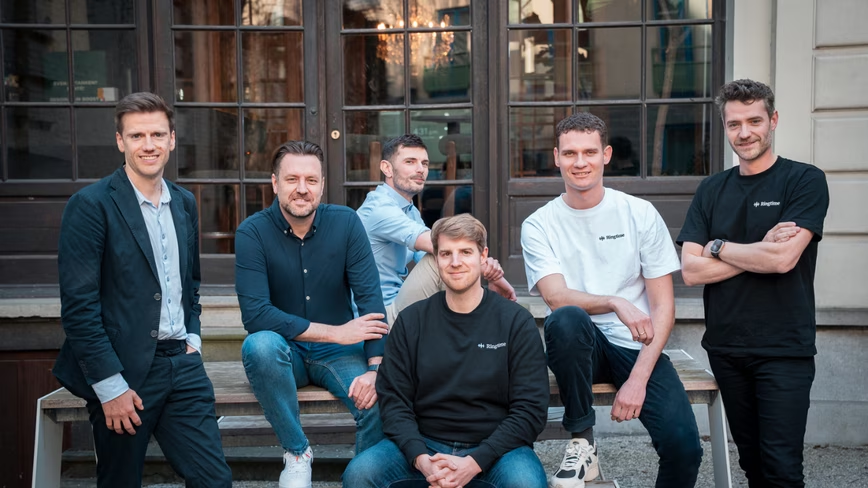
He stepped back from the CEO role at Cheqroom in late 2024, handing the position to Jim Hite, and has since turned his attention to Ringtime. He co-founded the company alongside Johan Krijgsman, owner and CEO of both ERA Belgium, the Belgian arm of the international real estate franchise, and Alfabet, a real estate software business he has led since 2022; Michiel Vanhaverbeke; and Diederik Syoen, who previously served as Head of Marketing at Cheqroom.
The ERA connection is more than biographical. Ringtime says it is already managing property viewings for ERA, allowing prospective buyers to book visits automatically outside office hours and at weekends, without agent involvement.
According to Krijgsman, several properties have been sold with Ringtime handling the scheduling entirely. It is an early illustration of how the company intends to expand its orchestration layer beyond recruitment: any sector where contact volumes are high and time pressure is acute is, in principle, a candidate.
The company says it is currently generating €400,000 in annual recurring revenue, with clients including staffing firms Trixxo Jobs, Synergie Jobs, and House of HR. All three figures, the ARR, the client names, and the revenue trajectory, come from the company’s own communications and have not been independently verified.
“Ringtime is evolving into a complete, intelligent solution for connecting technical candidates to the right job across sectors, languages and geographies,” said Diederik Syoen, co-founder, in a statement.
“We’re building the infrastructure that brings supply and demand together faster than the market can do on its own.”
Europe’s blue-collar vacancy problem is real and structural. Labour shortages in logistics, hospitality, and retail have persisted across the continent despite, and in some analyses, because of, wider AI-driven disruption to adjacent white-collar roles. The problem Ringtime is solving is not, as Theeten frames it, primarily a matching problem.
It is a communication infrastructure problem: the tools that connect recruiters to candidates were built for a workforce that communicates via email and applies through polished CVs. That workforce is not the one stacking shelves or driving vans.
Ringtime plans to use the fresh capital to expand into the Netherlands, the UK, and Germany. It is, at six months old, an early bet on whether an AI-native voice and messaging layer can bring the same efficiency gains to physical-world hiring that software has delivered, in fits and starts, to the office economy. The answer will arrive faster than a voicemail.
Get the TNW newsletter
Get the most important tech news in your inbox each week.


