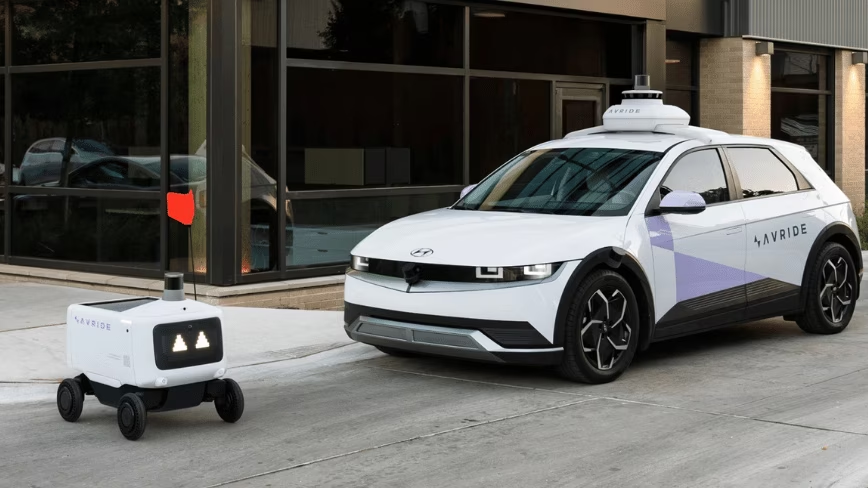
Avride
 Credit: Avride
The National Highway Traffic Safety Administration has opened an investigation into Avride, Uber’s autonomous vehicle partner, after identifying 16 crashes and one minor injury in the four months since the company launched its robotaxi service in Dallas. The regulator’s language is unusually blunt: the vehicles displayed “excessive assertiveness and insufficient capability,” a phrase that could describe not just Avride’s self-driving system but the broader industry’s determination to deploy autonomous vehicles before they can reliably avoid hitting things.
The crashes, which occurred between December 2025 and March 2026, involved Avride’s fleet of Hyundai Ioniq 5 vehicles changing lanes into the path of other cars, failing to slow or stop for slow-moving and stationary vehicles, and striking objects in the road. All incidents occurred with a safety monitor sitting in the driver’s seat. In only one of the 16 reported crashes did the safety monitor attempt to intervene.
The partner
Avride is a subsidiary of Nebius, the Amsterdam-based technology company that emerged from the restructuring of Yandex NV after the Russian internet giant sold its domestic business in 2024. Yandex founder Arkady Volozh launched Nebius with 1,300 employees, 2.5 billion dollars in cash, and businesses spanning data infrastructure, edtech, and autonomous driving. Avride inherited Yandex’s self-driving technology, which had been in development since 2017.
Uber announced its partnership with Avride in October 2024, and the companies launched a robotaxi service in a nine-square-mile section of downtown Dallas on 3 December 2025. Uber and Nebius committed up to 375 million dollars in investment to scale Avride’s fleet to 500 vehicles. Avride also operates sidewalk delivery robots on Uber Eats in Austin, Dallas, and Jersey City, and on Grubhub at university campuses including Ohio State.
The NHTSA investigation covers all crashes related to what the agency’s Office of Defects Investigation described as the “competence of” Avride’s self-driving system. The minor injury occurred in December 2025 when an Avride vehicle clipped the open door of a parked pickup truck. Other incidents involved the vehicle turning into a van during a lane change and striking a dumpster. The agency said the behaviour pattern “may also constitute traffic safety violations.”
The platform
Uber reported in its first-quarter 2026 earnings that autonomous trips grew tenfold year over year, a figure that reflects the company’s strategy of integrating multiple autonomous vehicle partners into its ride-hailing platform rather than developing its own self-driving technology. The strategy is the inverse of what Uber attempted between 2015 and 2020, when it spent billions building an in-house autonomous programme that culminated in the death of pedestrian Elaine Herzberg in Tempe, Arizona, in March 2018.
After shutting down its autonomous unit and selling the technology to Aurora Innovation, Uber pivoted to a platform model. It is testing a Lucid Gravity robotaxi with Nuro in San Francisco. Volkswagen’s MOIA is testing self-driving ID. Buzz minibuses on Uber in Los Angeles. Uber, Wayve, and Nissan are bringing robotaxis to Tokyo. Waymo rides are bookable through Uber in Austin and Atlanta. The company is live with autonomous rides in eight cities and targeting 15 by the end of the year.
The platform model gives Uber scale without the capital expenditure and safety liability of operating its own fleet. It also means Uber’s brand and its passengers are exposed to the safety record of every partner it integrates. When an Avride vehicle changes lanes into a van in Dallas, the ride was booked through the Uber app.
The pattern
Avride is not the only autonomous vehicle operator facing regulatory scrutiny in Texas. Tesla’s robotaxi service in Austin has been involved in 14 crashes since launching, a rate that Electrek calculated at approximately four times worse than human drivers. NHTSA has escalated its investigation into 3.2 million Tesla vehicles equipped with Full Self-Driving software, opening an engineering analysis that is a required step before a potential recall.
Waymo, which operates the largest and longest-running commercial robotaxi service with 3,000 vehicles, 500,000 paid rides per week, and more than 200 million fully autonomous miles, has established the benchmark that regulators and the public use to evaluate every other autonomous operator. Waymo’s safety record, while not perfect, is substantially better per mile than human drivers in the cities where it operates. The gap between Waymo’s performance and Avride’s 16 crashes in four months illustrates the range of capability among companies that are all legally permitted to operate on public roads.
Texas has some of the most permissive autonomous vehicle regulations in the United States, which is why multiple companies have chosen it as a launch market. The permissiveness that attracts operators also means the regulatory response to safety failures is largely reactive. NHTSA’s investigation into Avride was triggered by crash reports, not by pre-deployment safety standards that the vehicles failed to meet.
The question
Uber sold its autonomous technology in 2020 because the cost and liability of developing self-driving vehicles was unsustainable. The platform model was supposed to solve both problems: partners bear the development cost and the safety responsibility, while Uber provides the demand. The Avride investigation tests that assumption. The crashes occurred on rides booked through Uber’s app, in vehicles displaying Uber’s branding, carrying Uber’s customers. The regulatory investigation is into Avride, not Uber. But the reputational exposure is shared.
Avride’s 375 million dollars in backing from Uber and Nebius, its fleet of 200 vehicles, and its expansion plans all depend on the NHTSA investigation’s outcome. A finding that the self-driving system has a safety defect could lead to a recall or operational restrictions. The investigation could also establish a precedent for how regulators evaluate the platform companies that deploy autonomous vehicles they did not build and do not directly control.
NHTSA’s phrase, “excessive assertiveness and insufficient capability,” is precise. The vehicles were programmed to act decisively in traffic. They lacked the perception and decision-making quality to execute those actions safely. The combination produced 16 collisions in 16 weeks. The question for Uber, which has staked its autonomous strategy on trusting partners to solve the hardest problem in robotics, is how many crashes it takes before the platform’s brand absorbs the partner’s failures. The question for regulators is why autonomous vehicles that are excessively assertive and insufficiently capable were permitted to carry passengers in the first place.
Get the TNW newsletter
Get the most important tech news in your inbox each week.
Also tagged with


