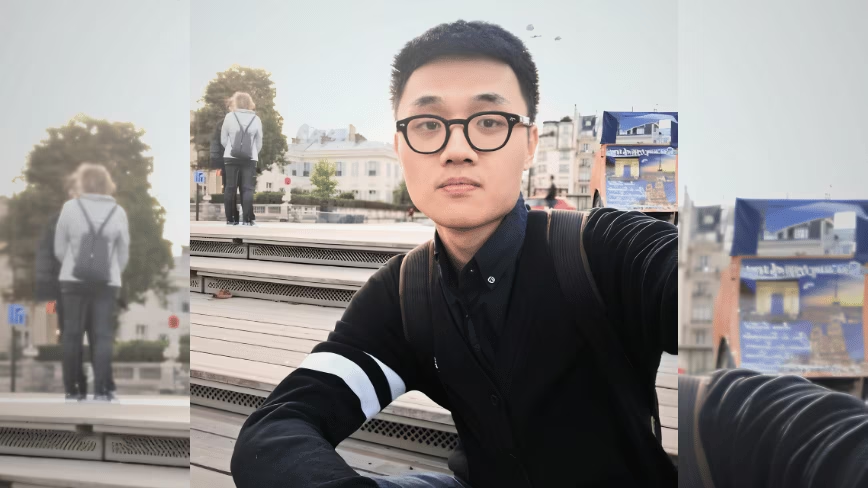
The researcher who led Alibaba’s Qwen models has started his own company. Junyang Lin announced Pragmatik Labs on X on Tuesday evening, five months after walking out of Alibaba.
The lab is based in Shanghai and works on what Lin calls next-generation agents across digital and physical worlds. Gaorong Ventures and HSG, the firm formerly known as Sequoia China, co-led the round.
Tencent invested too. So did one more backer, and it is the one nobody else reported.
The investor everyone missed
Lin thanked the Shanghai Engine Fund, giving its Chinese name in the same breath. That name translates as the Shanghai Future Industries Fund.
It is not a private firm. The fund runs to 10 billion yuan, roughly $1.4bn, and is financed entirely by the Shanghai government.
Shanghai unveiled it in September 2024 with a 15-year horizon, extendable by three more. It targets six areas the city has designated as future industries, and it invests both directly and through sub-funds.
None of the major coverage carried this. The Information named Gaorong and HongShan. Bloomberg named Gaorong, HSG and Tencent, and the state money appears only in Lin’s own post.
Why the name is the thesis
Lin did not come to AI through computer science. He holds a bachelor’s degree in English literature and a master’s in linguistics from Peking University, where he later led a group at the Institute of Computational Linguistics.
He joined Alibaba’s DAMO Academy in 2019 and worked on language generation for Taobao search before Qwen. The lab’s name comes from that first act.
“I studied linguistics because my friend recommended pragmatics to me,” he wrote. “The name just means being back to where it happens.”
Pragmatics is the study of meaning in context, which is a reasonable description of what an agent has to do. Lin also invoked pragmaticism, judging a system by how well it works in the world rather than on a benchmark.
What he is actually building
Pragmatik’s own site splits the work four ways. Digital agents for knowledge work, physical agents for real environments, frontier research, and products shaped by real-world feedback.
The physical half is the expensive half. Digital agents need planning, tool use and memory, while physical agents add perception, spatial reasoning and machines that move.
Doing both at once is a much larger bill than building an app on someone else’s model. Lin has not said what the physical agents are, and the term usually points at robots.
China is already the place that builds them. The country ships almost every humanoid robot sold worldwide, so the supply chain sits on Lin’s doorstep.
The exit that started it
Lin left Alibaba on 4 March, posting “Bye my beloved Qwen”. Two other senior figures had gone in the same stretch, and he had warned publicly about the gap between Chinese and American AI.
His Qwen record is the collateral. He was an author on the original 2023 technical report and a core contributor to Qwen2.5, and the family became the base for Alibaba’s AI products.
Alibaba has not stood still. It shipped Qwen 3.8-Max this month, its largest model yet, and let developers customise it.
Lin also championed open weights, an approach that looked shaky at Alibaba around the time he left. The company has since moved back towards it, and it is separately trying to charge its heaviest open-model users.
A wave, not a one-off
Lin is one of many. Elite researchers are walking out of large labs everywhere, and China now has its own crop of what investors are calling neolabs.
The money has followed fast. Chinese AI startups have seen a funding surge that has minted unicorns at speed.
The strategic backdrop is open weights. Cheap Chinese models have created what one analysis called a death zone for American rivals trying to sell access.
Agents are the next front. Alibaba itself has been redirecting models towards agents and robots, which is the same bet Lin has left to make independently.
What is missing
There is no model, no product and no demo. Pragmatik has a website, a mission statement and an email address asking for serious notes.
Lin did not give a valuation. The Information reported in May that he was seeking several hundred million dollars at $2bn, and neither he nor his backers have confirmed a figure since.
Gaorong confirmed the funding and said nothing further. HSG and Tencent did not respond to Bloomberg, and Lin did not respond to a request for comment.
So the round prices a reputation. It buys the Qwen name, the people Lin can recruit, and a research agenda that spans software and machines, before any of it has produced a single released model. The first technical output is the only thing that will settle whether that was cheap or expensive.
Get the TNW newsletter
Get the most important tech news in your inbox each week.


