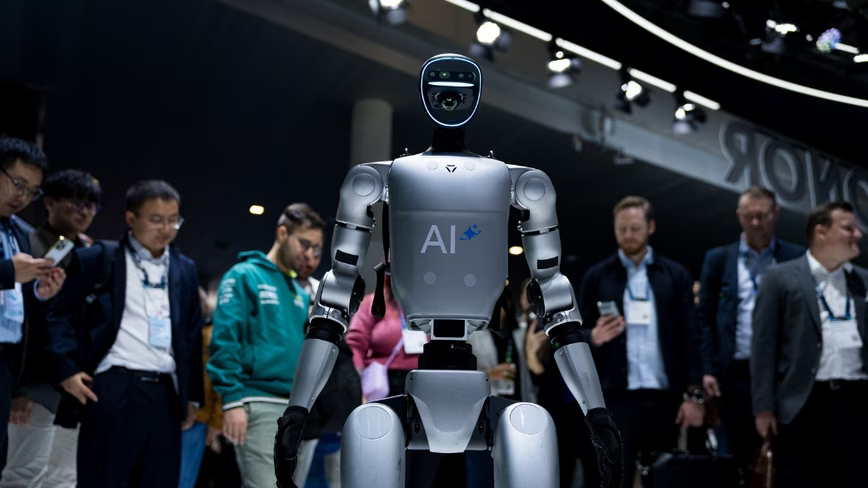
A humanoid robot by the company Unitree is seen at the Mobile World Congress 2025 (MWC) at the Fira de Barcelona.
 Credit: Davide Bonaldo via Shutterstock
If a humanoid robot shipped anywhere in the world this year, the odds are overwhelming that it was made in China.
A new report says Chinese manufacturers now account for roughly 97% of global humanoid shipments, a level of dominance that leaves every rival nation as little more than a rounding error.
That figure is startling, yet it only sharpens a trend already well under way. Earlier analysis from Morgan Stanley found that about 90% of the 13,000 to 16,000 humanoids shipped in 2025 came from Chinese firms, while the US, Japan and others remained largely stuck at the prototype stage.
The gap between the leaders and everyone else is enormous. Zhiyuan alone shipped some 5,100 units last year, close to two-fifths of the global total, with Unitree not far behind, whereas American names such as Figure, Tesla and Agility each managed only a few hundred.
Put bluntly, a single Chinese maker can out-ship the entire American field several times over. By Morgan Stanley’s reckoning the top Chinese firm shipped roughly 36 times as many robots as its US counterparts, a chasm that no amount of Silicon Valley hype has yet closed.
The reasons run deeper than any one company, starting with the supply chain. More than half of the hundred key global suppliers of parts like reducers, servo motors and 3D-vision sensors are Chinese, which lets domestic makers build faster and far more cheaply than rivals who must import the same components.
Cost is the whole game at this stage, and China has an edge there too. Surveys of Chinese firms suggest mass adoption only really kicks in once prices fall below a certain threshold, and the country’s manufacturers are relentlessly cutting costs to reach it, exactly the discipline that turns prototypes into products.
Money is pouring in to match. By early 2026 China was drawing close to half of all global venture funding for the sector, and its champions have been racing to the public markets, with Unitree having cleared its Shanghai listing as investors scramble for exposure.
The state has made all of this a priority, and the momentum shows. Forecasts keep climbing, with Morgan Stanley doubling its shipment target for the country as the industry moves from demonstrations into early commercial use.
Demand is starting to appear in ordinary places, too. China’s carmakers are among the early adopters, with BYD planning to put a humanoid in its showrooms, the kind of concrete use case that helps justify the breakneck production.
The contrast with the United States could hardly be sharper. American efforts are real but nascent, and even ambitious ventures aiming to build robots for the Pentagon are starting from a tiny base compared with China’s factories.
A dose of scepticism is still warranted, however. Many of the robots rolling off Chinese lines remain more performative than genuinely useful, better at demos and dance routines than at reliable work, so raw shipment numbers flatter the real state of the technology.
Even so, scale has a way of becoming its own advantage. The country that builds the most machines gathers the most operating data, drives costs down fastest and cements the supplier relationships that lock in a lead, which is why a 97% share is about far more than bragging rights.
Western firms would counter that the fight is far from settled, and they have a point. Software still matters enormously, and a robot is only as useful as the intelligence that guides it, so a US lead in AI models could yet blunt China’s manufacturing edge if capable machines end up running on American brains.
For the rest of the world, the report is a warning shot all the same. Whoever ends up dominating physical AI will shape a market some analysts think could eventually be worth trillions, and on current form the race to actually build the machines has a very clear front-runner.
Get the TNW newsletter
Get the most important tech news in your inbox each week.


