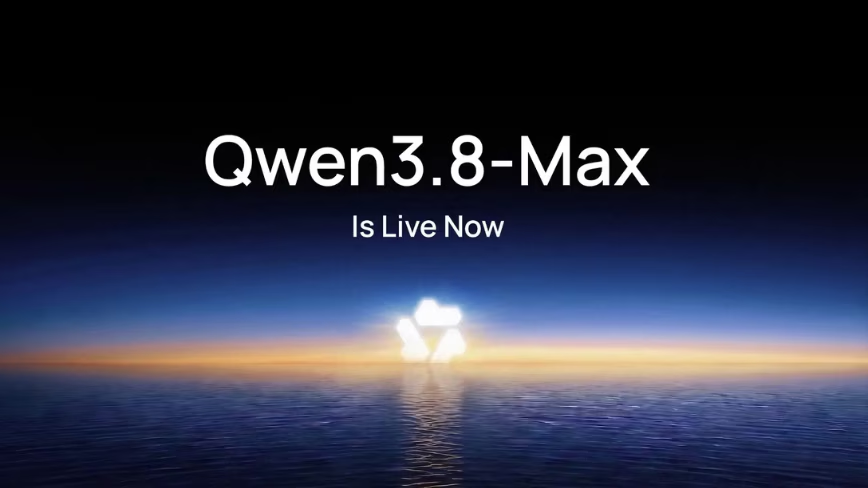
Alibaba has unveiled Qwen3.8-Max, the most capable model it has built and a pointed entry in the size race between China’s largest AI developers. At 2.4 trillion parameters it sits just below Moonshot’s Kimi K3, which carries 2.8 trillion, close enough that the comparison is the story.
The model is multimodal, handling text, images, and video, and can take up to a million tokens in a single prompt. Alibaba says it will launch next week through Model Studio, the developer platform on Alibaba Cloud.
On Arena.AI’s public leaderboard, Qwen3.8-Max ranks highest of any Chinese text model and second in the world on the visual-analysis benchmark, behind only Anthropic’s Claude Fable 5. It is a step up from the version Alibaba recently billed as the world’s No.2 AI model.
The headline parameter count is not the number that governs cost. Qwen3.8-Max uses a mixture-of-experts design that activates only about 95 billion parameters for any given request, a way of keeping a very large model cheap to run and quick to answer.
A million-token context window matters for the tasks Alibaba is chasing. It is enough to hold a large codebase, a long video transcript, or a stack of documents at once, the raw material for the agent work the company keeps circling back to.
That Alibaba is quoting parameter counts at all marks a divide in the industry. Chinese developers have made openness a selling point, publishing sizes and often weights, while OpenAI, Anthropic, and Google keep those figures to themselves.
Alibaba also says the model completed a software-engineering project over a 16-day autonomous run, a claim that points at the growing interest in long-horizon agent tasks. The figure is the company’s own and has not been independently tested.
The release keeps Alibaba in close contact with Moonshot, whose Kimi K3 has been the model to beat this year. Demand ran hot enough that Moonshot paused new sign-ups to protect capacity, a sign of how fast a strong Chinese model now finds users.
Size is only part of the push. Alibaba has been building out AI models for robots as China’s attention shifts from chatbots to agents that can act, and Qwen is meant to be the brain those products call on.
There is a commercial engine underneath all of it. Alibaba has been folding Qwen into its own services, from cloud to consumer shopping, which gives each new model an immediate route to real users rather than a standalone demo.
The launch continues a fast release cadence from the Qwen team, which has shipped a steady run of models this year. The tempo is part of the strategy, keeping Alibaba in the conversation each time a rival claims the lead.
Giving models away, or close to it, is a deliberate wedge. Open weights win developer mindshare and pull workloads onto Alibaba Cloud, where the company can still charge for the compute that runs them, whatever the model itself costs.
None of it comes with a price yet. Alibaba did not publish token pricing for Qwen3.8-Max, though its recent models have undercut Western rivals sharply, and the wider Chinese market has been racing costs toward the floor.
The rise has not been frictionless. Anthropic has accused Alibaba of running its largest distillation campaign against Claude, alleging attempts to copy the American model’s behaviour, a charge Alibaba disputes.
For buyers outside China, the question is less about the top of a leaderboard than whether an open, cheaper model is close enough to the frontier to switch to. On these benchmarks, Alibaba is arguing that it is.
Whether Qwen3.8-Max holds those rankings once developers get their hands on it next week is the open question. Leaderboards move quickly, and in Chinese AI right now they move faster than most.
Get the TNW newsletter
Get the most important tech news in your inbox each week.
Also tagged with


