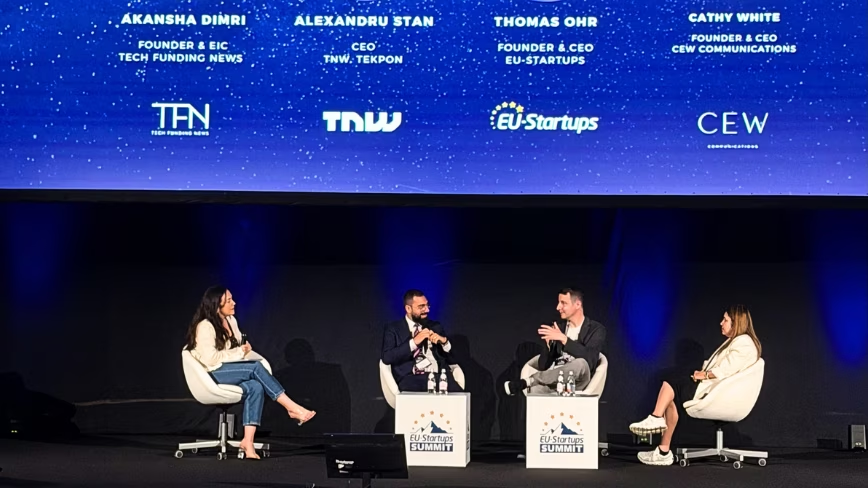
A panel in Valletta laid out a working playbook for startup PR, from the friends-and-family headline test to the case for hiring an agency.
Founders looking for media coverage at this year’s EU-Startups Summit in Valletta got a fairly direct briefing from the people who decide what gets published.
The session, titled “The Startup Media Landscape, PR Tips & Tricks”, brought together three editors and a moderator to walk early-stage operators through what works, what does not, and what has changed in the last twelve months.
The panel featured Thomas Ohr, founder and chief executive of EU-Startups; Akansha Dimri, founder and editor-in-chief of Tech Funding News; and Alexandru Stan, chief executive of TNW.
It was moderated by Cathy White, founder of CEW Communications. The session was part of the summit’s main-stage programme at the Mediterranean Conference Centre, which expects roughly 2,500 attendees across this year’s two-day event.
The headline takeaway was practical rather than philosophical. Alexandru Stan argued that founders, especially those at seed and Series A, should consider working with a PR agency. His reasoning was straightforward: the major publications covering the European tech scene receive a high volume of pitches every day, and a professional with experience cutting through that volume is often worth the line item.
A founder writing their own pitches in spare hours, he suggested, is competing against agencies that pitch the same outlet five days a week and know which journalist covers which beat.
That argument was paired, throughout the discussion, with a warning. Several speakers stressed that founders should avoid leaning too heavily on AI-generated press releases, which are now filling inboxes, and which read identically across companies.
The advice instead was to focus on authentic storytelling: a clear sense of what the company does, who it serves, and why this particular news matters now. Generic announcements, even well-formatted ones, are increasingly easy to spot and easy to ignore.
A related point landed early in the session and stayed with the audience. Before pitching a journalist, take time to understand what the publication actually covers. Read recent pieces.
Note which writers cover which beats. Send the right story to the right person. The point was not subtle, but it remains, by every editor’s account, the single most common mistake startups make.
Perhaps the most quotable piece of advice was a test for headlines. If the headline of a press release is not strong enough to catch the attention of friends and family, the panel suggested, it is unlikely to be strong enough for the media either.
The framing was deliberately low-tech, but it captures something the more elaborate PR playbooks sometimes obscure: editors are reading hundreds of subject lines a day, and the ones they open are the ones that read like a story rather than a corporate announcement.
The audience for the session reflected the summit’s wider mix. Founders made up the largest segment, alongside investors, marketers, agency operators, and ecosystem leaders from across Europe.
The conversation, by design, was less about how to game coverage and more about how to earn meaningful attention without treating media as a shortcut to credibility.
That framing matters because the underlying problem the panel was responding to has not gone away.
European founders consistently report that coverage of the continent’s companies skews towards the largest markets and the most-funded rounds, leaving earlier-stage companies and those based outside London, Berlin, Paris, and Stockholm fighting harder for visibility.
The summit’s choice of Malta as a location and the panel’s choice of audience reflect that imbalance directly.
During the session, journalists on stage also asked Alexandru Stan about his acquisition of TNW from the Financial Times Group, which closed in late 2025. Stan acknowledged the topic but did not disclose further details about the transaction, which was completed through Tekpon, the SaaS marketplace he founded in 2020.
For founders in the room, the broader message of the panel was harder to misread than most. Coverage is earned. The shortcut, the AI-generated release sent to a mailing list scraped from a database, is now also the most crowded route.
The slower path, knowing the publication, finding a story that reads like a story, and writing a headline a friend would click on, is also the one that still works.
Disclosure: Alexandru Stan is the chief executive of TNW. This article was written and edited independently.
Get the TNW newsletter
Get the most important tech news in your inbox each week.


