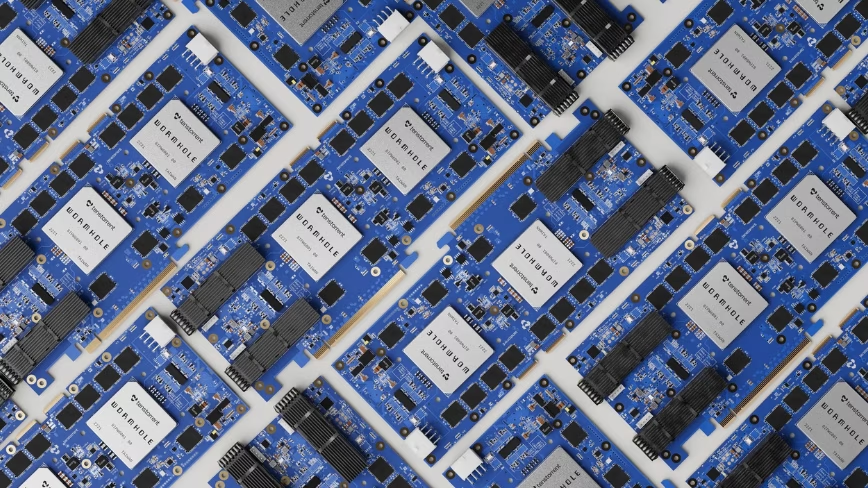

Bloomberg reports early-stage takeover conversations with the Jim Keller-led AI chip startup, which raised $800m at a $3.2bn valuation last year and counts Bezos Expeditions and Samsung among its backers.
Tenstorrent, the Jim Keller-led AI chip startup, has held early-stage takeover conversations with Intel and Qualcomm, Bloomberg reported on Monday, citing people familiar with the matter.
The talks are at the conversational rather than transactional stage, on the wire’s own framing. Tenstorrent declined to comment, and neither Intel nor Qualcomm has confirmed the discussions on the record.
The valuation backdrop matters. Tenstorrent was in talks to raise $800m at a $3.2bn pre-money valuation led by Fidelity Management in November 2025, up from the $693m Series D it closed in December 2024 at a $2.6bn valuation.
Existing investors include Bezos Expeditions, LG Electronics, Baillie Gifford, and the Healthcare of Ontario Pension Plan. The company is also reportedly sitting on roughly $150m in customer contracts, including manufacturing arrangements with Samsung and automotive-AI commitments with Hyundai.
The technical positioning is the part that makes the takeover interest legible. Tenstorrent designs RISC-V-based AI accelerators (Ascalon CPU cores and Tensix AI cores) that the company is selling both as packaged silicon and as licensable IP, an unusual hybrid model for a chip startup.
Keller, whose CV runs through Apple’s A-series, Tesla’s autopilot silicon, AMD’s Zen architecture, and Intel’s CPU group, joined as CTO in 2020 and took over as chief executive in 2025.
The pitch to the named acquirers is that the alternative to building an NVIDIA rival from scratch is buying the only credible RISC-V-AI platform on the market.
The buyer-side logic differs by name. Intel needs anything that lets it reposition against NVIDIA inside the AI training market, having spent the past two years restructuring its discrete-accelerator strategy after the Gaudi line underperformed against expectations.
Qualcomm is the more interesting buyer, with a smartphone-SoC and Arm-architecture business that has historically not competed in data-centre AI but which would acquire, in Tenstorrent, both a licensable IP block and a credible non-Arm CPU roadmap inside the same transaction.
Bloomberg’s reporting does not specify whether either buyer is exploring a full takeover or a minority strategic investment.
The market context is the wider re-rating of NVIDIA alternatives. NVIDIA has itself committed over $40bn of AI equity in 2026 to lock in long-term GPU supply commitments from named customers; Google’s TPU programme has shown that the alternative-architecture path can produce customer traction at scale; Cerebras has filed to go public on an inference-optimised pitch; and Groq has been raising at structurally rising valuations through 2025.
The Tenstorrent conversations are happening inside that competitive frame. Either acquirer would be paying for the category position as much as for the technology itself.
What Bloomberg’s reporting does not say is the proposed transaction structure, the indicative price range, or whether Tenstorrent’s earlier-disclosed IPO plans remain on the table alongside the strategic-buyer conversations.
Companies frequently run dual-track processes at this stage; an $800m primary round and a takeover conversation are not, on the cleanest reading, mutually exclusive.
The most plausible outcome on the available evidence is that Tenstorrent continues its primary fundraising while letting the strategic conversations clarify the upper bound of its public-market exit valuation.
The corporate-finance reading is straightforward. Tenstorrent’s Ascalon RISC-V CPU and Tensix AI core programme are productisable assets that fit cleanly inside either Intel’s data-centre roadmap or Qualcomm’s diversification strategy.
The valuation will be the variable. The $3.2bn the company commanded in its last fundraise sets a floor for what either buyer would need to clear, with a typical strategic-acquisition premium on top.
Whether the conversations reach formal bids over the next several months is the question the next two quarters of Tenstorrent’s product and customer announcements will help settle.
Get the TNW newsletter
Get the most important tech news in your inbox each week.
Also tagged with


