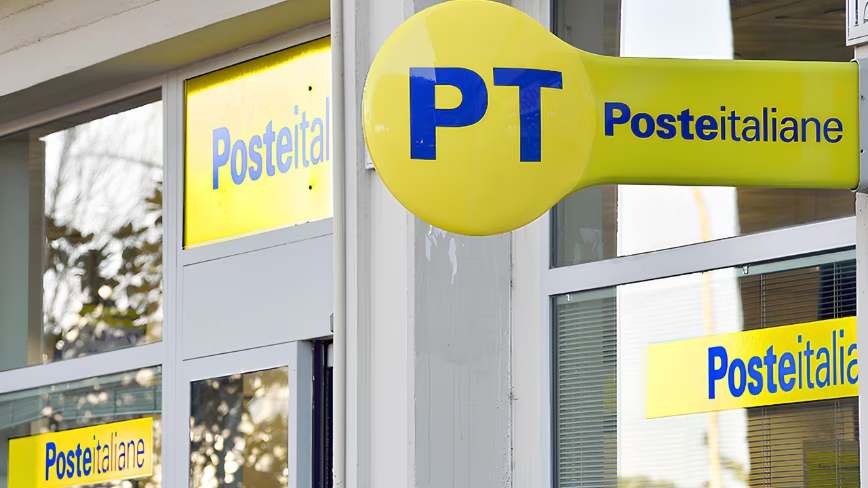

Italy’s postal service has spent a century and a half moving letters, parcels and pension payments around the country. Now it wants to move data. Poste Italiane, which still hands out state pensions through roughly 12,600 branches, has cast itself as an unlikely contender in Europe’s scramble to build the infrastructure behind AI.
The bet rests on Telecom Italia. Poste has been steadily tightening its grip on the former state monopoly, and it is now the largest shareholder in a group it frames as the nucleus of a bigger, state-backed digital champion. The company argues that a combined Poste-TIM could put Italian computing capacity on Italian soil rather than renting it from American hyperscalers.
The logic is as much geographic as financial. Poste says the enlarged group could layer new capacity onto TIM’s existing data centres and telecom exchanges, then push processing power outward by turning former mail-sorting hubs into local edge-computing sites.
The pitch is that a network built to deliver post is, conveniently, already spread across every corner of the country.
That geography is the argument. Edge computing, which keeps data close to where it is generated rather than routing it to a handful of distant megacentres, rewards exactly the kind of dense, distributed footprint a postal operator has spent decades assembling.
A sorting centre outside a mid-sized town is not glamorous, but it has power, space and a location that a greenfield data-centre developer would have to fight to secure.
Poste is not moving into a quiet market. Italy has become one of Europe’s more active data-centre destinations, with several large investments landing in quick succession and analysts expecting the sector to roughly double over the 2025-2026 period.
Microsoft alone has committed billions to expanding its Italian cloud region, part of the surging hardware demand reshaping the industry from chips to memory prices.
What separates Poste from the hyperscalers is its ownership. It is majority state-controlled, which makes the TIM consolidation as much an industrial-policy move as a commercial one. Rome has spent years trying to keep strategic telecoms and computing assets in domestic hands, and a Poste-led group folds neatly into that ambition.
It also has a business that has already outgrown the mailbag. Poste is a sprawling operation that runs payments, mobile services, insurance and one of Italy’s larger savings platforms, which gives it both a nationwide customer base and a reason to want computing capacity of its own. Adding infrastructure to that mix is a smaller leap than it looks from the outside.
It also folds into a wider European mood. Governments across the continent have grown wary of leaning on a few US cloud giants for the compute that increasingly underpins public services, a nervousness visible in Brussels’ expanding tech agenda. A national operator offering sovereign infrastructure is an easy story for policymakers to like.
Whether it works is another matter. Building and running competitive AI infrastructure means capital, cooling, power contracts and technical talent, none of which a postal operator has historically needed at scale.
Converting a sorting centre into a functioning edge node is a genuine engineering project, not a rebranding exercise, and Poste will be doing it against rivals who have been at this for years.
There is also the small question of whether Poste can fully digest TIM, a company whose finances and restructuring have absorbed the energy of several previous owners. The infrastructure ambition assumes the integration goes smoothly enough to free up attention for a project this large.
For now, the plan is a statement of intent as much as a blueprint. Italy’s postman has decided the future of its business runs through data as well as parcels, and it is betting that the network it already owns is worth more than it looks. The next few years will show whether the country’s letter carrier can credibly reinvent itself as its cloud provider.
Get the TNW newsletter
Get the most important tech news in your inbox each week.


