TL;DR
Commerce Department denied Polestar authorization under the Connected Vehicle Rule, barring new sales despite the Polestar 3 being built in the US.
The Geely-owned EV maker was denied authorization under a rule designed to block Chinese and Russian technology from American roads, even though its Polestar 3 is built at a Volvo plant in South Carolina
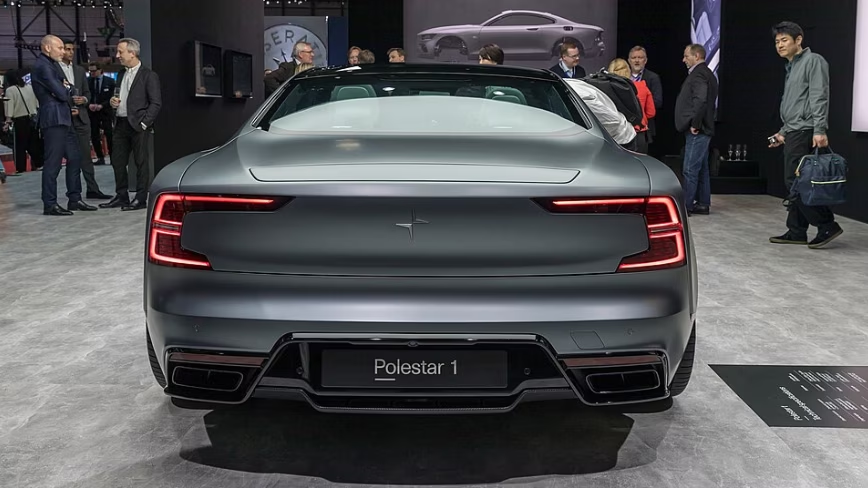
Polestar
 Credit: Matti Blume
Commerce Department denied Polestar authorization under the Connected Vehicle Rule, barring new sales despite the Polestar 3 being built in the US.
The Trump administration has barred Polestar from selling new electric vehicles in the United States, denying the Geely-owned automaker authorization under the Connected Vehicle Rule. The decision, first reported by TechCrunch, means Polestar will not be able to sell any new models in the US once the rule’s software restrictions take effect for model year 2027 vehicles.
The Connected Vehicle Rule was finalized under the Biden administration on 16 January 2025 and took effect on 17 March of that year. It prohibits vehicles with software or hardware from Chinese or Russian entities in their connectivity and automated driving systems. Software restrictions apply starting with model year 2027, while hardware restrictions kick in at model year 2030.
Polestar is majority-owned by Geely, the Chinese automotive conglomerate that also controls Volvo Cars. That ownership structure is what triggered the rule, regardless of where the vehicles are actually manufactured. The Polestar 3, the company’s flagship SUV, is built at Volvo’s plant in Ridgeville, South Carolina, a facility Volvo has invested more than one billion dollars in expanding.
Building cars on American soil was not enough. The rule targets the origin of the technology inside the vehicle, not the location of the assembly line. Even a US-built vehicle can be barred if its connectivity systems use software or components traceable to a covered foreign entity, and Polestar’s ties to Geely put it squarely in that category.
The inconsistency is hard to miss, because Volvo, which shares the same Geely parent company, was granted authorization under the Connected Vehicle Rule in May. Volvo and Polestar use the same South Carolina factory, yet only one was cleared to continue selling vehicles. Neither the Commerce Department nor Polestar has publicly explained the distinction, though Volvo’s longer presence in the US market and its separate corporate structure may have played a role.
Polestar said it will continue selling existing stock of the Polestar 3 and Polestar 4 in the US while those vehicles remain available. The Polestar 4 is built in Busan, South Korea, by Renault Korea Motors. The company added that global production of the Polestar 3 will shift exclusively to the South Carolina plant from the fourth quarter of this year, a move that was already planned before the authorization was denied.
The financial impact may be limited in the near term. Polestar reported that 94 percent of its retail sales in the first quarter came from markets outside the United States, and the company has been increasing its strategic focus on Europe. But losing US market access entirely removes any path to growing American sales at a time when the company is already under severe financial pressure.
That pressure is considerable. Polestar posted a net loss of $383 million in the first quarter, more than double the $166 million loss a year earlier. Revenue was flat at $633 million despite a seven percent increase in deliveries to 13,126 vehicles, and gross margins turned negative due to pricing pressure, tariffs, lower carbon credit sales, and currency effects.
The Connected Vehicle Rule is part of a broader US effort to limit Chinese technology in vehicles sold on American roads. A bipartisan Senate proposal would go further, banning Chinese-manufactured vehicles and components from the US market entirely. Combined with tariffs that have already forced a dozen EV models off the American market, the regulatory environment is increasingly hostile to any automaker with Chinese ties.
The rule was conceived under Biden but is being enforced under Trump, and the current administration has shown no interest in softening its application. Polestar’s denial is the most prominent example yet of the rule being used to block a brand that manufactures in the US and sells primarily in Western markets, solely on the basis of its Chinese parent company’s involvement in the vehicle’s technology stack.
Polestar now faces a choice about how much to fight for a market that already accounts for a small fraction of its sales, or whether to redirect those resources toward Europe, where it faces no comparable restrictions. The company said it remains committed to all its markets but did not outline any plan to seek a reversal of the Commerce Department’s decision.
Get the most important tech news in your inbox each week.


