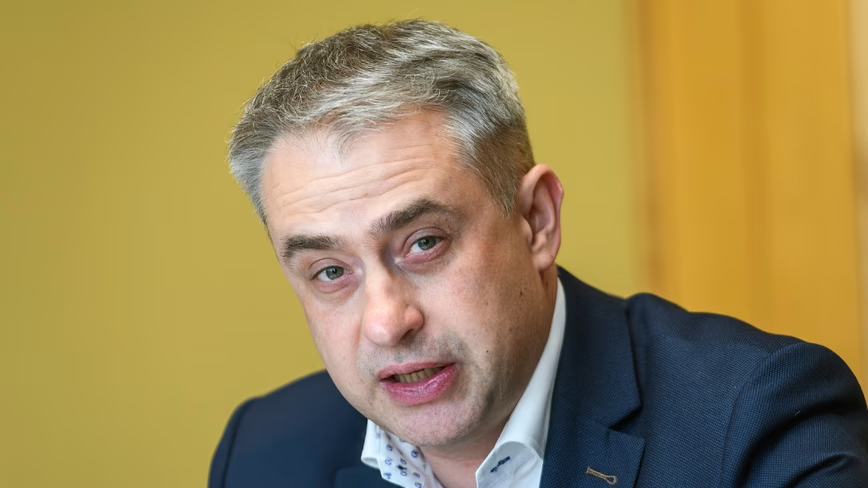
Deputy Prime Minister of Poland and Minister of Digital Affairs Krzysztof Gawkowski during a visit to Kyiv, Ukraine May 6, 2024
 Credit: paparazzza via Shutterstock.com
Poland’s deputy prime minister and digital affairs minister Krzysztof Gawkowski has asked the European Commission to fine Meta €250M, roughly $291M, over scams and false advertising on Facebook and Instagram.
“I also call on Meta to immediately introduce effective tools to eliminate scams, false advertising, and the promotion of illegal applications,” he said, in a country where the company is already fighting litigation over fraudulent ads.
Warsaw sent Meta nine written questions on 18 August, covering the scale of scam advertising in Poland, how the company detects deepfakes, how it verifies advertisers, and how long it takes to remove a reported ad, with seven days to respond.
Deputy minister Dariusz Standerski said at the time exactly what would happen next if the answers did not satisfy. The next letter, he said, would go to the Commission asking it to open proceedings under the Digital Services Act, and that is now what has happened.
Here is the constitutional oddity, though. Poland cannot fine Meta and cannot set the figure, because enforcement against very large online platforms sits exclusively with the Commission, so €250mn is a request rather than a penalty.
It is also a fairly modest request by the standards of the instrument. The DSA allows fines of up to 6% of global annual turnover, which for Meta would run to several billion euros, and the Commission has so far issued penalties in the low hundreds of millions.
The reference point is X, fined €120M last year for breaching its transparency obligations. Set against that, €250M for advertising fraud looks like a number chosen to be plausible rather than punitive.
Whether the Commission acts on it is a separate question entirely. Member states can refer, complain, and publicise, but Brussels sets its own enforcement priorities and has been notably unhurried about concluding the Meta cases it has already opened.
What has made this politically unavoidable in Poland is a running feud involving Rafał Brzoska, the founder of the parcel locker company InPost and one of the country’s wealthiest businessmen.
Fraudulent investment ads have used his manipulated likeness for years, including a false claim that he had died, which reached his own children.
Meta then suspended his Instagram account after he criticised the ads publicly. Gawkowski called that “censorship in its darkest form”, which is the sort of phrase that tends to precede a formal complaint.
Underneath the politics sits a court ruling with wider consequences. In March, the Warsaw Court of Appeal, hearing a case brought by Brzoska and Omenaa Mensah, rejected Meta’s attempt to claim the DSA’s hosting liability shield.
The court’s reasoning is the part worth reading. Meta “receives remuneration and offers advertisers support and tools (algorithms)”, the judgment held, which makes it an active participant in the advertising rather than a passive intermediary, and therefore outside the protection of Articles 6 and 7.
Meta had argued, as platforms generally do, that it merely hosts what advertisers submit. The court did not accept that a company selling targeting tools and taking a cut of the spend is a bystander to what it publishes.
If that reading travels, it changes the economics of advertising fraud across the single market. A platform that is an active participant in an ad it was paid to run is a platform that can be liable for the ad, which is a materially different business to hosting whatever advertisers upload.
There is an awkward wrinkle in Poland’s position, which is that its own DSA implementation only passed this month after a presidential veto in January, and the domestic watchdog it created has drawn criticism for including serving lawmakers. Poland is asking Brussels to enforce a law vigorously that it has itself only just written into national statute.
Meta has not responded publicly to the request. European consumer groups filed their own DSA complaints over financial scam advertising against Meta, TikTok, and Google in May, and the Commission is separately pursuing Meta over addictive design and child protection, so the queue is already long.
Get the TNW newsletter
Get the most important tech news in your inbox each week.


