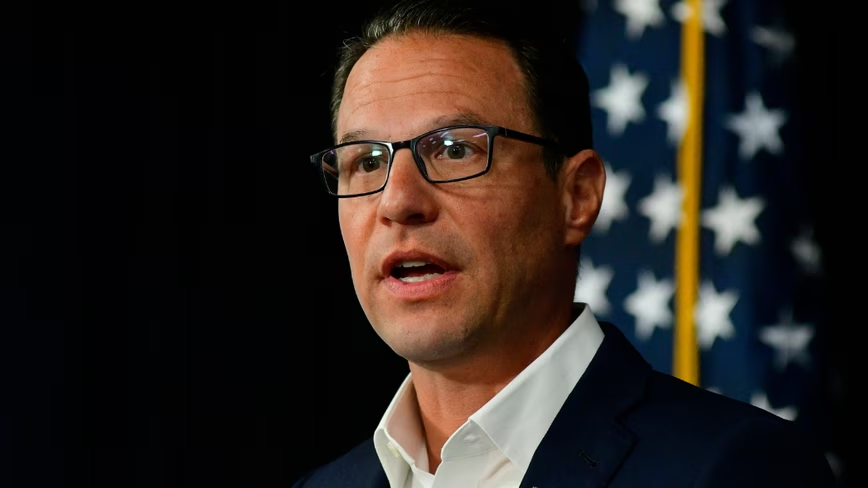
Governor Josh Shapiro signed an executive order on Tuesday that makes Pennsylvania one of the harder places in America to build an AI data centre.
The order strips data centres from the state’s permit fast-track programme, blocks environmental review until developers have secured local approval, and bars state agencies from signing non-disclosure agreements on data centre projects.
It arrives in a state that has become one of the country’s most active AI build-out markets and one of its most aggressive regulators.
Pennsylvania sued Character.AI in May after a chatbot told a state investigator it was a licensed psychiatrist, and it is now doing to physical infrastructure what it did to consumer chatbots.
The framework is branded GRID, for Governor’s Responsible Infrastructure Development, and rests on four principles: energy affordability, transparency and community engagement, workforce development, and environmental protection.
Six agencies are directed to implement it, including the Department of Environmental Protection, the Public Utility Commission, and the Special Counsel for Energy Affordability.
The mechanism is a consent order and agreement. The DEP will not begin reviewing a permit application unless the developer signs one, binding it legally to the GRID requirements, and unless every required local approval is already in hand.
The ratepayer provisions are the part with real financial teeth. Developers must “pay the full cost of new electricity generation, transmission, distribution, and other infrastructure needed to power their project without shifting costs to Pennsylvania households and businesses”, which puts the state alongside the federal bill introduced in June to make Big Tech carry AI’s power bills.
The Special Counsel has also been told to write protocols under which data centres lose service before other customers during grid stress, and to develop procedures charging data centres rather than ratepayers for reliability backstop auction costs.
Annual reporting of energy consumption, peak demand, total water use, and maximum-day water demand becomes mandatory.
Shapiro was not subtle about the intent. “We will not be bullied by developers and bulldozed by the lawyers working for these big tech companies,” he said at the signing, adding that the requirements are “not voluntary standards” but legally binding conditions of operating in the state.
He told Reuters he is “using the full weight of my executive authority to block objectionable, unwarranted projects”. Pennsylvania has identified more than 100 data centre proposals; 15 have applied for DEP permits, and five have received everything they need.
The numbers behind the backlash are not small. Amazon committed $20bn to Pennsylvania data centres in June 2025, the largest private investment in state history, and the Homer City Energy Campus is a $10bn-plus development with 4.5 gigawatts of gas generation across 3,200 acres.
Neither is the cost. Wholesale power prices in PJM territory rose 76% year on year in the first quarter of 2026, to $136.53 per megawatt-hour, and PJM’s independent market monitor attributes $7.3bn of the last capacity auction’s $16.1bn total to data centre load.
Shapiro cited Archbald, a borough of 7,500 people facing six proposed data centre campuses, as the sort of case the order is meant to catch.
That scale of local pressure is why financing has become its own constraint on the build-out, with power availability increasingly determining where projects can go at all.
The order also fills a legislative vacuum. Four data centre bills passed the Pennsylvania House and stalled in the Senate, covering PUC rules for loads above 25 megawatts, water-use notification thresholds, annual reporting with $10,000 daily penalties, and a model township ordinance.
Pennsylvania is not alone in slowing down as New York enacted a statewide hyperscale moratorium of up to a year in July, and Texas paused data centre interconnection approvals against roughly 474 gigawatts of pending requests, the same month Trump was in the state pitching data centres as bigger than oil.
Governor Josh Shapiro calls his the strictest set of guardrails in the country, which is a governor’s characterisation rather than a finding, and sits awkwardly next to New York’s outright pause. The order takes effect immediately, and the DEP is due to publish a public permit tracking map.
Get the TNW newsletter
Get the most important tech news in your inbox each week.


