The bottleneck in AI is no longer chips. It is power, and the scramble to secure it is sending data-centre builders to the banks for billions in financing commitments, Bloomberg reports.The shift is a big one.
For much of the AI boom the scarce resource was Nvidia’s GPUs; now it is electricity, along with the contracts, substations, and financing needed to deliver it at scale.
The numbers are staggering. The four largest cloud firms are set to spend around $725bn on AI infrastructure this year alone, and single sites now carry price tags that would once have funded a whole company, like Meta’s $13bn Texas data centre.
Power is what makes those sites so expensive. Server racks that drew about 3kW for ordinary computing now pull up to 150kW for AI, and global data-centre capacity is expected to nearly double to roughly 200GW by 2030.
That is where the banks come in. Builders want firm financing pledges before they commit to power deals and construction contracts, and the sums are large enough that no single balance sheet wants to carry them alone.
The borrowing has already reshaped credit markets. Lenders have poured into the sector, from a $5.9bn loan for one data-centre operator to a wave of bonds and private-credit deals feeding the build.
The financing is getting creative, and opaque. Oracle’s $16.3bn data-centre raise leaned on private credit after banks grew cautious, a sign of how far off the traditional path the money now travels.
Much of it sits out of plain view. Analysts estimate the sector is carrying around $1.65tn in off-balance-sheet obligations, structured through special vehicles that keep the debt off the tech giants’ own accounts.
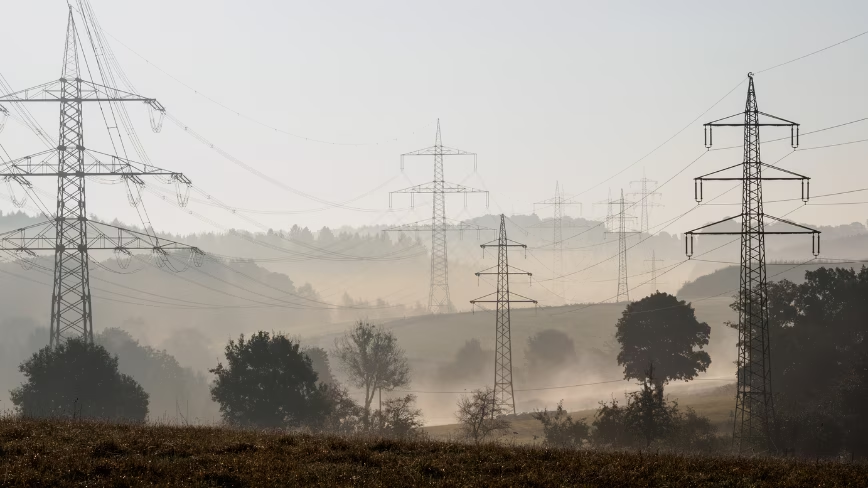
The hunt for power is reshaping energy markets. Builders are reviving gas plants, signing nuclear deals, and jumping utility queues, turning data centres into some of the largest new electricity buyers in a generation.
The strain is landing on everyone else. Grids are creaking under the new load, and in some regions households are already paying more as data centres compete for the same electrons.
Regulators are watching uneasily. The Bank for International Settlements has flagged ‘circular financing’ between cloud firms, their suppliers, and construction lessors as one of the bigger risks to financial stability.
The building itself is a chokepoint. Fewer than ten firms in the world can deliver a hyperscale project, and one of them, Turner, is sitting on a record backlog of about $44bn with a large share tied to data centres.
Banks are not lending blindly, either. As the sums swell and the structures grow more circular, some lenders have pulled back, which is part of why builders are chasing firm pledges rather than assuming the money will be there.
Power is being locked up years ahead. Builders are signing long deals for electricity, gas, and even nuclear output, and the bank pledges are what make those commitments credible.
Underneath it all is a bet that demand shows up. The spending only pays off if AI usage keeps climbing fast enough to fill the capacity, which is why every quarter of AI revenue is now watched so closely.
There is a self-reinforcing quality to it, too. The more money commits to the build, the more the industry needs AI to keep growing to justify it, which is precisely what makes the circularity regulators fear so hard to unwind.
The scale is historic. Goldman Sachs sees cumulative spending on this buildout running into the trillions by 2030, a figure that dwarfs past infrastructure booms and leaves little room for error.
For now, the money keeps flowing toward the wall socket. The race for compute has become a race for power, and the winners may be decided less by who has the best models than by who can finance the electricity to run them.
Get the TNW newsletter
Get the most important tech news in your inbox each week.


