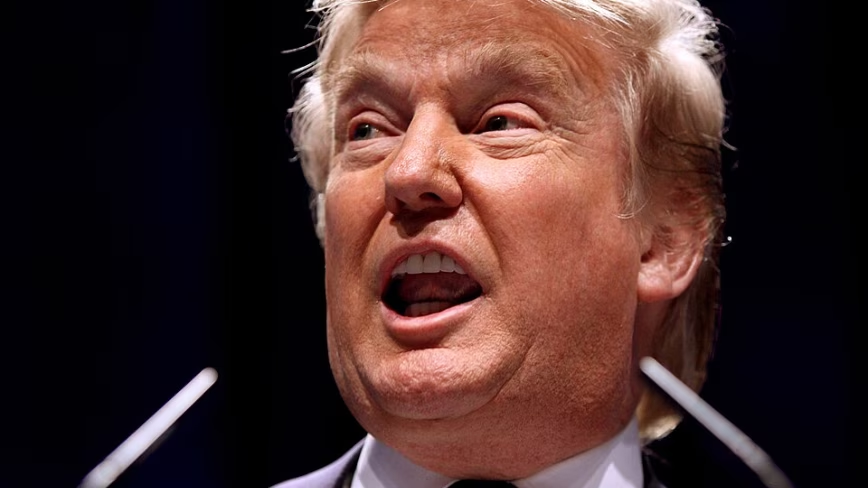
President Donald Trump
 Credit: Gage Skidmore from Peoria, AZ, United States of America
Speaking to Punchbowl News on its “Fly Out Day” show, Trump framed AI as a prize the US cannot afford to lose. “Whoever wins AI just wins. It’s that big,” he said. “It’s bigger than the internet by many times.” The line that drew attention was blunter still: “Data centres could be bigger than oil.”
The comparison was pointed. Trump said Texas, the heart of the US oil industry, was making a “mistake” in resisting data centres, and that other communities would welcome the money instead. He waved away complaints that the buildings are unsightly, calling some “the most incredible buildings I’ve ever seen”.
The energy doctrine
Behind the boosterism sits a policy. Trump’s answer to the strain data centres put on the grid is to let them build their own power. Under his plan, operators can add generation with fast-track approvals, feed spare electricity back to the grid, and behave like small utilities. Without it, he said, “we wouldn’t have one building being built”.
Some of his claims stretch the facts. Trump said a data centre can need “more electricity than the entire nation uses”, sometimes twice as much. No single site comes close. Data centres are a fast-growing but still minority slice of US power demand. The strain on the grid is real, yet not on the scale he described.
The China frame
Every argument looped back to Beijing. “We can’t let China beat us at this,” Trump said, tying AI leadership to cheap energy and claiming, without evidence, that China was funding the campaign against data centres. He said he would raise the issue with President Xi Jinping at a meeting in the coming weeks.
The race is closer than the rhetoric. By one measure, China has narrowed the US lead in frontier AI to a record low. Trump credited America’s position to fossil-fuelled power, and repeated his dislike of wind, which he called “a disaster”. He made the same “can’t let China have it” case for crypto.
The pushback
Not everyone is sold. New York has imposed a statewide pause on large data centres, a move Trump called a “terrible decision”. Communities elsewhere have fought projects over water, power and rising bills. The White House has since leaned on developers to promise their build-outs will not push up local electricity prices.
The “bigger than oil” line is a bet, not a fact. It assumes demand keeps climbing, the power arrives, and the returns follow. For now it captures how the administration sees the moment: AI as the next great American industry, and cheap energy as its fuel. Whether the country, and its grid, agree is another question.
Get the TNW newsletter
Get the most important tech news in your inbox each week.


