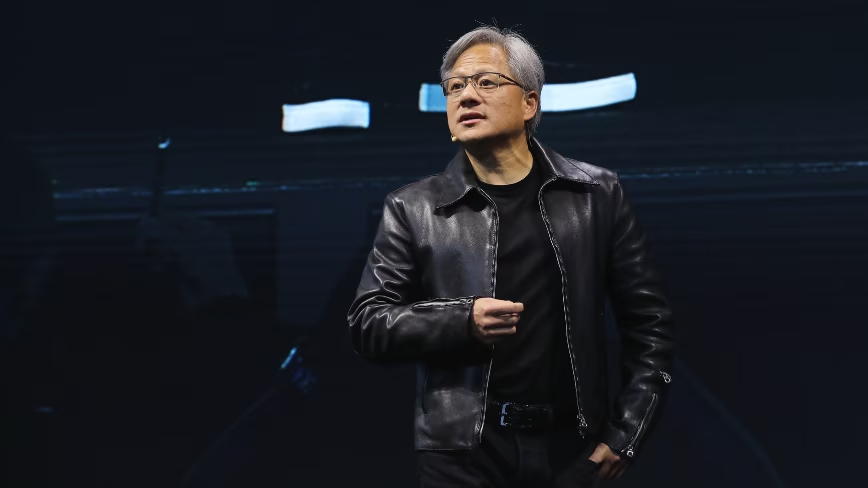
Nvidia chief executive Jensen Huang at Computex in Taipei in 2023.
 Credit: glen photo via Shutterstock
Nvidia sells the chips that the AI industry runs on. It now also owns $99bn of the industry.
The figure sits in the company’s own quarterly filing. CNBC’s Kai Nicol-Schwarz pulled it out. Nvidia equity investments stood at $99bn as of 26 July. A year earlier the figure stood at about $7bn. Two years earlier, $2.2bn.
That is a fourteenfold rise in twelve months, and a forty-fivefold rise in twenty-four. The company has committed more than $40bn to financing deals during 2026 alone, and reported a further $25bn of investment commitments still outstanding.
Half of it is in companies you cannot sell out of
Business Insider broke down the composition, which is the part the headline number hides. Roughly $48bn sits in publicly traded stocks and other marketable securities. Another $48bn sits in private companies and other non-marketable holdings. About $3bn is in equity-method investments.
The public half is legible. Nvidia’s disclosed US stock positions as of 30 June included $30bn in Intel, from an investment that cost $5bn, and $21bn in SpaceX. CoreWeave, Coherent, Synopsys and Nokia each sat between $2bn and $5bn.
The private half is not. It covers frontier labs and cloud providers that funding rounds price rather than markets. Nobody can exit those on a bad morning.
Where the money went
Chief financial officer Colette Kress told analysts the company has put nearly $50bn into frontier AI labs. The largest single commitment was $30bn into OpenAI in February, part of that company’s $110bn round.
The neoclouds, which buy Nvidia GPUs and rent access to them, took $2bn each: CoreWeave in January, Nebius in March. Nokia took $1bn. Since March the company has committed at least $6.5bn to photonics and optical firms, with $2bn each going to Lumentum, Coherent and Marvell.
The pace has not slowed. In the past week alone, Nvidia confirmed it is buying Hugging Face for $12.93bn. It also turned up as a backer in Nscale’s pre-IPO round.
And The Information reports it is in talks to supply roughly half the capital for a $6bn raise at Thinking Machines Lab. Three deals, one week, across a chip platform, a cloud and a model lab.
One distinction is worth holding on to. Hugging Face is an acquisition, not a stake. Buying a company consolidates it. Taking a minority position buys influence and a mark on the balance sheet. The $99bn counts the stakes, not the takeovers, so the takeovers sit on top of it.
The company’s explanation is a flywheel
Nvidia says the investments enhance its growth opportunities, cultivate its ecosystem and strengthen its competitive position. Kress put it more directly on the earnings call. Frontier labs have extraordinary demand for compute, she said. But they outgrow their own balance sheets and credit profiles, and they cannot secure AI factory infrastructure alone. Nvidia, in her phrase, is needed to help power this flywheel.
Analysts describe the same mechanism in less flattering terms. Naveen Chhabra of Forrester told CNBC that injecting capital into infrastructure financiers, specialised clouds and model labs gives those startups the balance-sheet strength to buy tens of thousands of Nvidia GPUs.
Ian Fogg of CCS Insight put the control question plainly. Equity investments help companies innovate, he said, but they also give Nvidia a degree of influence over whether that innovation takes an Nvidia-shaped path.
The optics investments show the same logic at the component layer. Chhabra argues that funding Coherent and its peers keeps their tooling and design work optimised for Nvidia’s architecture. That raises switching costs and defends the CUDA software moat against AMD, and against the custom chips the cloud providers are building themselves.
Not everyone reads it as a flywheel
Michael Burry, who made his name shorting the mortgage market, says Nvidia is overreaching. His objection is that it finances and invests in the customers for its own chips. Mark Cuban has called it truly scary how much the AI boom now depends on Nvidia funding, in his words, everyone and anyone.
Neither is a disinterested observer, and neither has produced a number. But the structure they are describing is the one Kress described approvingly, seen from the other side.
There is a counterexample worth putting alongside them. When CoreWeave took its $2bn, it said the proceeds would go to land, power, infrastructure, research and hiring rather than to buying Nvidia chips. Money that arrives as equity does not have to come back as an order.
The number against the business
Some scale. Nvidia reported $96.2bn of revenue in its fiscal second quarter, up 106%. Net income reached $59.7bn. So the equity portfolio is now worth slightly more than the company turns over in a full quarter.
It is not the largest such portfolio in technology. Alphabet held $232bn at the end of June, including $94bn of SpaceX shares, and Amazon is also above $100bn. What is unusual is the speed. Alphabet built its position over two decades. Nvidia built most of this one since the summer of 2024.
The valuations underneath it are doing work too. The Intel stake is up sixfold on paper. Nvidia stock has gone from under $15 at the start of 2023 to $228, a market capitalisation of $5.5tn, and rising tech valuations lift the holdings alongside it.
Which is the part worth watching. Nvidia sells to its own portfolio. The same boom that drives those sales also sets the prices at which the portfolio is carried. That is two exposures to one cycle rather than one.
Nvidia has disclosed the number, and disclosure is the easy part. What it does not answer is what happens to the private half of that $99bn if the marks stop going up.
Get the TNW newsletter
Get the most important tech news in your inbox each week.


