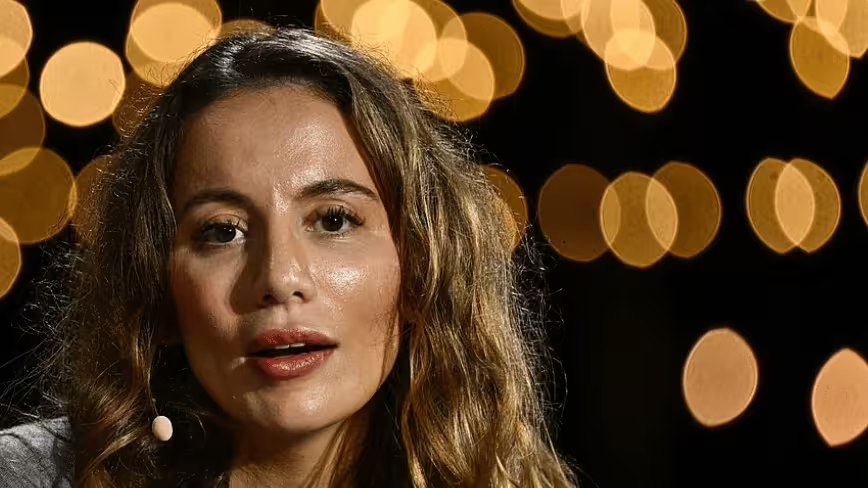
Mira Murati, founder and chief executive of Thinking Machines Lab.
 Credit: Patrick T. Fallon / AFP via Getty Images
Mira Murati’s Thinking Machines Lab is raising money again. The figure that travelled around the internet last week was the wrong one.
The Information broke the story on 3 September. Its current version puts the raise at $5bn to $6bn, on a pre-money valuation of at least $40bn. Accel, an investor since the seed round, is in talks to lead. Nvidia would supply roughly half the capital, somewhere near $2.5bn to $3bn.
The sourcing is unusual and worth stating plainly. Reporter Amir Efrati said on X that the detail came from Andreessen Horowitz, which had told its own investors what was happening. This is a backer briefing its limited partners. It is not a company announcing a round.
Most of the coverage is carrying the first draft
The Information published, then updated. The early version put the raise at more than $1bn. The new one is five to six times that, and it names Nvidia.
Almost everything written since has followed the first number. TechCrunch reported it on the afternoon of 3 September, before the change. RuntimeWire carried the same figure that day.
Tech Funding News built a full analysis on the smaller figure on 4 September, a day after the update landed.
Nobody was careless. The story moved faster than the aggregation could. But the two versions describe different events, and the clearest illustration of that comes from RuntimeWire itself.
At $1bn the infrastructure maths did not work
RuntimeWire made the point under a heading saying a billion dollars does not buy a gigawatt. It was right.
Thinking Machines and Nvidia announced a multiyear partnership in March to deploy at least one gigawatt of Nvidia’s Vera Rubin systems, with the first deployment targeted for early 2027. Nvidia invested at the same time and neither company said how much. A gigawatt puts the lab in direct competition with far better capitalised rivals for chips, power and data-centre space. Raising $1bn against that would have covered a fraction of it.
Five or six billion is a different proposition, particularly when the chipmaker selling the systems supplies half of it.
Nvidia is buying its own demand
Thinking Machines gives its models away. Inkling, the open-weight model it shipped in July, is a 975-billion-parameter mixture-of-experts system handling text, images and audio, and it earns nothing on the weights themselves.
The money arrives through Tinker, which reached general availability in December 2025. It sells access to GPU clusters for training and fine-tuning open models. Customers keep control of their data and algorithms through an API, and Thinking Machines runs the hardware and bills for it. The platform supports outside model families as well as its own.
Nvidia frames its involvement as backing American open-source AI developers. The commercial logic is simpler. Every job that runs on Tinker runs on hardware Nvidia sold to somebody.
The pattern runs wider than this deal. Two days later, Nvidia appeared again as a backer of Nscale’s pre-IPO financing. A chipmaker funding the companies that buy its chips closes a circle, and the market has so far priced that circle as growth rather than as risk.
The multiple is harder to pin down than it looks
Stephanie Palazzolo, one of the reporters on the story, says the lab is generating annualised revenue in the hundreds of millions. RuntimeWire adds the caveat that matters: the figure is self-reported through people close to the business, not audited. TechCrunch, working from a different source, put it at more than $100m.
So the multiple is a range rather than a number. Against $40bn pre-money it lands somewhere between roughly 80 and 400 times revenue, depending which end of “hundreds of millions” is accurate. Any figure in that band is steep.
Efrati was drier about it, calling the price lower than the company wanted but still high for a lab this young, especially as a multiple of revenue.
Both halves hold. The seed round in July 2025 raised $2bn at $12bn post-money, led by Andreessen Horowitz, with Accel and Nvidia among the investors. By late last year the company wanted $50bn or more, and those talks did not close. The new price is at least 20% below that ask and more than three times the seed.
One clarification, because it changes the headline number. The $40bn is pre-money, so a raise at the top of the range would put the post-money mark nearer $46bn.
The founders left, and the company kept building
People walking out is part of why the $50bn attempt failed. Andrew Tulloch went to Meta in late 2025. Co-founder and chief technology officer Barret Zoph left in January, mid-all-hands, and OpenAI announced it had him back within the hour. Co-founder Luke Metz went the same way. Lilian Weng stepped down in July.
Two things complicate the tidy reading. Zoph has since moved on to Google, so OpenAI was a staging post rather than a destination. And Weng, usually listed alongside the others, stepped back over her health before OpenAI re-signed her two days later. Same destination, different reason.
The company also did not stand still. Co-founder and chief scientist John Schulman stayed. After Zoph’s exit, Thinking Machines brought in Soumith Chintala, who co-created PyTorch, to run technical work. Both launches since then shipped under that team.
One governance detail underpins all of it. Murati holds voting control over the board on major corporate decisions, whatever the other directors do. She resurfaced in June after eighteen months of near silence with a warning about AI governance and a product nobody had predicted. Investors buying in at $40bn are buying her judgement with limited recourse.
What has to be true
Accel has to want this at a price its peers walked away from ten months ago. Nvidia has to keep finding it rational to fund the demand side of its own market. And the revenue, which nobody outside the company has audited, has to grow into the number.
None of it is signed. Every figure here describes talks, sourced to a venture firm briefing its investors. The last time this company was close to a big number, it did not get there.
Get the TNW newsletter
Get the most important tech news in your inbox each week.


