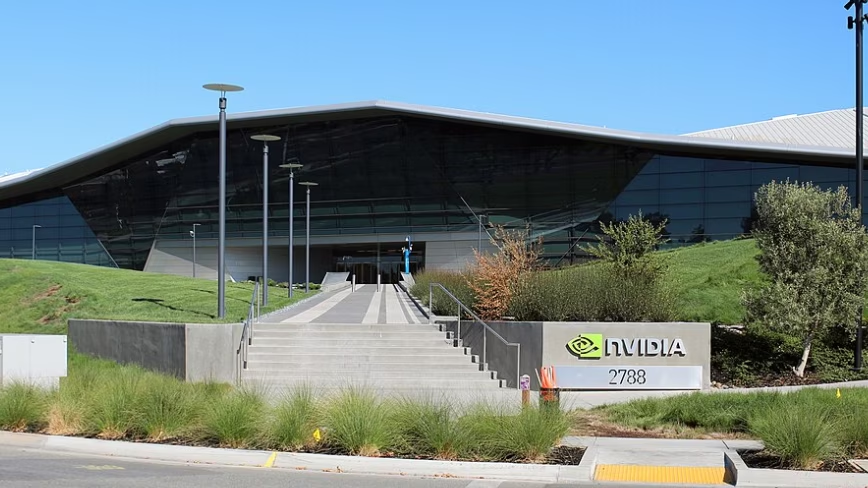
Nvidia headquarters in Santa Clara, California

Nvidia reported revenue of $96.2bn for the quarter, up 106% from the same period last year, and then did something it has never done before by guiding a full year ahead.
The shares slipped about 1.3% on the release and only turned sharply higher once chief financial officer Colette Kress reached the section of the call dealing with the $500bn financing plan it assembled with six finance giants, which is a fair indication of what investors were actually waiting to hear.
Data centre revenue accounted for $89.0bn of the total, up 117% year on year and a little over 92% of everything Nvidia sold. Edge computing contributed the remaining $7.2bn, and Vera Rubin is now in full production.
The year-ahead forecast is the genuine novelty here rather than the beat. “It is the case that we’ve never forecasted, never guided to a year in advance,” Jensen Huang said, before Kress put fiscal 2028 growth at roughly 70%.
Run that against this year’s numbers, and it implies something close to $690bn of revenue, against an analyst consensus nearer $570bn.
Melissa Otto of S&P Global Visible Alpha said the figure “blew away expectations”, and Kress presented it as a floor rather than a ceiling, describing the company as supply constrained and saying revenue could otherwise double.
Nearer-term guidance is $108.0bn plus or minus 2% for the current quarter, against consensus of $104.19bn. That assumes no data centre compute revenue from China whatsoever, a market where Nvidia shipped less than 1% of the quarter’s data centre revenue.
What moved the stock, though, was the part of the call addressing what critics have spent the summer calling circular financing.
“We recognise the scale of this support, and we know some will call this circular financing. We see it differently,” Kress said, adding pointedly that “we’re not making loans” and that independent capital underwrites each deal separately.
The scale she was recognising is documented rather than alleged. Nvidia has put roughly $50bn into frontier AI labs, carries maximum gross guarantee exposure of $108.5bn, and has lined up Apollo, BlackRock, Blackstone, Brookfield, Goldman Sachs, and KKR behind a plan to raise more than $500bn of third-party capital for AI infrastructure.
The accounts make that entanglement legible in a way the commentary does not. GAAP earnings of $2.46 a share came in above the non-GAAP figure of $2.22, an inversion produced by $7.77bn of net gains on equity securities, which means a meaningful slice of the quarter’s reported profit is Nvidia’s stakes in its own customers going up in value.
Rubin is the product the whole forecast rests on, and Kress expects the fastest ramp the company has run, at around a fifth of data centre revenue this quarter.
The economics are the argument for it, with Nvidia putting revenue per gigawatt of installed capacity at $18bn for Hopper, $25bn for Blackwell, and $40bn for Rubin.
Gross margin held at 75% and is guided to 74% this quarter, with Kress signalling a floor of 71 to 72% before settling at 72 to 73% next year. Rising memory costs are the reason, and margin was the one line analysts had said in advance they most wanted reassurance on.
Nvidia also returned a record $26bn to shareholders in the quarter, $20bn of it in buybacks and $6bn in dividends, with the next payment of $0.25 a share due on 1 October.
That is a company producing more cash than it can spend on itself while guaranteeing other people’s data centres, and off-balance-sheet structures across the sector are absorbing a good deal of the rest.
The market’s reaction says more about positioning than performance. “Nvidia has beaten every quarter for two straight years,” said Mark Malek of Siebert. “The stock is flat since the last earnings call. Flat!”
Bill Birmingham of Rex Financial had the sharper data point, noting that July’s reports of the OpenAI guarantees pushed Nvidia’s five-year credit default swap spread from 40 to 82 basis points and took roughly $250bn off its equity value.
That is the market pricing Nvidia as a credit rather than a chipmaker, which is more or less what turning compute into an asset class invites.
Get the TNW newsletter
Get the most important tech news in your inbox each week.


