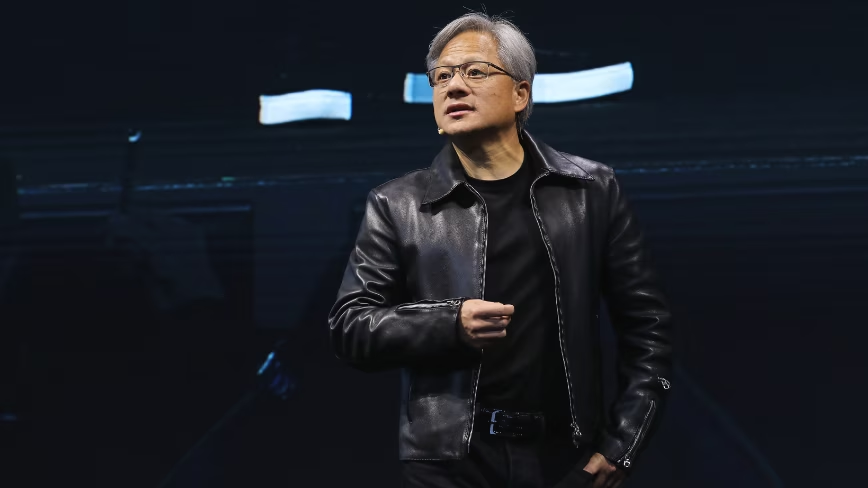
Jensen Huang NVIDIA’s Founder, President and CEO at Computex Taipei.
 Credit: glen photo / Shutterstock
Nvidia is expected to report quarterly revenue of $92.18bn, close to double the same period last year and its fastest growth in seven quarters, with analysts forecasting a further rise to $104.20bn in the current quarter.
The numbers are not really the issue anymore, because the scrutiny has moved to how much of that demand the company is underwriting itself after arranging $500bn of financing for customers this month.
The commercial question for the quarter is the transition to Rubin. Shipments of the next-generation processors begin this autumn, and how quickly customers move off Blackwell determines whether the guidance holds.
Morgan Stanley expects Rubin to contribute nearly $9bn in the current quarter, on the argument that it unlocks a large improvement in what the bank calls AI factory economics. Nvidia has already said Vera Rubin is in full production with OpenAI deploying at scale.
The financing arrangements are where the analyst questions have concentrated. Alongside the $500bn package, Nvidia guaranteed up to $105bn for OpenAI’s Ohio data centre, which places the chipmaker somewhere between supplier and lender to its own customers.
“This makes them a kind of central banking figure in the AI space,” said Brian Mulberry of Zacks Investment Management. “The real risk is total AI exposure with no diversification.”
Credit markets have already registered the point. Nvidia’s roughly $750bn of announced AI commitments pushed its own credit default swaps to record levels, which is the bond market saying it would like to see the demand stand on its own.
The structural worry is not that customers cannot pay. It is that a supplier financing purchases of its own product records revenue that looks independent of it, and nobody outside the company can easily separate the two from the income statement.
Customer concentration compounds it. A handful of hyperscalers and model labs account for a very large share of Nvidia’s revenue, and several of them appear on both sides of the ledger as buyers and as recipients of its investment or financing.
Competition is the other pressure, and it is no longer theoretical. Amazon, Google, and Meta all have custom silicon programmes; AMD and Intel are pushing on inference, and inference is the workload that grows fastest once models are deployed rather than trained.
Inference also has different economics to training. It rewards cost per token rather than raw throughput, which is the ground on which custom silicon competes best and where Nvidia’s architectural advantage is least decisive.
Market sentiment has been unusually mixed for a company posting these figures. Nvidia shares are up 11.8% for the year but have lagged the major indices recently, and it briefly lost its position as the world’s most valuable company to Apple.
Cost pressure is now visible in Nvidia’s own pricing too. The company has told customers that AI server prices are rising by more than 15% because of memory shortages, which passes the DRAM crunch straight to the buyers it is simultaneously helping to finance.
The bull case has not gone anywhere in the meantime. Demand for inference capacity keeps outrunning supply; the buildout has years of announced projects behind it, and no competitor has yet matched the software stack that keeps customers on Nvidia hardware once they are there.
The guidance will carry more weight than the reported quarter. A beat on revenue with a soft outlook would confirm what the credit market has been signalling, and a strong outlook invites the follow-up question of how much of it is committed capacity the company arranged the money for.
Neither answer settles the underlying argument. Nvidia can keep growing at this rate for as long as the buildout continues, and the buildout continues for as long as capital keeps arriving, which is a circular sentence describing a circular arrangement.
Get the TNW newsletter
Get the most important tech news in your inbox each week.


