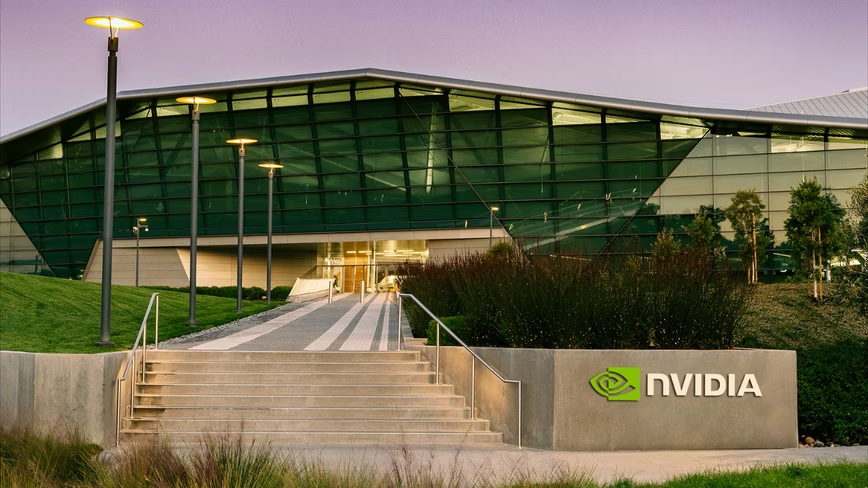
 Credit: NVIDIA
For the better part of a fortnight, the tenant behind one of the largest data centre leases in Texas history existed only in the negative, described in Hut 8’s own filings as an “unnamed, investment-grade hyperscaler,” and now the Financial Times says the name is Nvidia.
The FT reported citing five people familiar with the arrangement, that Nvidia is the counterparty behind two 15-year leases at Hut 8’s Beacon Point campus in Nueces County, near Corpus Christi, and that the deal could be worth as much as $50bn to the developer over its full life.
Hut 8 did not respond to requests for comment, and Nvidia has not confirmed that it is the tenant.
The circularity that story implies is already familiar territory: Nvidia is separately reported to be in talks to backstop $250bn of OpenAI debt, and it took a $2.1bn warrant in IREN earlier this year as part of a 5GW neocloud agreement.
The $50bn headline needs a footnote, though, because the contracted base is both smaller and already public.
Hut 8 announced the first 352-MW lease weeks earlier, worth $9.8bn on a triple-net basis over 15 years, then doubled it on July 20 with a second 352-MW lease that brought the campus’s base-term value to $19.6bn.
The path to $50bn, or $50.2bn to be precise, runs through three five-year renewal options attached to each lease. Exercise all of them and the rent reaches the ceiling; leave them and it does not. So the number in the slug is a maximum, not a signed commitment.
What is not in doubt is the shape of the campus. Beacon Point sits on 525 acres with a gigawatt of utility capacity secured through an interconnection agreement with AEP Texas, and it is being built to Nvidia’s DSX reference architecture for gigawatt-scale AI factories.
Hut 8 expects to energise the site in the first quarter of 2027, with a Phase II data hall following in the second quarter of 2028.
The company, a bitcoin miner until fairly recently, has now let 704 of the 949 megawatts across its AI portfolio, according to the terms it disclosed without naming the tenant.
If the FT is right, the arrangement puts Nvidia on three sides of the same table at once. It designs the reference architecture the campus is built around, it supplies the chips that will fill the halls, and it now appears to be the tenant whose rent makes the whole thing bankable.
That pattern is not confined to Nvidia, either. Google has quietly come to guarantee $44bn of lease payments on data centres it does not own, up from $6.5bn nine months earlier, as it pushes its own TPU chips against Nvidia’s.
And in Texas the former crypto miners have become the preferred vehicle for these builds, since Cipher Digital raised $810m in junk bonds to put up another campus on much the same logic, that a long, investment-grade lease makes the debt cheap.
For Hut 8 the appeal of a tenant like Nvidia is obvious, because a lease is only as good as the credit behind it, and few names in technology carry more of it right now. The silence is harder to read.
Hut 8 has every commercial reason to trumpet an anchor of that calibre, which suggests the reticence is contractual rather than coy, the kind of confidentiality large hyperscalers routinely write into their leases, and which the FT’s sources have now stepped around.
Whether the full $50bn is ever paid turns on demand no one can forecast 15 years out, and on options that will not be tested until the 2040s.
What Hut 8 has actually banked is the $19.6bn. What the market took from the reporting is narrower and more immediate, that the money behind Corpus Christi’s newest gigawatt is, in all likelihood, Nvidia’s.
Get the TNW newsletter
Get the most important tech news in your inbox each week.


