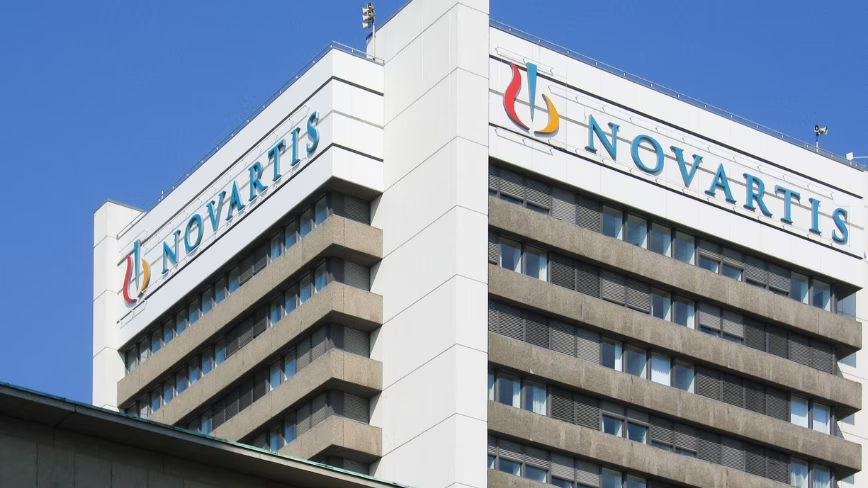
Novartis has agreed to buy Myricx Bio, a small British oncology company, for up to $1.5bn, adding an early-stage but potentially significant technology to a cancer pipeline the industry keeps racing to expand.
The Swiss group will pay $1.1bn upfront, with up to $400m more tied to milestones, in a deal that fits the pattern of large pharma companies reaching into European biotech for the next generation of targeted therapies. It is a bet on science that has not yet reached patients.
Myricx is not a household name, and for good reason: it is pre-clinical, meaning its lead programmes have not begun human trials. What it offers is a novel payload for antibody-drug conjugates, the class of medicines that has become one of oncology’s most competitive battlegrounds.
An ADC works like a guided weapon, using an antibody to carry a toxic drug directly to a tumour cell, and Myricx’s pitch is a new kind of warhead.
The specific chemistry is a mouthful. Myricx is developing N-myristoyltransferase inhibitors, or NMTi, as the toxic component of its conjugates, an approach the company argues can get around the resistance and toxicity that limit many existing ADCs.
Its two lead assets are aimed at targets known as B7-H3 and HER2, both associated with a range of solid tumours, which is to say the disease areas where the commercial and clinical stakes are highest.
For Novartis, the logic is familiar. Big pharmaceutical companies increasingly treat their own laboratories as one source of innovation among many, and buy the rest, particularly in fast-moving fields where a smaller, focused team may be several steps ahead.
ADCs have drawn enormous investment across the sector, and owning a differentiated payload platform is more valuable than owning yet another me-too version of an approved drug.
The deal also lands in a period when the boundary between biology and computation is blurring, and money is following it. AI-driven drug discovery pulled in billions in the first quarter of 2026 alone, and the field has seen deals from Anthropic’s biotech acquisition to a wave of activity around European AI drug discovery.
Myricx’s work is grounded in conventional medicinal chemistry rather than machine learning, but it belongs to the same broad rush toward novel therapeutic modalities.
Myricx’s backers include Brandon Capital and Novo Holdings, the investment arm connected to the Danish pharmaceutical world, and the sale represents the kind of exit that venture investors in biotech are structured to chase.
A pre-clinical company being bought for up to $1.5bn is a substantial outcome, even if the headline figure depends on milestones that may never be paid.
It is also a notable result for British life sciences, a sector that produces strong early-stage science but often watches its most promising companies get absorbed by larger foreign buyers before they mature.
Myricx spun out of academic research and grew on venture money, and its sale to a Swiss giant follows a well-established path, one that is good for founders and investors but leaves the eventual value creation offshore.
The pattern is familiar enough that it has become a running argument in UK industrial policy.
That caveat matters. The upfront $1.1bn is real money changing hands; the additional $400m is contingent on the science working, and pre-clinical assets fail more often than they succeed.
Novartis is buying optionality here, not a finished product, and the value of the deal will be settled in clinical data that is still years away. The companies expect the transaction to close in the second half of 2026.
What the acquisition signals is less about any single molecule than about where the majors are looking.
The easy targets in oncology have largely been drugged, and the frontier now runs through cleverer delivery, better payloads, and combinations that spare healthy tissue. Novartis has decided that a small British team may hold one of those keys, and has paid to find out.
Get the TNW newsletter
Get the most important tech news in your inbox each week.


