GPT
 Credit: Canva
Marc Andreessen has a bold new claim about your health. The billionaire investor says “Doctor ChatGPT” is already a better doctor than 99% of human ones. Doctors, and the peer-reviewed evidence, strongly disagree.
Andreessen made the remark on Joe Rogan’s podcast in early June. The New York Post clipped the line, and it spread fast after the prediction-market account Polymarket reshared it on X on 29 June. The number is striking. The backing for it is thin.
The claim
Andreessen offered no data for the 99% figure. He runs Andreessen Horowitz, one of the most powerful venture firms in tech, so the words carry weight. “99% of the time, the answer that I’m getting from the AI is better than I would get from talking to basically almost any expert,” he told Rogan. The Post turned that into the doctor line.
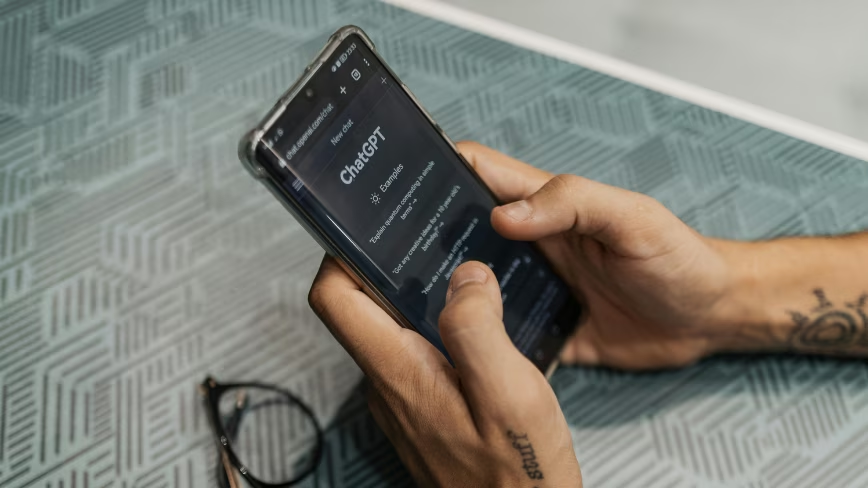
People are certainly trying it. OpenAI says more than 40 million people ask ChatGPT about their health every day. At that scale, even a small error rate means millions of risky answers, especially for patients who cannot afford a real visit.
What the studies actually show
The research paints a more mixed picture. In a 2024 study in the Journal of Medical Internet Research, doctors and ChatGPT-4 both answered 100 real patient questions. Patients found the chatbot more empathetic and useful. Specialists, though, flagged 15 of its answers as potentially harmful, IBTimes UK reported, and warned that lay readers could not tell the safe ones from the dangerous ones.
A newer study is more alarming. In February 2026, a Nature Medicine paper led by Mount Sinai urologist Dr Ashwin Ramaswamy tested OpenAI’s ChatGPT Health on 60 clinical scenarios. The tool failed to send 51.6% of true emergencies to the emergency room. It suggested a routine appointment instead. One missed case involved a patient going into respiratory failure.
That fits a familiar pattern. AI has learned to match or beat doctors at naming a likely diagnosis. It is far weaker at the harder job of weighing risk and choosing treatment, which is where real medicine lives.
Follow the money
Andreessen also has a stake in the answer. His firm has poured money into health-AI startups, including Hippocratic AI, Ambience Healthcare and Abridge. It also runs a $500mn biotech fund backed by drug giant Eli Lilly.
None of that makes him wrong. It does mean his bullishness is not neutral. When the man talking up Doctor ChatGPT profits if you believe him, the claim deserves a closer read.
The prompt that backfired
There is also reason to doubt how well he grasps the tool. In May, Andreessen shared a long “super prompt” on X that told ChatGPT to “never hallucinate or make anything up” and to double-check every fact.
Engineers pointed out the obvious problem. You cannot switch off hallucination with an instruction. It is baked into how large language models work. “Hilarious (and maybe a little bit scary),” AI critic Gary Marcus wrote, that he still had not learned this.
Why it matters
The stakes here are not abstract. Millions of people now treat a fluent, confident chatbot as if its fluency were medical accuracy. The two are not the same.
Doctors are not saying AI is useless. Many use it already, and the tools for diagnosis keep improving. Dr Adam Rodman, a Harvard hospitalist who studies AI in medicine, suggests a sensible rule: never use a chatbot to triage an emergency, and treat it as a companion to a human visit, not a replacement.
That is the gap Andreessen’s soundbite skips over. The public is already wary of AI hype, and on health the caution is earned. Doctor ChatGPT may well be useful. On the current evidence, better than 99% of doctors it is not.
This piece touches on medical decisions and personal health. AI tools can be a helpful starting point, but for anything urgent or serious, speak to a qualified clinician.
Get the TNW newsletter
Get the most important tech news in your inbox each week.


