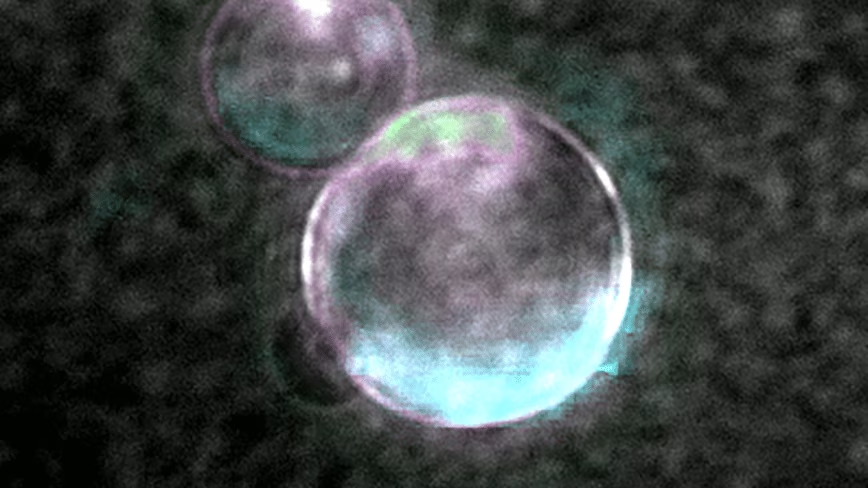

Scientists in Minnesota have built a cell from scratch. It can feed, grow, and divide, and it competes with its own offspring. Its makers do not claim it is alive. But the line between chemistry and biology just got a lot thinner.
The team at the University of Minnesota calls its creation SpudCell, and says it is the first synthetic cell to complete a full life cycle.
Earlier efforts stripped down a living microbe to its bare essentials. SpudCell works the other way, built entirely from the bottom up. It uses only known chemicals, none of them alive. A preprint, still awaiting peer review, describes the work.
The recipe is deceptively simple. Each cell is a tiny bubble of lipids wrapped around a genome of about 90,000 base pairs, split across seven strands of DNA. Inside sit 36 purified enzymes that read that DNA and build proteins.
The cell grows by fusing with “feeder” bubbles that deliver lipids and nutrients. It divides without the internal scaffolding most cells rely on, splitting when proteins crowd its surface until the membrane gives way.
Evolution in a dish
The most striking result is competition. The team introduced a genetic tweak that made cells build more of a key protein. Those cells grew faster and left more offspring. After five generations, the faster variant had outcompeted the original. That is natural selection, running in a fully synthetic system.
The work also rewrites a rule of thumb. Earlier estimates put the smallest possible genome for a living cell at about 113,000 base pairs. SpudCell runs on 90,000. Its lead scientist, biochemist Kate Adamala, told The Register that the point is not the cell itself.
“SpudCell is proof of what is possible,” she said. It shows, she added, that non-living molecules can assemble into something that behaves like life.
Very much not alive
SpudCell is also, in Adamala’s words, an “incredibly wimpy organism.” It cannot build its own ribosomes, the machines that make proteins. So researchers must keep feeding it. Each lineage lasts only five to ten generations before its borrowed parts wear out. It divides once every 12 hours or so, held at a warm 30C. That is far slower than E. coli, and it cannot survive outside the lab.
Those limits matter for the biggest question: is it alive? Most researchers say no, and the team agrees. John Glass, a synthetic-cell scientist at the J. Craig Venter Institute who was not involved, told the New York Times that being alive is not a precise condition. It is, he said, a bit like the old line about obscenity: you know it when you see it.
Even so, he judged SpudCell far closer to alive than anything the bottom-up field had built before.
Why build a cell at all
The prize is control. Engineers can reprogram a cell when they know its every part. Adamala talks of a coming “bioeconomy” in which engineered cells make medicines, capture carbon, or produce materials that industrial chemistry cannot. It is the same promise driving the wider engineering-biology boom.
That boom runs from self-replicating living robots and stem-cell life-forms to the first approved CRISPR therapy and big AI bets on biology like Anthropic’s biotech buy.
Such power invites caution. Because SpudCell cannot live outside the lab, biosecurity experts say it poses no threat today. But the field is watching. The tools, one expert noted, are neither good nor bad in themselves. To keep the science open rather than locked in a few private hands, Adamala’s team has launched a nonprofit, Biotic, so other labs can copy and extend the work, hype and hard limits alike.
The name adds a final flourish. The team first called it “Potato Cell,” a nod to Adamala’s Polish roots, before shortening it. The de-extinction crowd, from Colossal’s dire wolves onward, has nothing on a spud that competes to survive.
Get the TNW newsletter
Get the most important tech news in your inbox each week.


