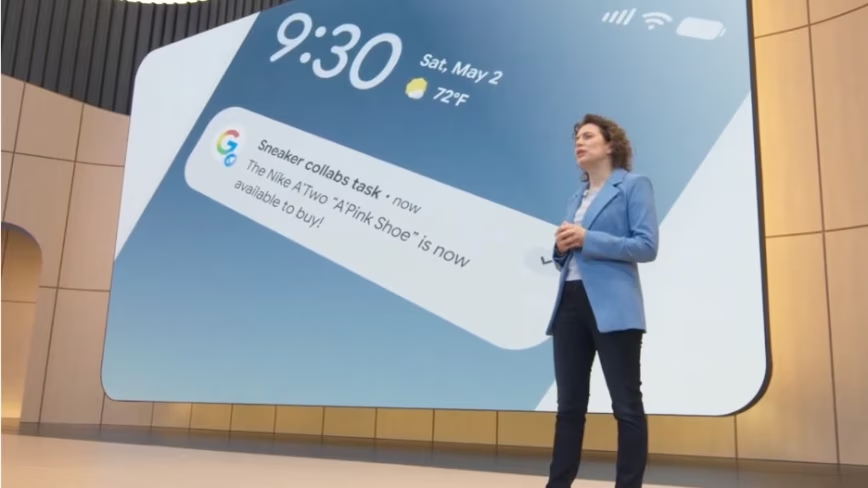
Elizabeth Reid, Google’s VP of Search,
 Credit: Google
Two of the biggest names in tech now want to watch the web on your behalf.
Within a month, both Google and Apple announced features that monitor web pages and tell you when something changes. Both claim they will use AI to alert you when a condition is met and reduce false positives.
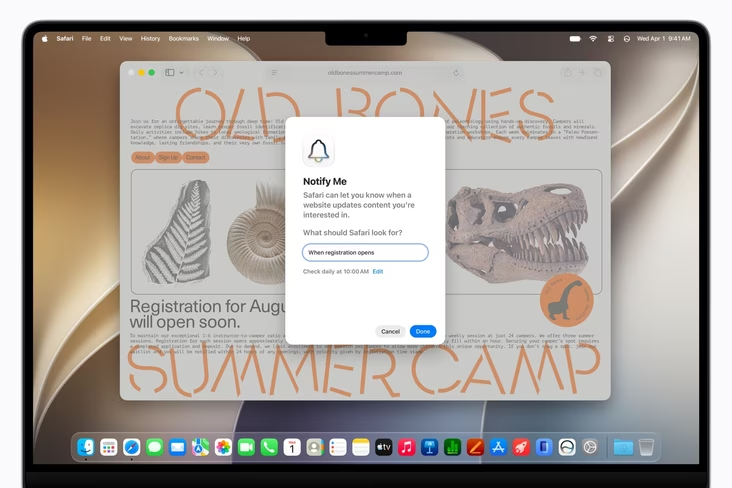
At its Worldwide Developers Conference on June 8, Apple introduced Notify Me, a Safari feature that watches a page you choose and pings you when it updates. At Google I/O in May, Google unveiled information agents that do the same across the open web.
“We’re entering the era of search agents now,” Elizabeth Reid, Google’s VP of Search, told the I/O keynote.
Neither has shipped widely yet. Google’s information agents arrive over the summer for AI Pro and Ultra subscribers in the US, and Apple’s Notify Me ships this fall with iOS 27 and macOS 27.
But the convergence is the signal. The idea behind both, software that watches the web so you don’t have to, has existed for more than twenty years. What’s new is that two of the companies that shape how most people find things online are reaching for it at the same moment.
Page monitoring won’t replace the search experience; rather, search is becoming a persistent, ongoing loop instead of a one-time query. Watching the web isn’t new: Google Alerts and price and stock trackers have done so for two decades. What’s changed is that Google and Apple are folding it into the surfaces where people already search and browse, with a plain-language setup.
Google puts standing instructions inside Search, and Apple puts a narrower version inside Safari. The idea: instead of checking, again and again, whether a listing, a price, or a policy page has changed, you tell software what matters once, and it comes back only when something does.
What These Agents Actually Do
A traditional search is a single transaction: you enter a question, get results, and the exchange ends. Apple’s Notify Me and Google’s information agents work differently. You describe what you want to track once, and the software watches in the background, alerting you when something changes.
The practical difference is between checking and being told. Apple’s demo watched a summer-camp registration page so a parent didn’t have to keep refreshing it. Google showed the same shift at I/O, with an agent catching the moment a new basketball sneaker went on sale. The everyday version is simple: stop refreshing, get pinged.
Before Google and Apple Had a Name for It
The idea of software watching the web and flagging changes goes back more than twenty years. Google Alerts, launched in 2003, was an early version: enter a keyword, get an email when new matching content appears. Journalists, PR teams, researchers and the general public have used it for years.
The approach has become more capable since then.
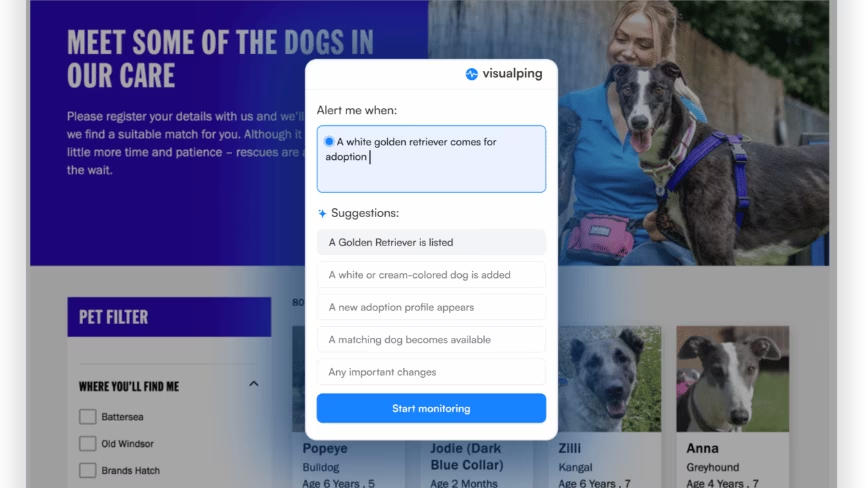
Page-monitoring agents such as Visualping, which has operated in this space since 2017, offer cloud-based monitoring of specific pages a user selects and alerts the user when a condition is met with detailed before/after screenshots, Visualping also offers a Chrome Extension if you prefer to use Chrome rather than Safari.
OpenAI’s ChatGPT Pulse, launched in late 2025, runs research overnight and delivers a personalized morning brief.
Anthropic brought the same always-on idea to developers in April with Claude Code Routines, which saved tasks that run on a schedule or in response to an event.
Interest has climbed. Search terms including “search agents,” “information agents,” and “page monitoring” are all up in 2026, according to Google Trends. Usage shows the same pattern: in the first five months of 2026, more than 1.06 million individual pages were set up with a new monitor on Visualping alone.
Two Kinds of Agents, Two Different Jobs
These tools split along one practical line: where the agent looks. Open-web agents scan across many sources to answer a standing question. Google’s information agents, ChatGPT Pulse, Perplexity work this way: you give them a topic, and they range across blogs, news, social posts, and data feeds.
They work well in cases where you don’t know in advance where the answer will come from. The trade-off is that broad scanning tends to run on a daily or hourly cadence, and pages that update frequently or block automated access may yield alerts that are too late or no longer relevant to act on.
Page monitoring agents work in the opposite direction. Rather than scanning broadly, they watch a specific page and detect the precise change on it. The approach suits cases where you already know the exact page that matters: a product listing, a child’s daycare schedule, or availability at the local swimming pool. The tradeoff is that it needs the page up front, which makes it less suited to open-ended discovery.
The split maps onto the two announcements. Google’s information agents lean toward open-web, and Apple’s Notify Me is page-monitoring from Safari using local resources, the user’s computer and internet connection.
The open-web approach answers “what’s happening with this topic?” Page monitoring answers “has this specific page changed yet?” Increasingly, the two connect: tools like Visualping now ship as ChatGPT apps and plug into Claude via MCP connections, so a broad agent can hand a page to a monitor to watch. The discovery layer finds the topic, and the precision layer keeps the watch.
What People Actually Monitor
What people monitor ranges from the routine to the life-changing. At the everyday end are tools for general awareness: people run Google Alerts on their own name, an employer, or a competitor, and rely on ChatGPT Pulse for a morning brief. Apple reached for an everyday example on stage, too, using a camp registration page.
Other uses are high-stakes and time-sensitive. During the pandemic, people used monitoring tools to secure scarce resources: the Wall Street Journal documented people using these tools to score hard-to-find COVID vaccine appointments, and the Telegraph reported on Britons using automated tracking to grab supermarket delivery slots that sold out in seconds.
“In Europe, we see people watching for released train tickets and fare drops on national rail sites, for visa and government-appointment slots that open unpredictably, and for rental listings in tight markets like Amsterdam, Berlin, and Paris, where flats can be gone within hours,” said Serge Salager, founder and CEO of Visualping.
Others carry higher personal stakes: hopeful parents watch adoption pages, and researchers monitor journals to catch the moment a relevant paper drops. In every case, the appeal is the same: people would rather be told than keep looking.
What’s Actually at Stake
These features are crucial where the economics lie: the browser and the default search box. Google pays Apple over $20 billion annually to keep Safari’s default search, and a judge declined to ban these payments in 2025. Thus, a browser that watches pages is significant. It shows the ongoing battle over browser and search ownership, even if it affects Google’s search volume.
European users should note that Apple’s new Siri and Intelligence features won’t arrive in the EU with iOS 27 this fall due to the Digital Markets Act. While built-in tools validate behaviours, standalone tools still have unique abilities: monitor across browsers and devices, keep change history, target specific page elements, and support teams.
What Happens When Monitoring Goes Mainstream
Until now, the behaviour has largely belonged to power users, hobbyists, and professionals who needed an edge. With Apple and Google both building it in, it is about to reach a far larger audience. “People are getting comfortable handing the watching over to software,” said Salager. “The question they used to ask was, ‘Where do I go to look this up?‘ Increasingly, it’s, ‘Tell me when this changes.’ That’s a different relationship with the web.”
For most of the internet’s history, finding something has meant going to look for it. Apple and Google did not invent the alternative, but together they will put it in front of many more people. Whether it sticks will shape what search becomes.
Get the TNW newsletter
Get the most important tech news in your inbox each week.
This article is presented by TNW Studio and sponsored. This is paid content. The TNW newsroom was not involved in its creation. Reach out to learn more about partnering with TNW Studio.
Also tagged with


