TL;DR
Czech startup Neuron Soundware built Sound Shield, an AI acoustic drone detection system using €100-150 sensors that consume 1W each.
Neuron Soundware's Sound Shield uses low-power microphone sensors and Nvidia Jetson modules to identify drone acoustic signatures in real time, and the company is pitching dual-use deployment on electrical transformer stations
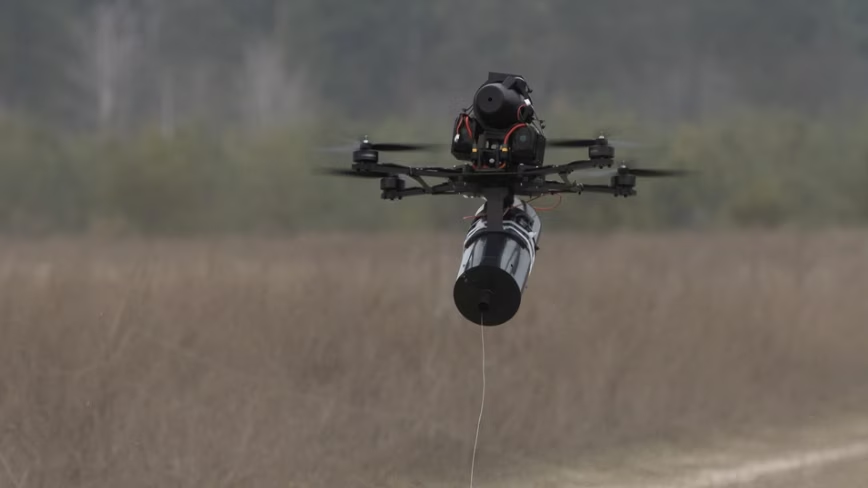
Drone
 Credit: АрміяІнформ
Czech startup Neuron Soundware built Sound Shield, an AI acoustic drone detection system using €100-150 sensors that consume 1W each.
Czech startup Neuron Soundware has built an AI-powered acoustic detection system called Sound Shield that identifies drones by the sound of their engines using microphone sensors that cost between €100 and €150 each. The system is designed as a passive, low-cost alternative to radar for detecting low-flying drones over cities, infrastructure, and military installations. The company, which has spent the past decade using AI to listen to industrial machinery for clients including Airbus, Siemens, and BMW, is now applying the same acoustic analysis technology to airspace defence.
Sound Shield works by deploying small sensors called nEdge Minis, each consuming just 1 watt of power, that listen continuously for drone engine signatures. The sensors report to a computing platform powered by Nvidia’s Jetson modules, which runs neural networks on-device to match incoming audio against a library of known drone acoustic profiles. When the system detects a threat, it alerts a centralised command platform with the drone’s estimated speed, altitude, and direction of movement.
The approach exploits a fundamental limitation of drone design. Radar-absorbing coatings and stealth shaping can make a drone nearly invisible to traditional detection systems, but no current technology can silence the mechanical noise of rotors and engines. Every drone produces a distinct acoustic signature that, according to Neuron Soundware, its AI can identify in real time across multiple sensor positions.
Pavel Konečný, founder and CEO of Neuron Soundware, is pitching Sound Shield as a dual-use system that would first be deployed on electrical transformer stations. “Primarily, they can continuously monitor the health of the transformer itself and other critical components of the distribution network, detecting internal discharges, oil leaks, or other operational anomalies,” Konečný said. “At the same time, their microphones listen to the sky.”
The dual-use angle is commercially significant. Rather than asking governments to fund a standalone drone detection network from scratch, Neuron Soundware is proposing to piggyback on infrastructure that already needs acoustic monitoring. The company argues this would reduce the number of sensors required and give governments a comprehensive air defence layer with minimal additional installation and power costs.
European governments are scrambling for affordable drone detection after the wars in Ukraine and Iran demonstrated how cheap UAVs can destroy billions of dollars in military hardware. Ukraine’s Operation Spiderweb in June 2025 used $2,000 drones to destroy an estimated $7 billion worth of Russian strategic bombers, according to Ukrainian officials, though Russia claimed far lower losses. The asymmetry between drone cost and the damage they inflict has made counter-drone systems one of the fastest-growing segments of defence procurement.
The counter-drone market is expected to more than triple from roughly $6.6 billion in 2025 to $20 billion by 2030. Startups across Europe are raising capital to build sovereign counter-drone capabilities, and NATO members along Russia’s border have agreed to construct a drone detection wall stretching from Norway to Poland. Sound Shield positions itself as a complementary layer to radar and radio-frequency detection rather than a replacement.
The economic case is straightforward. Modern radar systems capable of detecting small drones cost orders of magnitude more than a network of nEdge Minis, and they actively broadcast their position every time they sweep. Sound Shield’s sensors are passive, meaning they emit no signal that an adversary could detect or jam.
The trade-off is range and reliability.
Acoustic drone detection has well-documented limitations that the source material does not address. Most acoustic systems are effective to roughly 300-500 metres under favourable conditions, with performance degrading substantially in wind, rain, or noisy urban environments. Ambient noise from traffic, wildlife, and industrial equipment can produce false positives.
Newer drone models are also being designed with quieter motors that reduce the acoustic signature available for detection. Neuron Soundware claims its nEdge PRO computing module can aggregate data from sensors within a 20-kilometre radius, but independent testing of that range claim has not been published.
The company has raised approximately €7.4 million to date from investors including Inven Capital, J&T Ventures, and Lead Ventures, and received €7 million from the European Innovation Council. It has more than 130 industrial installations across four continents monitoring machines acoustically. Whether the jump from listening to pumps and turbines to tracking hostile drones in contested airspace is as transferable as the company suggests remains to be proven in real-world conditions.
Get the most important tech news in your inbox each week.


