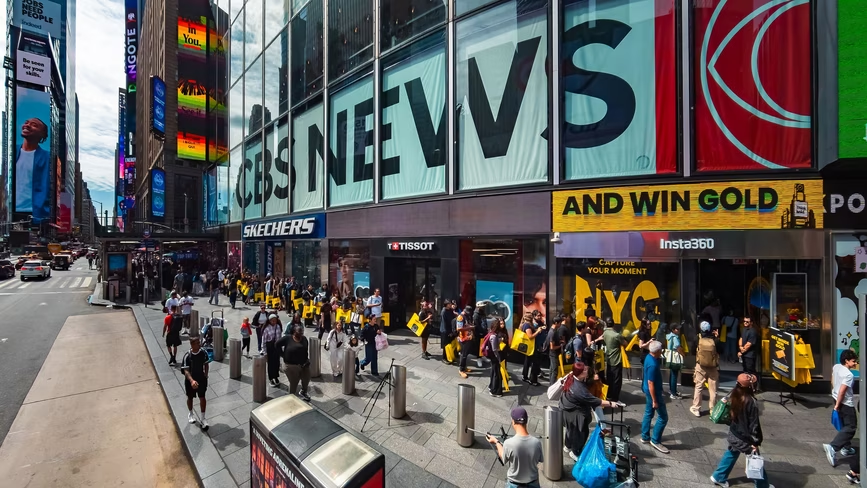
Shoppers outside Insta360’s Times Square store, the company’s first flagship outside Asia, which opened in September 2026.
Insta360 opened its first American store on Saturday at 1515 Broadway, in the middle of Times Square. It is the company’s second self-operated shop outside China, after Tokyo in August.
The ribbon-cutting is the least interesting part. Iris Deng interviewed co-founder Max Richter in Shenzhen for the South China Morning Post, and the numbers around the opening describe a category being rearranged by two forces nobody in it controls.
The memory bill is bigger than the rival
Insta360 spent nearly 2 billion yuan, about $298.4m, on what it called strategic procurement of memory chips in the first half of this year. Richter said a similar figure is unavoidable in the coming quarters, and that it is unclear when the memory crisis will ease.
GoPro agreed on 1 September to merge with Starman Optical. Its shareholders receive $285m in cash, at $1.14 a share, and keep about 10% of the company.
Starman is also retiring roughly $92m of GoPro debt, so the full consideration is larger than the headline cash. The comparison still holds at the level that matters: one company’s six-month component bill is the same order of magnitude as the price of the other company.
The same shock, two balance sheets
Both firms were hit by the same thing. AI data centre demand pulled wafer capacity away from consumer memory, and prices for the chips inside every camera went vertical.
Insta360 absorbed it and stayed profitable, barely. Half-year net profit fell 94% while revenue rose 50%, and research spending rose almost 80% at the same time.
GoPro could not absorb it and said it might not survive, citing memory price rises of 80% to 115%, a 26% revenue decline and expected covenant breaches. It cut 23% of staff and looked for a buyer.
That is the difference a balance sheet makes. The memory crunch is not a price story so much as a sorting mechanism, and it sorts by who can fund a year of inflated input costs.
GoPro’s exit runs through the thing that broke it
There is a closed loop in the rescue. GoPro will stay listed on Nasdaq and reposition towards AI data centre, government, defence and aerospace markets.
The AI buildout that starved GoPro of affordable memory is now the market it is being pointed at. Founder Nicholas Woodman described the combined business as an American imaging and optical company working on national security.
The deal is expected to close by the end of the year, subject to regulatory and shareholder approval. Until it does, the American action camera incumbent is a company in the middle of being sold.
The other rival cannot get new approvals
DJI was added to the FCC’s covered list in December 2025, after the security audit Congress ordered was not completed by the deadline. New products cannot get the radio approval needed for import and sale.
Existing models already authorised remain on shelves, so this is not an empty aisle. It is a frozen one, and the freeze compounds with every product cycle DJI cannot ship into.
The freeze may also deepen. The FCC has proposed pulling DJI drones it already approved, reaching by capability into thermal imaging, LiDAR and docking systems.
Richter would not call it an opportunity
Asked about his rival’s regulatory problem, Richter told the Post that Insta360 currently faces no US restrictions. He declined to treat the lockout as a windfall, saying the company did not want it to happen this way and that it is not the main motivation.
Read as manners, that is a gracious answer. Read as strategy, it is the careful one.
The covered list has kept widening, by company, by category and now by capability. It has since reached foreign robots and inverters, and Insta360 is a Shenzhen firm selling networked cameras that talk to a cloud service.
The share numbers explain the lease
IDC put DJI at 65% of the global handheld smart camera market in the first quarter, with Insta360 second on 22%. That gap looks settled until you read the growth rates.
Insta360’s shipments rose 66% year on year against DJI’s 38%. In 360-degree cameras specifically it holds 68%, and it has now shipped 10 million cameras in total since 2015.
A retail lease in Times Square is a multi-year commitment. It is the kind of bet a company makes when it thinks the next several product cycles belong to it.
Why a shop at all
Richter’s stated reasoning is about explanation rather than sales. A 360-degree camera is difficult to demonstrate in a listing, and the invisible selfie stick effect that made the brand travels as a video rather than as a spec sheet.
He also said Insta360 does not want to compete on price alone, and that escaping price competition through innovation matters more. That is aimed at DJI, with which it is in a full price war at home across cameras and drones.
Europe is next, in Munich or Amsterdam, which would make three overseas stores by year end. Richter said the company may accelerate in 2027 and explore store-in-store arrangements with local retailers.
What to watch
Watch the memory line in the next results. Richter has already said another 2 billion yuan is unavoidable, and the question is whether revenue growth of 50% can keep outrunning it.
Watch where Insta360 buys its chips. Domestic Chinese DRAM is starting to appear in Western products, and a Shenzhen manufacturer has a shorter route to it than its competitors do.
Watch the covered list. Nothing about Insta360 is restricted today, and the word carrying the weight in Richter’s answer was currently.
Get the TNW newsletter
Get the most important tech news in your inbox each week.


