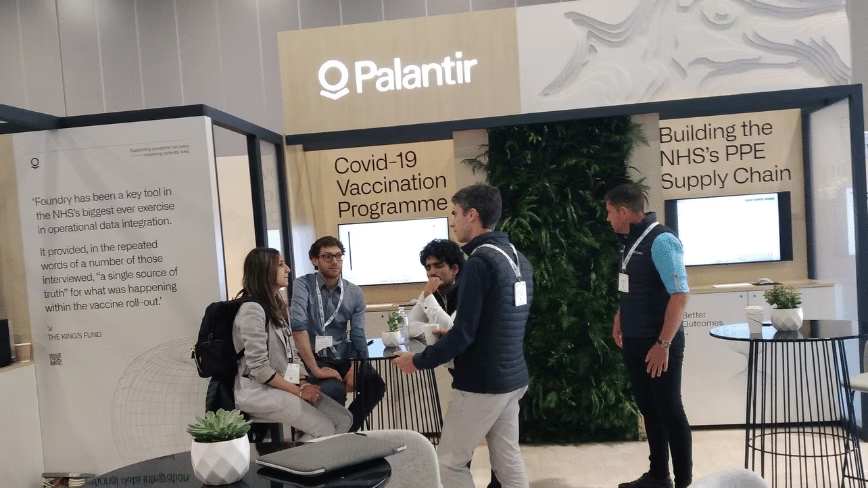
Palantir at a UK conference in June 2022. Its Maven system is the software France and Germany are trying to replace.

Britain’s publicly owned energy system operator has handed Palantir a £21.2m contract with no competition. The justification it filed is a plain description of why leaving will be difficult.
Lindsay Clark reported the award for The Register on Tuesday. The underlying transparency notice sits on Find a Tender. It went up on 26 August.
The National Energy System Operator runs two processes on Palantir’s Foundry platform, Connections and Skip Rates. The contract covers licensing and support for both. It is worth £17,700,270 before VAT and £21,240,324 with it. The term runs from Tuesday until 31 July 2027.
The legal basis and what it says
NESO used a direct award under Section 41 of the Procurement Act 2023, relying on paragraph 6 of Schedule 5. That paragraph covers the absence of competition for technical reasons.
The notice explains why. Foundry rests on “proprietary architecture licensed exclusively by Palantir”. The company, it says, holds “the specialist knowledge, technical expertise and the system knowledge” the platform needs.
Then the part worth reading twice. Moving to another supplier “is not possible without significant cost, resource commitment and delivery risk”. It would mean redeveloping the analytics environment, migrating the data, putting the replacement through security accreditation and retraining staff.
Nothing there is improper. It is also a textbook account of vendor lock-in. The locked-in customer wrote it, and filed it as the reason no competition could happen.
The exit plan has extensions built into it
NESO says it is running a competitive procurement for a replacement. That is the right response, and it has already started sounding out suppliers.
But the interim contract carries six-month extensions available until 31 July 2028. The notice puts the maximum at one year, ten months and 23 days.
There is also a risk clause. It lists legacy data structures, security, data quality and regulatory compliance as things that could go wrong in the migration. If they do, the contract “may be modified including to extend the transition timeline”.
So the conditions that would trigger an extension are the same conditions the direct-award justification says already exist. The document explaining why NESO cannot leave now also explains why the deadline for leaving may move.
Three things in the notice that the coverage has not picked up
First, the timing. The notice appeared on 26 August at 6.04pm. The earliest signature date is 8 September. That gives 13 days of public notice on a £21m award. It meets the requirement. It also leaves almost nobody time to react.
Second, the notice records that NESO prepared or revised a conflicts assessment. It does not say what that assessment found.
Third, the replacement dwarfs the stopgap. A separate market-engagement notice describes a Strategic Enterprise Modelling Capability. It runs from July 2027 to July 2032, with a possible two-year extension. The notice mentions enterprise-wide modelling, decision support, audit trails and “AI-enabled innovation”. Whoever wins it could hold the contract until 2034.
Why the NHS comparison matters here
The Register drew the parallel and it is the right one.
Palantir took roughly £60m of NHS contracts during and after the pandemic, some of them without competition. It then won the Federated Data Platform contract, worth up to £330m, through an open process. Critics argued the incumbency had given it an advantage. The NHS said the competition was fair.
NESO sits at the earlier stage of that same sequence. It has a Palantir system running critical processes. It has a direct award to keep that system running. And it has a large competitive procurement ahead. By the time bidding opens, Palantir will have held the system for four years and run the transition.
That is not an accusation. It is the structural problem the NHS argument turned on, appearing again in a different sector. It is also why the conflicts assessment would be worth seeing.
The relationship was never announced
The original contract began in March 2023, and nobody announced it. The Financial Times reported that detail, according to The Register. NESO says it had no obligation to publish, because at the time it formed part of privately owned National Grid.
That explanation holds. The Energy Act 2023 created NESO as a public corporation, wholly government-owned and funded through regulated industry charges. The Palantir relationship predates that change.
The effect still stands. The public learned about a three-year-old arrangement only at the point of its renewal, because renewal triggered the disclosure.
What NESO and Palantir say
NESO says the contract keeps critical services running while the competition happens, and that disruption would hit customer-facing services and its ability to meet regulatory obligations. It has published a pre-market engagement notice for the replacement.
Palantir told The Register: “We’re proud to be supporting Neso’s efforts to improve energy efficiency, drive down costs and transition to net zero.”
We did not put questions to either organisation. The Register did, and said it had offered both the opportunity to comment.
The same day, twice
NESO signed this contract on the day a UK health minister told MPs that mistrust of Palantir is pushing NHS patients to opt out of data sharing. Roughly 60,000 more people opted out over four months.
As procurement, the two facts have nothing to do with each other. Together they describe something odder. One department can now measure the cost of the company’s reputation. Another arm of the state is deepening its dependence on it.
The pattern reaches past Britain. A Pentagon memo in August directed staff to spend $244m with the company without a bid. In Britain, Palantir holds contracts worth around £670m and paid £2m in corporation tax in 2024. And European governments are discovering that building an alternative creates a dependency of its own, with Berlin wary of France’s rival system.
What to watch
Whether the interim contract runs to July 2027 or takes its extensions. That is the single test of whether the competitive procurement is real, and it is publicly checkable on Find a Tender.
Whether the conflicts assessment is published, or obtained.
And who bids for the 2027 contract. British energy infrastructure is already a target for state-linked hackers, and a plant went down for four days in July. An operator reading that has good reasons to want continuity. It also has good reasons not to spend the next decade with one supplier holding the architecture.
Get the TNW newsletter
Get the most important tech news in your inbox each week.


