TL;DR
Space startup funding hit a record in Q1 2026 as SpaceX’s IPO opened capital markets for orbital ventures beyond rockets and satellites
Global space investment nearly doubled to a record eight billion dollars in Q1 2026 as investors and founders bet the listing will do for space what Amazon's IPO did for e-commerce
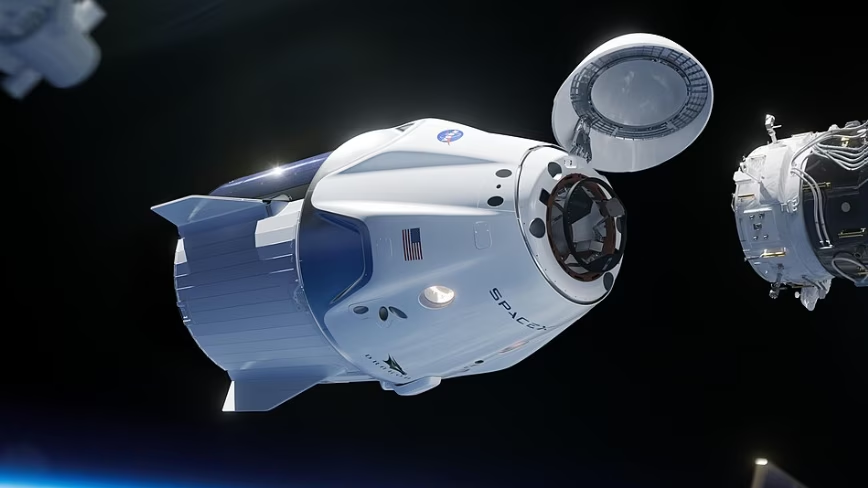
In this illustration, a SpaceX Crew Dragon spacecraft approaches the International Space Station for docking.
 Credit: NASA/SpaceX
Space startup funding hit a record in Q1 2026 as SpaceX’s IPO opened capital markets for orbital ventures beyond rockets and satellites
SpaceX raised roughly 86 billion dollars in the largest initial public offering in history after underwriters exercised the greenshoe option on its June debut. The stock has since slid from a post-debut high above $200 to around $108, but investors and founders say the most important effect of the listing may not be its size or its share price. It is what happens next for the rest of the space industry.
Global funding for space companies hit an all-time high of nearly eight billion dollars in the first quarter of 2026, almost double the four billion raised in the previous three months, according to data from Seraphim Space. Investors completed 159 transactions during the quarter, bringing the trailing 12-month total to a record 654 deals. The average deal size nearly doubled as well.
Keval Desai, founder of early-stage investment firm Shakti VC, told Fortune that SpaceX’s IPO could have as big an impact on the space industry as Amazon’s 1997 listing had on e-commerce. Before Amazon went public, there had been only a handful of online retail IPOs, yet hundreds followed once investors treated the internet as a real market. Desai predicts “the next decade in space is going to be full of startups,” driven by rapidly improving technology and a slowly expanding launch supply chain.
The startups are not limited to building rockets. Beyond Reach Labs, a Y Combinator graduate, is building solar panels that launch the size of a dining table and expand to the size of a football field in orbit, while a company called Galactic Resource Utilisation Space is taking million-dollar reservations for hotel rooms on the moon. Nebex raised $30 million from Google’s GV to build what it calls a stock exchange for the space economy, connecting space firms, governments, and investors across borders.
One of Shakti’s portfolio companies illustrates the breadth of what is emerging. Cosmoserve Space, an Indian startup founded by former ISRO scientist Chiranjeevi Phanindra, is building a robotic spacecraft designed to capture and remove space debris using soft “petals” inspired by the Venus flytrap. The company raised just over three million dollars in pre-seed funding and recently closed a seed round.
Cosmoserve ran its first space test in July after launching its robot aboard the Vikram-1, India’s first privately developed orbital rocket, built by Skyroot Aerospace. The capture mechanism did not deploy as expected, but the startup said it collected critical data in orbital conditions that will inform the next iteration. Phanindra told Fortune that SpaceX’s listing has already changed how investors perceive the sector, saying people now consider space “a less risky domain compared to a year back”
The underlying economics explain why. SpaceX’s reusable rockets have cut the cost of sending mass to orbit by roughly 95 percent since 2008, opening opportunities for startups to fill gaps that were previously too expensive to address. Shakti has placed about 10 percent of its portfolio in space technology over the past five years, and Desai expects that share to climb to between 25 and 30 percent over the next several years.
Challenges remain. Developing space hardware requires a limited talent pool with advanced knowledge, regulations often span multiple countries, and funding for early-stage space ventures is still scarce compared to software. Even Blue Origin, after 25 years of relying solely on Jeff Bezos, announced it would accept outside capital for the first time, framing the shift as a response to the scale of investment now required to compete.
Desai argued the listing will have a lasting structural impact, ultimately opening capital markets for entrepreneurs building the next generation of space businesses. The total addressable market, he said, is no longer limited to Earth.
Get the most important tech news in your inbox each week.


