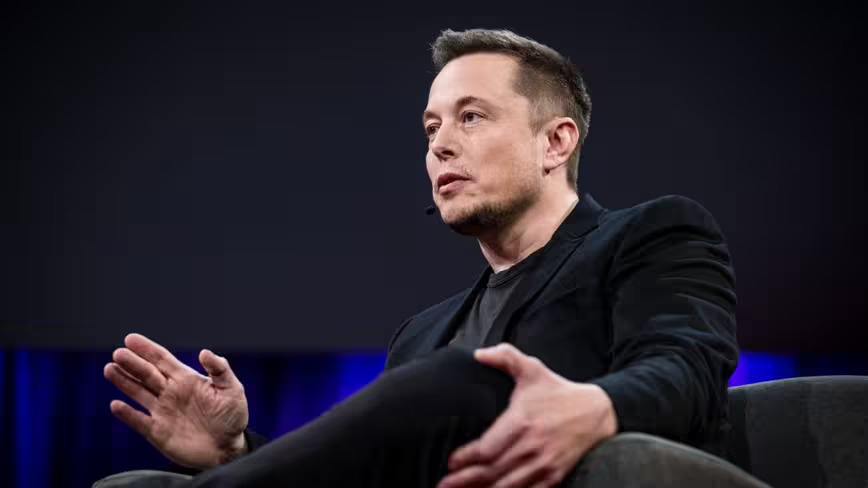
Musk calls himself ‘a fool’ on the stand

The tense day three of Musk v. Altman saw OpenAI’s lead attorney William Savitt use Musk’s own emails, pledge shortfalls, and Shivon Zilis texts to argue the lawsuit is a competitive grievance dressed as a charitable principle.
Elon Musk called himself “a fool” for funding OpenAI, accused its leadership of “looting the nonprofit,” and clashed repeatedly with the company’s lawyer in a tense cross-examination in Oakland federal court on Wednesday.
The day’s proceedings. day three of the four-week trial of Musk v. Altman, were the most combative yet, as OpenAI’s lead trial attorney William Savitt methodically tried to turn Musk’s donations, emails, and personal relationships against his own charitable trust argument.
“I gave them $38 million of essentially free funding, which they then used to create an $800 billion for-profit company,” Musk told the jury. “I actually was a fool who created free funding for them to create a startup. I literally was.”
The statement was striking: Musk’s own legal framing has positioned him as a deceived donor rather than a failed corporate power play, and calling himself a fool reinforces that framing for the jury.
But Savitt was quick to probe the gap between Musk’s $38 million in actual donations and the “up to $1 billion” he had pledged when OpenAI was founded.
“Without me, OpenAI wouldn’t exist!”
Musk shot back, raising his voice when Savitt pressed him on the funding shortfall. Musk argued that beyond money, he contributed his reputation, contacts, and credibility, “These things have value”, and that his total contribution exceeded $100 million in intangible terms.
Judge Yvonne Gonzalez Rogers at one point intervened as Savitt flagged to the court that Musk was proving “difficult” to get direct answers from.
“That is the challenge of all litigants,” the judge replied.
The Zilis texts: a second narrative in the room
The most damaging material Savitt deployed came not from OpenAI’s own records but from Musk’s personal communications with Shivon Zilis, a venture capitalist who was then on OpenAI’s board and is also the mother of four of Musk’s children.
Savitt presented a 2018 email in which Zilis asked Musk whether she should remain close to OpenAI in order to “keep feeding him information on the company.”
Musk confirmed he agreed she should. He also confirmed that Zilis facilitated ongoing communication between him and OpenAI after he departed the board.
Savitt’s second Zilis exhibit was more structurally significant: an email from Zilis to Sam Teller, who worked for Musk, describing two ways OpenAI’s structure could change, “Roll everything into a B corp,” or “OpenAI C Corp and OpenAI nonprofit.” Savitt’s argument was direct: Musk was presented with for-profit restructuring options and considered them.
Asked whether he had ever instructed Zilis to file paperwork converting OpenAI to a for-profit corporation, Musk replied: “I don’t recall.”
Savitt then put his sharpest question of the day: “You were never really committed to OpenAI being a nonprofit, were you, Mr. Musk?”
Musk disputed the premise. But the jury now has two structurally contradictory pictures: a donor who claims he was deceived about the nonprofit status, and a co-founder who was actively considering for-profit conversions in internal communications.
Under questioning from his own attorney on redirect, Musk testified about the sequence of events that drove him from scepticism to lawsuit. It was Microsoft’s $10 billion investment, not the initial for-profit structuring, that he identified as the decisive violation.
“At a $10 billion scale, there’s no way Microsoft is just giving that as a donation or any kind of charitable way,” he said.
“I texted Sam Altman and said, ‘What the hell is going on?’, something to that effect. I think I said, ‘This is a bait and switch.’”
He also raised the safety argument that has been central to Musk’s public positioning since he filed the lawsuit in 2024. Asked whether a for-profit AI company creates a safety risk, he said:
“Yes, I think it creates a safety risk.” Savitt countered that Musk couldn’t actually know what OpenAI’s safety practices look like from the outside. “You just don’t know,” Savitt said.
Musk acknowledged he did not know the specifics of OpenAI’s internal safety work but maintained that the for-profit structure itself was the concern: “It does worry me that a nonprofit suddenly is a for-profit with unlimited profit.”
Savitt also pressed Musk on xAI directly, asking whether Grok “lags much farther behind” ChatGPT. Musk acknowledged that xAI, now absorbed into SpaceX, has “very small market share” and is “much smaller” than OpenAI today, while insisting xAI is only “technically” a competitor.
The implication was unmistakable: that a man building a direct AI competitor to OpenAI is using the courts to slow it down, dressed in the language of charitable principle.
What comes next?
Savitt told the court he expected to complete his cross-examination of Musk for approximately one further hour on Thursday, after which Musk’s team planned to call Jared Birchall, the family office executive who manages Musk’s personal wealth.
OpenAI president Greg Brockman was given 48 hours’ notice to testify and may also appear on Thursday, depending on the length of Birchall’s session.
The stakes of the trial have not diminished. As we reported at the outset, the most damaging exhibit in the entire case may not be anything from Musk’s cross-examination but Greg Brockman’s 2017 diary entry, in which he wrote: “I cannot believe that we committed to non-profit if three months later we’re doing b-corp then it was a lie.”
Judge Gonzalez Rogers cited that entry directly in her January ruling that sent the case to trial. The advisory jury’s finding on liability will inform, but will not bind, the judge’s decision on remedies, which could include up to $134 billion returned to the nonprofit and the forced removal of both Altman and Brockman from OpenAI.
Get the TNW newsletter
Get the most important tech news in your inbox each week.


