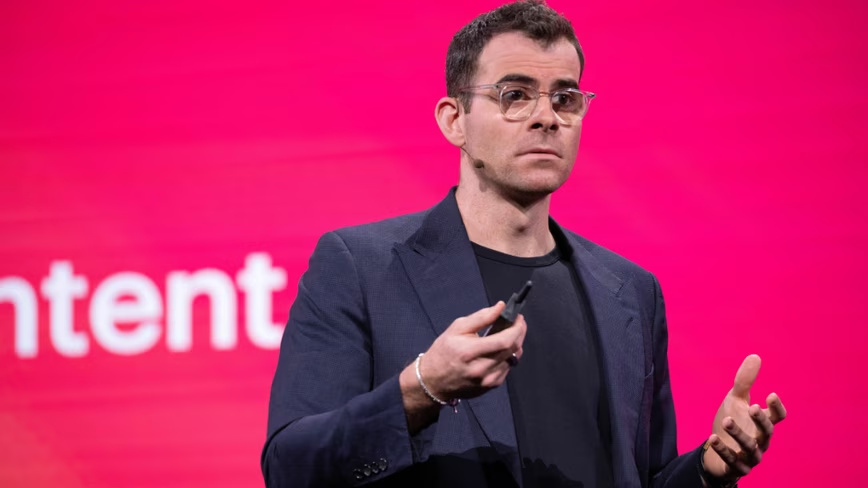
Head of Instagram Adam Mosseri

Adam Mosseri, who has run Instagram since 2018, told a federal jury in Oakland that the app’s “Take a Break” feature “helped, but not nearly as much as we hoped”, as internal documents showed only 1.8% of teenagers used it.
Meta’s public blog post at the time said more than 90% of users who turned it on kept it enabled, a framing that has now been put to the head of Instagram in a trial where the numbers being argued over run to the trillions.
The two figures are not contradictory, which is precisely the problem. One describes retention among the small group who enabled the feature, the other describes how many teenagers ever did, and only one of them made it into the blog post.
Mosseri confirmed under questioning that Meta never disclosed the low adoption rate to parents or the public. That admission is the sort of thing plaintiffs build closing arguments around.
The case is brought by the attorneys general of California, Colorado, Kentucky, and New Jersey, four of the 29 states pursuing Meta over youth harm, and they are seeking roughly $200bn. Jury selection began on 12 August, and the trial is expected to run around five more weeks.
Colorado’s lawyer Jason Slothouber pressed on the timing rather than the design. Meta withheld the effectiveness data even after being sued in 2023, and only made “Take a Break” the default for teen accounts in late 2024, well after the litigation had started.
That sequence is the states’ theory of the case in miniature. Their argument is not that Meta failed to build safety features but that it built them, discovered they did not work, kept the finding quiet, and shipped the effective version only under legal pressure.
One exchange concerned how much data Mosseri himself was shown, and whether lawyers had limited it.
“A lawyer would be a less qualified designer than a product designer,” he acknowledged, which is a considerable amount of ground to give in a case about what the company knew.
What makes the exchange damaging is not that a feature failed. Products fail routinely, and a company that ships a wellbeing tool and finds almost nobody uses it has learned something useful, provided it says so.
Mosseri is a more consequential witness than most. He has been the public face of Instagram’s teen safety work for years, including congressional testimony, and the states have used earlier witnesses to argue the problem was cultural rather than technical.
Instagram has shipped a good deal since then, including teen accounts with default restrictions and parental supervision tools. The states’ answer is that the timing of those releases tracks the litigation calendar more closely than it tracks the research.
Meta’s defence has been consistent throughout. The company argues that social media addiction is not a recognised clinical condition, that it has invested substantially in teen safety, and that the plaintiffs’ damages arithmetic bears no relation to any harm they can demonstrate.
Mosseri appeared to hold that line on the clinical question, distinguishing problematic use from addiction as the term is used in medicine. Whether a jury finds that distinction meaningful is a different matter from whether psychiatrists do.
The jury is also being asked to weigh a question courts are not well designed to settle, namely whether a design choice causes harm at population scale. Expert evidence on that point has been contested throughout, and both sides have their researchers.
The trial is one of several fronts. Meta is separately facing a Tennessee jury on Instagram’s addictive design, and a federal appeals court declined to halt the Oakland proceedings days before jury selection began.
Mosseri’s testimony will continue on Wednesday. The 1.8% figure is now in the record, and it is the kind of number that tends to outlive the proceeding it came from.
Get the TNW newsletter
Get the most important tech news in your inbox each week.
Also tagged with


