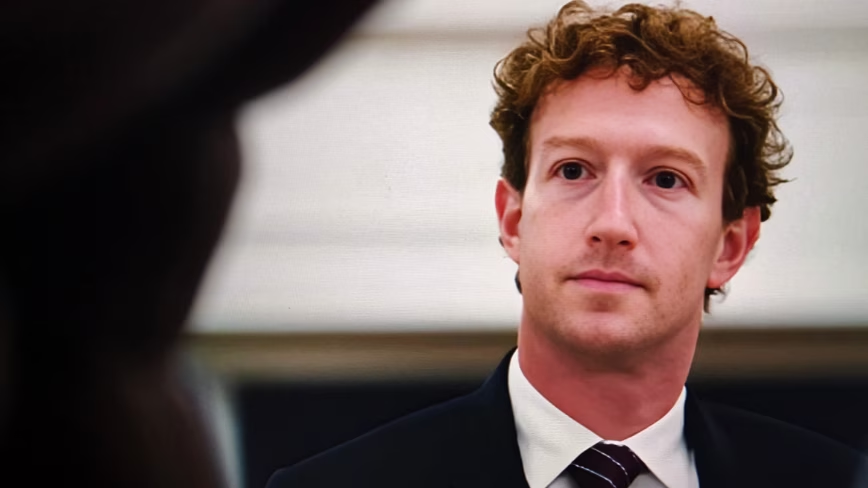
Meta CEO Mark Zuckerberg at a dinner with tech leaders in the State Dining Room of the White House in Washington, Sept. 4, 2025.
 Credit: FotoField via Shutterstock.com
Opening statements in the states’ case against Meta begin today in Oakland. The court seated a jury last week. The trial should run about five weeks.
Twenty-nine state attorneys general brought the case in 2023. Lawyers for California, Colorado, Kentucky, and New Jersey will argue it. They allege that Meta designed Facebook and Instagram to drive compulsive use by children, then misled the public about the risks.
Almost every outlet covering the Meta social media trial is reporting two things about it. Both need correcting.
The $1.4 trillion figure belongs to Meta
Nearly everyone leads on $1.4tn. That number did not come from the states. Meta’s own lawyers produced it, calculating the theoretical maximum if every alleged violation drew the full statutory penalty of $20,000.
We flagged this in July, when Meta said four states wanted $1.4tn. Since then the states have put their own figure on the record.
Megan O’Neill, a California Deputy Attorney General, told the court last week that the number sat closer to $193bn, Bloomberg reported. She suggested Meta cited the highest theoretical amount for shock value.
CNBC put the states’ figure to the judge slightly higher, at $200bn. Either way, the spread runs from roughly $193bn on the plaintiffs’ side to $1.4tn on the defendant’s.
Even the lower number would rank among the largest litigation payouts on record. Bloomberg sets it against the $206bn tobacco settlement of 1998.
The jury does not decide
The second correction concerns who rules.
The Oakland jury serves in an advisory capacity only. US District Judge Yvonne Gonzalez Rogers will decide whether Meta bears liability, and what penalties and remedies follow.
Gonzalez Rogers has spent nearly two decades on the federal bench, and she presided over the Musk and Altman trial. The BBC describes her as incisive and direct.
That changes how to read the next five weeks. Mark Zuckerberg and Instagram head Adam Mosseri are both expected to testify. They will be addressing a judge, not twelve jurors.
What the states want changed
Lawyers on both sides say the money is not the part Meta should fear most.
The states seek permanent injunctive relief on a nationwide basis rather than state by state. If the court finds Meta breached the Children’s Online Privacy Protection Act, they want the company to delete all personal data collected from under-13s, plus the algorithms and models trained on it.
On the consumer protection claims they name specific features: infinite scroll, autoplay, ephemeral content, beauty filters, and engagement-optimised recommendation algorithms. The BBC adds like counts, a ban on multiple accounts, and parental verification for teenagers.
Laura Marquez-Garrett of the Social Media Victims Law Center made the point plainly in a CNBC briefing. State attorneys general can force design changes through the courts in a way private plaintiffs cannot.
Minda Smiley, an analyst at Emarketer, called a trillion-dollar penalty symbolic at this point. She said the lawsuits could materially change how the platforms fundamentally operate.
Meta’s answer
Meta denies the allegations, and has done so consistently.
“The AGs offer no proof anyone in their states was misled, claim benign features like having an additional Instagram account somehow harmed their residents, and attempt to penalize Meta for industry-wide challenges like age verification,” the company said.
Meta called the claims unsubstantiated and the financial demands vastly disproportionate. It described the case as a chase for an outlandish payout. A spokeswoman told the BBC the evidence would show a longstanding commitment to supporting young people.
The company also tried to stop the trial. It asked the Ninth Circuit last week to postpone proceedings until that court resolves whether Section 230 forecloses the states’ claims. The request failed.
New Mexico is the template
Meta lost in New Mexico this month. A judge there ordered roughly $942mn in total, and $567mn went to an abatement fund. Meta is appealing.
That judge also labelled Meta a public nuisance, comparing the company to a factory polluting the air. The BBC reports that no court had applied the term to a social media company before.
New Mexico attorney general Raúl Torrez told CNBC the consequences in California could prove “astronomical”. He made the arithmetic explicit. New Mexico holds about two million people, and California, Texas, Florida, and New York do not.
Torrez also conceded what New Mexico failed to win. The judge declined to end infinite scroll or alter recommendation algorithms, citing Section 230 and the First Amendment, and noting that rivals would keep those features.
What the AGs are saying about themselves
The four litigating states published statements the day before opening arguments. Kentucky attorney general Russell Coleman made the largest claim in California’s release, calling it the largest consumer protection lawsuit in American history.
Coleman also drew the comparison the coalition keeps returning to. The AGs did it with tobacco in the 1990s, he said, and with the opioid manufacturers, and they will do it again with Meta.
New Jersey has co-led the investigation since 2021, according to its own statement. That is two years of work before anyone filed.
What would settle it
This case does not stand alone. We covered the Tennessee trial in July. Snap, YouTube, and TikTok settled the school district suits rather than face juries. Roughly 3,000 personal injury claims and 1,300 school district cases remain pending across the industry.
Our preview of this trial ran last week. Three things have changed since: the states named a number, the Ninth Circuit refused to delay, and the jury turned out to be advisory.
Watch two questions over the next five weeks. Whether Gonzalez Rogers treats design as conduct or as speech, which is what Section 230 turns on. And whether any remedy she orders runs nationwide, because that is the difference between a fine Meta absorbs and a product it rebuilds.
Get the TNW newsletter
Get the most important tech news in your inbox each week.


