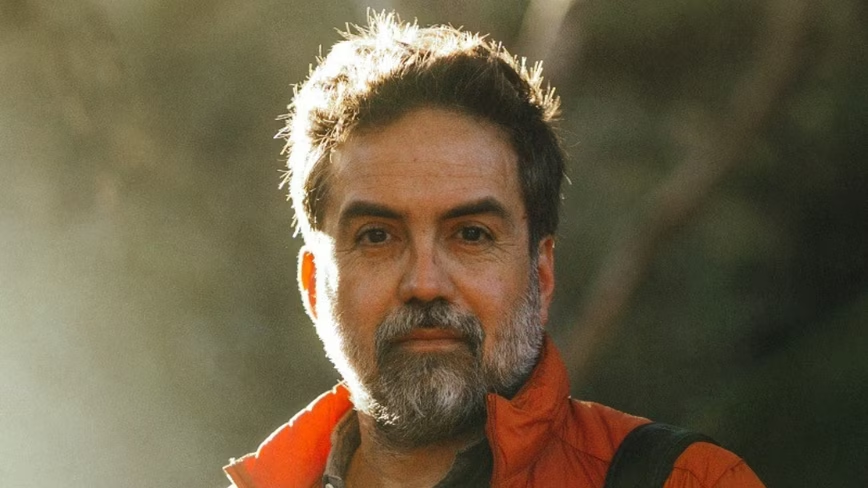
Former Meta engineer Arturo Béjar

Arturo Béjar took the stand in Oakland on Wednesday and told a federal jury that the reason Meta could never fix its own safety problems was the culture Mark Zuckerberg had built. He is the first witness in a trial that four state attorneys general have spent years assembling.
The case opened on Tuesday before Judge Yvonne Gonzalez Rogers at the US District Court for the Northern District of California, with California, Colorado, Kentucky, and New Jersey arguing that Facebook and Instagram were engineered to hook minors and keep them scrolling.
In their opening statements, the states reduced the company’s model to three verbs: hook the users, hold them as long as possible, and harvest their data.
Béjar spent roughly eight years inside Meta working on exactly the problems now in dispute, first from 2009 to 2015 and again from 2019 to 2021. That second stint ended with an internal warning about teenage harm that he later took to the US Senate, and it is the spine of the states’ case.
“At the end of the day, it was the company culture that Mark had created that made it so that it was practically impossible to deliver features that addressed the wellbeing and safety issues,” he told the court, in testimony reported from Oakland.
He was asked about a 2021 Facebook post in which Zuckerberg denied that the company put profit ahead of safety, and said flatly that it did not match what he had seen.
Much of the day turned on design rather than intent. The states have built their argument around infinite scrolling, autoplaying video, beauty filters, and the “like” button, and Béjar’s contribution was to argue that the countermeasures Meta did ship were left as optional settings rather than defaults, which in practice meant almost nobody used them.
Meta’s lawyers spent the afternoon trying to turn that into an admission. Brian Stekloff pressed Béjar on whether he or his teams had actually solved any of the harms he described, a line of questioning aimed less at his credibility than at the idea that the problems have solutions Meta declined to build.
In opening statements, the company’s counsel, Paul Schmidt, said Meta had been alert to the risks facing teenagers, had worked on them, and had not misled the public about what it knew. Meta’s broader position is that the states have assembled a case out of selectively quoted internal documents.
The money at stake remains contested and unusually large. Meta has told the court the states are pursuing penalties that could reach $1.4 trillion, a figure the states have not adopted, while California Attorney General Rob Bonta has framed exposure against the roughly $200bn the company takes in annual revenue.
Oakland is not the only front. A New Mexico court ordered Meta to pay $567m into a teen mental health fund earlier this year, and a separate jury in Tennessee is weighing Instagram’s design in a seven-week trial of its own.
What makes the Oakland case different is that it is being tried by states rather than individuals, under consumer protection and children’s privacy statutes, which lowers the bar for proving harm to any single user. That is also why Béjar matters more here than he did in Congress, where he could describe a culture but not be cross-examined on it.
Meta had tried to keep him off the stand altogether.
Judge Gonzalez Rogers ruled that he could testify, a decision reported at the time alongside an estimate that the states’ claims might reach $200bn, which is a third figure in a case that has already produced several.
Whether any of it survives contact with a jury is a different question. The states have to show not only that the products harmed young users but that Meta knew and said otherwise, and Béjar’s account of safety settings left switched off by default is being offered as the bridge between the two.
The trial is scheduled to run for about six weeks. The states have not said whether they will call Zuckerberg, and their lawyers were still declining to answer the question when the court rose on Wednesday.
Get the TNW newsletter
Get the most important tech news in your inbox each week.


