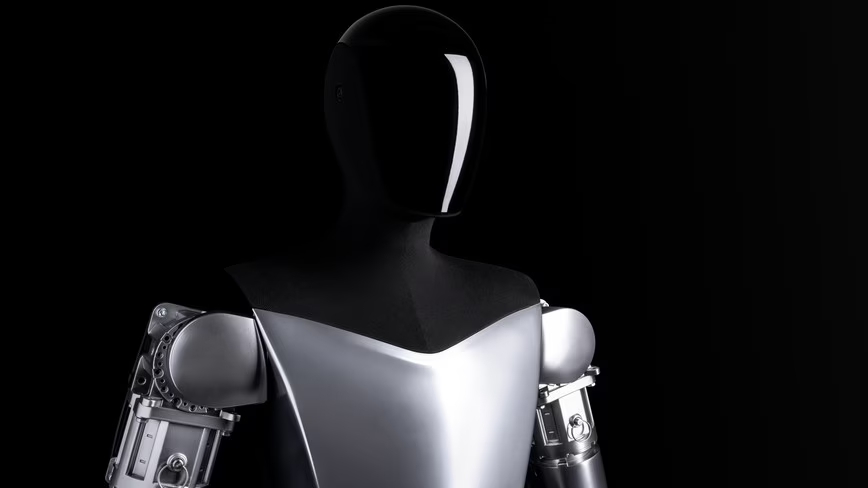
Tesla’s Optimus humanoid robot

Tesla has increased Optimus production about tenfold in recent months. It is still struggling to build the humanoid robots reliably at scale. Qianer Liu and Grace Kay reported for The Information on Friday, citing people familiar with the project, that the hands, factory equipment and suppliers are holding it back.
Tesla made several hundred robots a week last month, up from a few dozen a week in the second quarter, according to the report. It aims to make more than 1,000 a week by the end of 2026. TNW has not independently verified the figures.
Small parts, new lines
Tesla stopped making the Model S and Model X at its Fremont factory in May and moved workers and engineers to Optimus. The robot it now builds, Optimus V3, is lighter and has more cameras than earlier versions.
Equipment at several stations, including those that assemble the hands and joints, does not always line up parts precisely. More robots then need fixing after they come off the line.
“Not only are the Optimus production lines new, but the Optimus parts are much smaller and have to fit together far more precisely than car parts,” The Information wrote.
Each hand and forearm has more than 100 screws and other small parts that workers assemble by hand. Some touch sensors have also been unreliable, so Tesla has developed a replaceable “sensing glove” that holds them. It plans to add the glove to next year’s model.
Training the robots, and the workers
The software is not ready for general use either. Optimus still needs programming and training for each job, and basic tasks take several days to learn, according to the report. For now, Tesla uses most units internally for testing, training and data collection, in tightly supervised areas.
To gather training data, Tesla had factory workers in Texas and California wear suits that record their movements. Some complained because they “knew the robots were designed to eventually replace them”, The Information reported. Tesla then moved the work to dedicated teams and set up training hubs.
Tesla still relies on Chinese suppliers for robot parts, according to the report. It plans to lease the first robots to commercial customers rather than sell them.
A bigger bet on robots
Elon Musk said on Tesla’s investor call in July that Optimus could be “the biggest product ever”. Optimus is part of Tesla’s $25 billion capex plan for 2026. This week the company also began volume production of the Tesla Semi.
In China, Beijing is reportedly slowing humanoid robot IPOs. China also installs 59% of new factory robots worldwide, according to the International Federation of Robotics.
Get the TNW newsletter
Get the most important tech news in your inbox each week.
Also tagged with


