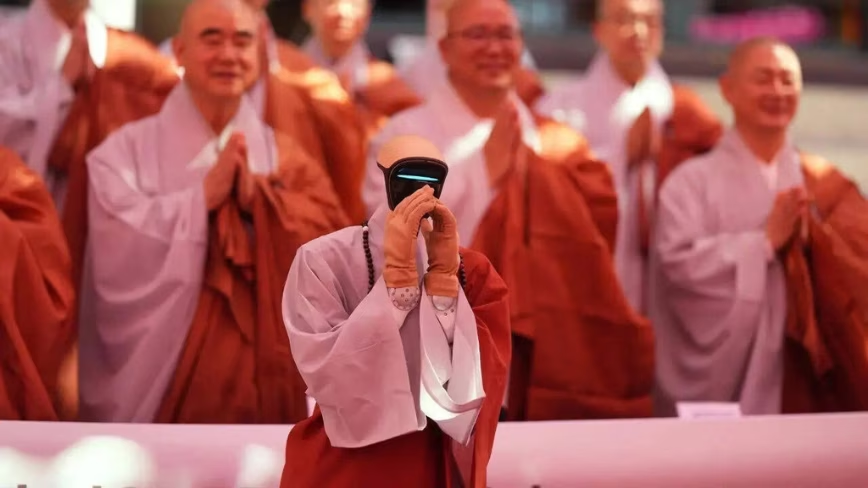
A $13,500 Unitree robot was ‘ordained’ at Seoul’s Jogyesa Temple
At about ten in the morning on Wednesday, in the courtyard of Daeungjeon Hall at Jogyesa, a 130-centimetre humanoid in brown robes pressed its palms together and bowed. A monk asked the figure whether it would devote itself to the holy Buddha.
The reply, in a recorded voice supplied by a temple manager, was “Yes, I will devote myself.”
The crowd cheered. The robot, a Unitree G1 that retails from around $13,500, received the dharma name Gabi, derived from Siddhartha Gautama and the Korean word jabi, meaning mercy.
By the afternoon it was gone. The robot had been loaned for the day by Unitree Robotics, and visitors who travelled to the temple hoping to meet the new monk found that the new monk was on a truck back to Hangzhou.
Its responses had been pre-recorded by Hong Min-suk, a manager at the Jogye Order. It had been remote-controlled throughout the ceremony.
It is, in the strictest sense, not really a monk and not really an AI. It is a high-end mechanical puppet whose strings happen to be wireless.
All of which has been reported, with varying degrees of arched eyebrow, by the world’s press. The standard line, on both the secular and the religious side, is that this was a publicity stunt by a faith that has been bleeding members for two decades. That much is true.
South Korean Buddhism’s share of the population fell from 22.8% in the 2005 census to 15.5% by 2015; Korea Research’s 2025 survey has it at 16%, with 43% of those Buddhists over the age of sixty and only 18% under thirty.
The Jogye Order’s annual monastic intake collapsed from 510 postulants in 1993 to 151 in 2017. A robot in robes is, among other things, a press release with legs.
If the goal was to put Korean Buddhism in front of an audience that would otherwise scroll past it, mission accomplished: the Reuters video of Gabi’s pledge passed a million views the same day.
But the easy reading misses something. Strip away the theatrics, ignore the truck, ignore the puppetry, and what was actually performed in that courtyard was an exercise that neither Silicon Valley nor Brussels has yet managed with any seriousness.
The Jogye Order rewrote the Buddhist Five Precepts for machines.
The traditional precepts ask the devotee to abstain from killing, stealing, sexual misconduct, harmful speech, and intoxicating substances.
The robot version asks the machine to protect life, refrain from damaging property or other robots, respect and obey humans, abstain from deceptive behaviour, and conserve energy by not overcharging.
Read them in sequence and they sound like a child’s book. Read them again, slowly, against the actual debates of the past three years, and they describe with embarrassing economy almost every category of AI harm currently litigated in the technology press: physical safety, property damage and tort liability, alignment, deception and disinformation, and the unsustainable energy draw of large-scale machine intelligence.
The list is not comprehensive, it is also not stupid.
The Venerable Seong Won, who runs the order’s cultural affairs department, told reporters that the precepts were drafted as “the minimum rules robots should follow in society and for humanity,” and that he hoped they might serve as basic principles for human and machine coexistence.
The Venerable Jungnyum, another senior figure, described the present as a “turning point where artificial intelligence is coming like a tsunami”.
It is the sort of language that, in a Silicon Valley founder’s blog post, would be filed under hype.
In a Buddhist monastery in central Seoul, said by a man in his sixties wearing grey robes, it reads differently. The metaphor is older than the technology.
Compare this with what the West has produced. The most ambitious religious engagement with AI from the Vatican, the document Antiqua et Nova published under Pope Francis in January 2025, runs to 118 paragraphs and 30 pages.
It is a serious work of theology. Its conclusion, distilled, is that AI is a tool, that it cannot replicate the human soul, and that its use must be guided by the dignity of the person.
These are true things. They are also, as a piece of practical guidance for the engineers actually building the systems, almost completely inactionable.
“Respect human dignity” is a value.
“Do not overcharge” is a rule.
The Jogye Order’s five precepts for robots are not a substitute for the European AI Act or the Vatican’s anthropology.
They are something more modest and, in their own way, more useful: a vernacular ethics, written in language that an engineer in Hangzhou and a pilgrim in Seoul can both parse.
They do not pretend to settle the question of machine consciousness. They do not pretend the robot has agency. They give the robot a small set of behavioural commitments that anyone, of any creed, would prefer the machine in their kitchen to honour.
That is the part of the story that the spectacle has obscured. The robot was on loan; the ethics framework is not. Western coverage has fixated on the puppet because the puppet is the easy joke, the easy outrage, the easy thinkpiece.
The harder thing to grapple with is the suggestion, implicit in the ceremony, that the people who have spent fifteen hundred years thinking about how to live well alongside non-human minds, ghosts, deities, ancestors, mountains, foxes, may have something to contribute to a debate that Western technology culture has, until very recently, treated as either a marketing opportunity or an existential threat.
It is worth noticing the binary the West has constructed around this technology. On one side, the panic: AI will take your job, hollow out democracy, deceive your grandmother, and, given sufficient compute, end the species.
On the other side, the worship: AGI is coming, it will solve cancer and fusion and loneliness, and those who get there first will be remembered as the founders of a new geological epoch.
Both modes share a quality of overstatement. Both treat the machine as something other than a thing. The panic deifies it as a destroyer. The worship deifies it as a saviour. Neither has very much to say about the prosaic question of how to live with one in the room.
South Korea, and East Asian Buddhism more generally, has a longer practice in this register. The local tradition does not require a sharp metaphysical line between sentient and non-sentient.
Trees can have buddha-nature. Mountains can be addressed. Foxes appear in stories with names. Treating a Unitree G1 as a participant in a ritual is, in this idiom, less of a category error than it would be in the Christian tradition, where the line between ensouled human and unensouled matter runs through every theological argument since Aquinas.
Hong Min-suk told the New York Times that robots are “destined to collaborate with humans in every field in the future,” and that it was therefore only natural for them to participate in religious festivals.
The sentence is offered without anguish. It would be unimaginable from a Vatican spokesperson.
None of which makes the ceremony less of a stunt. It was a stunt. The robot was rented. The voice was pre-recorded. The temple is courting younger Koreans whose grandparents kept the order solvent and whose grandchildren will not.
Gabi was returned to its owner before the prayer beads had cooled. To pretend otherwise would be naive.
But stunts can have content, and this one did. South Korea sits inside a regional robotics boom that has been the dominant theme of the technology beat for two years now.
Chinese makers shipped roughly 90% of the world’s humanoid robots last year, and Unitree itself is approaching a Shanghai IPO at a valuation in the billions.
The same week as Gabi’s ceremony, humanoid robots performed kung-fu routines at televised galas and out-ran the human half-marathon world record in Beijing, with remote-controlled units carrying a 20% time penalty for not running autonomously.
The robots are real. The capability is improving quickly. The question of what rules govern their behaviour, what we ask of them, what we permit them, has been left almost entirely to the firms that build them and the regulators chasing those firms with lawyer-shaped nets.
A small group of Korean monks decided, last week, to write their own. Five lines. Drafted in a register old enough to predate the printing press, applied to a machine new enough to predate the IPO that will list its manufacturer.
Whether any engineer at Unitree or Figure AI or Tesla Optimus will ever read them is a separate question.
What matters is that they exist, and that they were placed, for one morning, on the shoulders of a $13,500 puppet in a courtyard in Seoul.
It was a small gesture. It was also, in a year of grand gestures by people with much more money and much less to lose, one of the more interesting things to happen in the field.
Amen!
Get the TNW newsletter
Get the most important tech news in your inbox each week.


