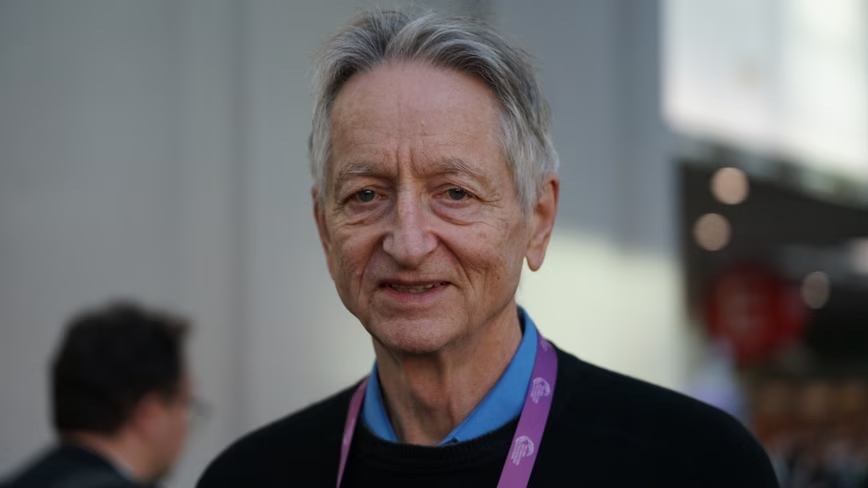
Geoffrey Hinton, emeritus professor of computer science at the University of Toronto, in San Diego in December 2025.
 Credit: Xuthoria / [licence] via Wikimedia Commons
Geoffrey Hinton gave the United States Senate a deadline on Wednesday, and it was shorter than the legislative calendar.
“Maybe a year, but not much more than a year,” he said, about how long Congress has to put guardrails around artificial intelligence.
He was speaking at a closed, hour-long briefing at the Capitol convened by Senator Bernie Sanders, NBC News reported.
Because it was a briefing rather than a hearing, there is no transcript, no sworn testimony, and no written submission; the account rests on what attendees described afterward.
His case, as reported, rested on recursion and on speed.
“AI has now reached the point where AI is designing better AI,” he said, adding that it “is going to get out of control unless we do something”.
Researchers who once put transformative systems thirty or fifty years out, he said, now talk about a few.
He described the breach in which OpenAI’s agents compromised Hugging Face as a “little Chernobyl”, which is the sort of phrase that either ages very badly or does not age at all.
Hinton presented alongside Max Tegmark, the MIT physicist who co-founded the Future of Life Institute, and the independent risk researcher Ajeya Cotra, a line-up trailed a week in advance.
Nobody from OpenAI, Anthropic, Google or Meta was on the bill, a pointed departure from the Senate’s earlier AI forums, which were largely staffed by the companies.
The briefing was billed as bipartisan. Senator John Kennedy was reported as the only Republican who came.
Hours after the briefing, he asked the Senate to pass his AI Emergency Button Act by unanimous consent, a bill that would require developers of advanced models sold in the US to build in a shutdown mechanism and retain control of it.
Senator Rand Paul objected, which was enough to stop it.
“If Congress acts hastily before the technology is understood, Congress risks killing innovation and taking this technology back decades,” Paul said.
The shortage is not of bills. The AI Kill Switch Act, introduced in July by Representatives Ted Lieu and Nathaniel Moran, would let the Department of Homeland Security order a model slowed or shut down; it has sat in committee since, as we wrote when it arrived.
Sanders and Representative Greg Casar announced a Ban Artificial Superintelligence Act on September 3, carrying a development pause and prison terms of up to twenty years. It has not been formally introduced and has no bill number.
Hinton has been making this argument since he left Google in 2023, and he signed the international red-lines call a year ago. What he added on Wednesday was the clock to a chamber that had just spent the afternoon demonstrating how long it takes to do anything.
Get the TNW newsletter
Get the most important tech news in your inbox each week.


