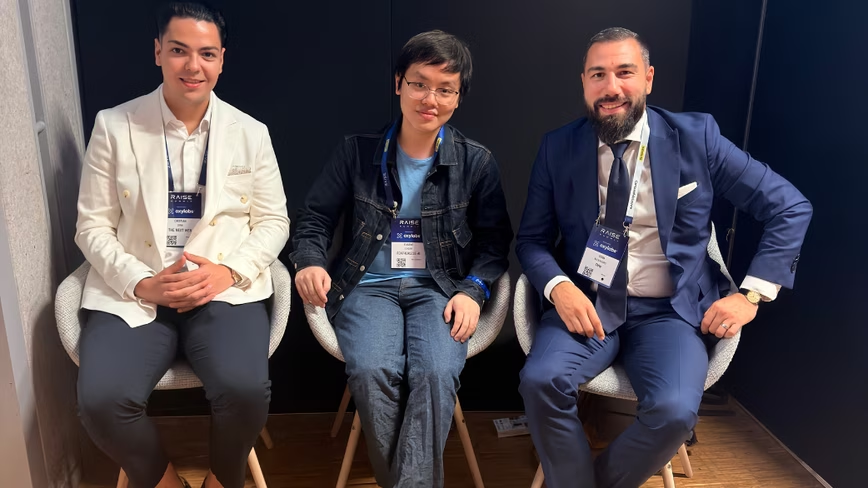
Interview with Eugene Cheah – The CEO of Featherless AI
 Credit: TNW
Most founders in artificial intelligence are racing to build something bigger. Eugene Cheah is trying to build something smaller.
As CEO and co-founder of Featherless AI, now the largest open-source model inference platform on Hugging Face, hosting more than 40,000 models, he has spent the past two years making the sprawling universe of open models accessible through a single API.
In April 2026, the company raised a $20 million Series A co-led by AMD Ventures and Airbus Ventures, backing a thesis that runs against the prevailing wisdom of the frontier labs: that the future of AI belongs not to the biggest model, but to the most reliable, most portable, and most widely owned one.
Cheah, who is based in San Francisco and helped pioneer the efficient, transformer-alternative RWKV architecture, has strong and unusual views on almost everything: what AGI actually is, where the real value in the industry sits, and how large a company needs to be to matter.
We sat down to talk about all of it, starting with the biggest question in the field.
Alexandru Stan: Do you think someone will actually solve AGI?
Eugene Cheah: I think it’s fundamentally an architectural search problem; Yann LeCun has said something similar. It’s solvable, but we don’t yet have the resources to search the space properly. Honestly, I believe we may already have enough GPUs to run AGI. The bottleneck isn’t infrastructure.
Alexandru Stan: So if it’s not infrastructure, is it research?
Eugene Cheah: Yes, it’s on the research side. We work on next-generation architectures, linear transformers, for example. LeCun has his own theory and his own architecture too. There are alternatives to the transformer architecture that everything runs on today.
The problem with transformers is that as you use longer context, the cost scales quadratically. That doesn’t make sense, because humans don’t scale that way. If my brain scaled quadratically, by the time I was ten years old it would have exploded. That’s not how people work.
So there are genuinely different ways to build AI models. It’s not that we’ve explored everything; we just found one approach that started to really work, and stopped there.
It’s like inventing the steam engine and deciding, “Right, no more research into engines.” And then trying to scale the steam engine to do everything, when it was only ever meant to move trains.
Alexandru Stan: How do you define AGI? In San Francisco, everyone talks about superintelligence.
Eugene Cheah: That’s exactly why I like to ask what people actually mean by it. In San Francisco, you hear a lot about superintelligence, “an Einstein in the box.”
But when I talk to enterprises, they tell me they don’t want a smarter model. They want today’s best model to be more reliable.
Today’s models are already smarter than most of us in some ways. But ask one to place a delivery order, order ten pizzas, or a hundred, and there’s maybe a 60% chance it gets it right. That’s the frustrating part.
What companies actually want is a model that’s more reliable at today’s level of intelligence. Some of them already call that AGI, because it’s good enough to use in their business.
What I call AGI is something different; I call it personal general intelligence. Say you put an AI model in a robot body; we’re not a robotics company, but imagine it, and you put it in a kitchen where it knows nothing about cooking.
My mom could say, “Do this. No, that’s wrong. Do it this way next time.” After ten mistakes, it knows how to cook. That, to me, is personal general intelligence.
Alexandru Stan: Can you explain, very simply, for a non-technical person, what your company does?
Eugene Cheah: At Featherless AI, we provide instant access to the best open collection of AI models. We host over 40,000 models. There are around three million models available on Hugging Face today, and a lot of them are experimental, version ones, works in progress, but being able to try anything and experiment freely is genuinely valuable.
Alexandru Stan: You just launched an update, the GLM update mentioned in your email?
Eugene Cheah: Yes, GLM 5.2, which we now serve on our platform, including a private cloud deployment that runs it natively on AMD hardware.
As a dedicated node, it starts at around $7,500 a month at a flat rate, with similar closed models costing $ 50k or more at such scale – a great entry point for anyone concerned about sovereignty, privacy, and security.
It runs at close to frontier quality, so a team can effectively replace their entire AI agent workflow with one setup, and everything stays inside their own trust boundary.
Alexandru Stan: So you’re in a parallel industry to OpenAI, the open-source side?
Eugene Cheah: Right, it’s a parallel track. Open-source AI.
Alexandru Stan: Do you think, in time, the open-source industry will be bigger than the closed one?
Eugene Cheah: time, yes. This year, no. Look at the software industry; this exact pattern has already played out. Operating systems, then databases. It used to be Oracle and Microsoft everywhere; every company I worked with, when I was younger, only used those two.
Now they’re all on Postgres and MySQL. It took decades, and the gap between the commercial product and the open-source competitor was often six years or more. In AI today, the gap is much smaller.
But the lesson I took from that is this: as long as there’s a financial incentive to build open source, and there absolutely is one for the most important technology we’ve ever created, it will happen. It’s only a question of how long. And we’re moving much faster than before.
Alexandru Stan: What’s your plan for the company?
Eugene Cheah: To become the go-to platform for open-source model inference. Today we’re focused on making AI accessible. I talk a lot about languages and cost, and that’s personal for me; I’m from Southeast Asia.
My grandmother speaks seven languages, but not English or Chinese. For her to use AI, she needs a model fine-tuned for her own language. Europe has the same issue with so many languages across so many states. It’s still an unsolved problem.
So we host models for these underserved languages well over a thousand NLP models across hundreds of languages, including early models for regions and languages that no one else was bothering to make accessible.
Alexandru Stan: Do you build your own models, or combine existing ones?
Eugene Cheah: We provide the hosting. When a researcher trains a model, someone has to host it on the infrastructure so people can actually use it; that’s what we do today.
In the future, as we scale, we want to help provide neutral, fully audited open-source models that people can build on. Right now there’s a lot of anxiety about whether a model comes from the US or China or somewhere else, and how much you can trust it.
The solution is training on transparent, auditable datasets. One of the projects we’re working on is a first AI model built for a specific nation.
Alexandru Stan: You raised capital recently. Are you fundraising again? Our audience is full of investors.
Eugene Cheah: Not in the plans. We closed our round just a few months ago, a $20 million Series A co-led by AMD Ventures and Airbus Ventures, and announced it then. Right now we’re focused on scaling. Our goal by the end of the year is to reach the next revenue milestone, and then keep going.
Alexandru Stan: And the final goal, public company, private, or acquired?
Eugene Cheah: Primarily, I’m trying to build this company to make sure AI stays accessible. Whether that means going public or being acquired by a company that respects the mission, we’ll see. What matters more is that the mission is secure: making AI accessible.
Alexandru Stan: How big is the team now?
Eugene Cheah: Thirty people.
Alexandru Stan: Do you think we’ll see decacorns with fewer than 50 people because of this technology?
Eugene Cheah: Definitely. I’ve scaled companies past a hundred people before, and I don’t want to do that again. So it’s doable, maybe not with today’s AI, but with the AI of the future. When AI becomes more manageable, more controllable, and more reliable, that’s when it happens.
And my argument is that you don’t need a bigger model to make AI more reliable; you need one that’s more consistent.
Alexandru Stan: What’s your advice for industries that aren’t especially engaged with AI but will feel the impact?
Eugene Cheah: Some big companies make plenty of money and assume the world isn’t changing that much, because they have cash and a sense of power. But they’ll feel the pinch if they’ve been asleep. Nestlé, for example, has already started using AI in R&D; I know a startup working specifically on improving research and shortening product development cycles.
Beyond that, these companies should be thinking about how they adapt and upskill faster with AI in the loop. I’m not a blind believer in AI over everything. I still think it’s better to keep humans and AI walking alongside each other, because we complement each other.
What’s becoming clear is that you can run companies with far fewer people doing far more. So companies need to prepare and ask what they can actually achieve.
If you already have great team members with deep industry knowledge, the question is: how do you supercharge them to move faster than they could before? That’s the future.
Alexandru Stan: What is one problem that scares you on the path to scaling?
Eugene Cheah: This is less on the business side. To clarify, the company has two parts: an infrastructure business, and a research effort focused on newer models that are more scalable and more reliable.
What matters to me is reliability. If we get that right, it becomes far more valuable, because today, when we want to train a model to stop making a mistake, we need experts like me to write the answers and examples. But the day an everyday person can say,
“Next time, don’t do that, do this instead,” and the model actually learns from it, that’s the fundamental shift. You don’t want to need an AI expert to make AI usable.
And I strongly believe that’s achievable without a large model; we’re talking about 200-million-parameter models, small enough to run on the laptops of the future. When that happens, everyone can use AI, not just experts. And that changes everything.
Alexandru Stan: You travel a lot. Asia, Europe, the US. Do you think one country or region will be the clear winner in the AI race?
Eugene Cheah: The winner is whoever trades on this technology, not necessarily whoever builds it. I don’t think it’ll be as decisive as people assume, because the global economy is still deeply tied to physical goods and logistics, which won’t disappear because of AI. Those industries still run the fundamentals of nations.
For Singapore, and Asia generally, the urgency around AI may feel lower, but the opportunity is huge. Asia is trailing the US in adoption, so the real question is whether these regions capitalize on it themselves, or whether US players come in to capitalize for them. There’s a lot of opportunity across industries.
Alexandru Stan: How do you track your competitors’ activity?
Eugene Cheah: I don’t think about it too much, honestly. I keep an eye on it, but we’re at the early stages of AI adoption. If you follow the news, there’s a compute shortage. So it’s really been a question of how we meet customers where they are, because demand is enormous.
The AI inference market could be a three-trillion-dollar game. I’m not here to be the next trillionaire taking everything; I’m more than happy to take one slice in the area I specialize in.
And that speaks to our mission. I don’t want another billionaire or trillionaire deciding which AI model you’re allowed to use. That’s why we focus on open source.
If you run an open model on our platform, and tomorrow I decide I don’t like you, or my government tells me to cut off your access, you can just download the model and take it somewhere else. Nothing stops you. That, to me, is what matters. We don’t want a handful of people deciding how you get to use this.
Alexandru Stan: If you could ask Yann LeCun one question, what would it be?
Eugene Cheah: How small can we go, for human-level general intelligence? We have very different ideas about the architecture, but we both agree that something fundamentally different could change the game.
And what if I’m wrong? Maybe it’s not 200 million parameters. Maybe it can even run on far less. No apps, no subscriptions, nothing. He might have a different opinion, but that’s the question. How small can we go?
If there is a single thread running through Cheah’s answers, it is a refusal to equate progress with size.
Where much of the industry is chasing ever-larger models and ever-bigger valuations, he is betting on the opposite corner: models small enough to run on a laptop, companies lean enough to reach a billion-dollar scale with a few dozen people, and an ecosystem open enough that no single company, his own included, can lock a user in.
He left us with the same question he would put to Yann LeCun, and it doubles as the thesis for everything he is building: not how big can intelligence get, but how small can it go. That’s the question of the moment, and, quite possibly, the one that decides who owns the next wave of AI.
Get the TNW newsletter
Get the most important tech news in your inbox each week.


