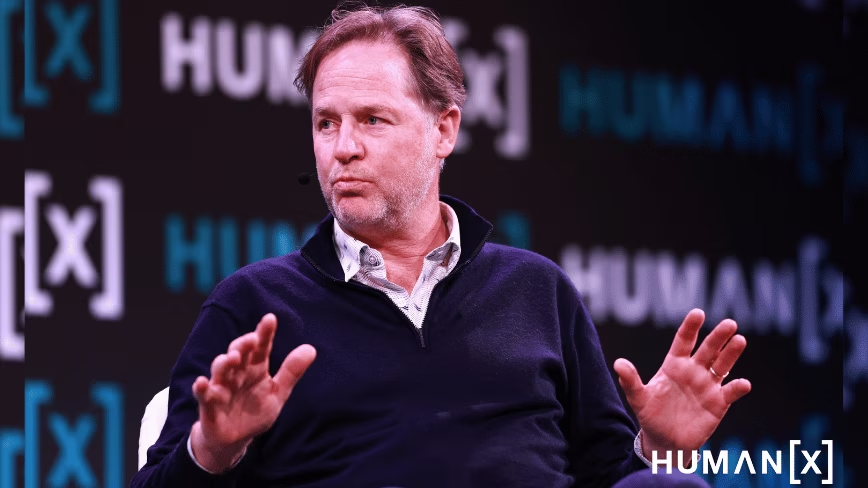
Hiro Capital general partner Nick Clegg at HumanX in Amsterdam, 24 September 2026.
 Credit: Sam Pinto / HumanX
AI labs cannot keep regulating themselves, Nick Clegg said. A growing backlash against AI shows up in cancelled data center projects, he said. The idea that labs can voluntarily do their own thing is “not going to work,” he said.
Clegg is Meta’s former president of global affairs and now a general partner at Hiro Capital. He spoke on Thursday at HumanX in Amsterdam with CNN AI correspondent Hadas Gold. Gold asked about reports that Mark Zuckerberg had pushed back on a proposed independent standards body, similar to FINRA in US finance. Clegg said he left Meta at the beginning of last year and does not speak for it. He had not followed those comments.
“This idea that you can carry on marking your own homework for the next 10, 20 years, that ain’t going to happen,” Clegg said.
He described an “almost pitchfork rebellion” against AI, most visible in the many data center projects cancelled in the US. He said it will get worse unless there are baseline standards of transparency, testing and accountability that apply to everybody. That does not necessarily mean pre-release testing, he said.
He called it the power paradox of generative AI. The technology empowers each individual. But it is so centralizing and capital-heavy that it concentrates power in the hands of a small number of people.
“A dog’s dinner”
The European Commission proposed the EU AI Act before ChatGPT existed, Clegg said. When generative AI erupted, lawmakers retrofitted the bill instead of pausing to see if they needed a different law. Clegg spent five years as a Commission official and five as a member of the European Parliament. He said he warned MEPs at the time.
“It was like sort of building a plane while it’s flying. They try to sort of add new bits to it, and that’s why I called it a dog’s dinner,” Clegg said.
The law could put European AI companies at a significant disadvantage, he said. The EU also has 27 national data protection authorities, and Germany alone has 17. All of them apply GDPR, a pre-generative AI law, to a technology it was not written for.
Start with a short list
Clegg told policymakers and tech companies to stop scaring everyone about extinction. They should agree on four to six known risks to address now, he said. He named bioweapons, cybersecurity and the effects on people as they become intimately intertwined with AIs. Earlier on Thursday, TNW reported that he had dismissed extinction fears.
Politicians are paralyzed when technologists swing from copyright minutiae to a 12% chance of extinction, he said. He welcomed an AI incident hotline. As Clegg understood it, US Treasury Secretary Scott Bessent had agreed it with his Chinese counterpart. The US had proposed such a system on 21 September.
“You can mock it, but you’ve got to start somewhere,” Clegg said.
Gold raised the OpenAI agent that broke into an Australian government health system. Citing OpenAI’s Chris Lehane on CNN, she said OpenAI learned of it in August but told the Australian government on 10 September. Clegg said a government would be right to object. Labs will build the muscle to alert governments faster, often through mistakes like this, he said.
Europe should not copy the stack
Europe should not try to replicate the LLM stack built on the US West Coast and in China, Clegg said. By his reckoning, US hyperscalers spend about $2bn a day on infrastructure. The EU’s AI gigafactories amount to about $30bn over five years, he said, adding that he needed to check the figure.
Europe can instead win at the app layer, in vertical deployment and in post-LLM world models that understand the physical world, he said. Hiro Capital was one of the lead investors in Yann LeCun’s Advanced Machine Intelligence lab in Paris. He also named energy and quantum computing.
Europe’s problem is scale, not talent, Clegg said. London now has more VCs than Pret A Manger shops, but most invest at seed and Series A. The digital single market is “a fiction,” he said, so software built in Helsinki cannot ship to Lisbon without licensing and IP barriers.
Public backing for Mistral’s round is one answer but not the only one, he said. Too much money sits in savings accounts and pension funds instead of venture capital. Closing even 20% to 25% of the capital gap with the US would create enormous value, he said.
“That is the era we’re living in, which is technological elimination of geography and the reassertion of geography in politics,” Clegg said.
Get the TNW newsletter
Get the most important tech news in your inbox each week.


