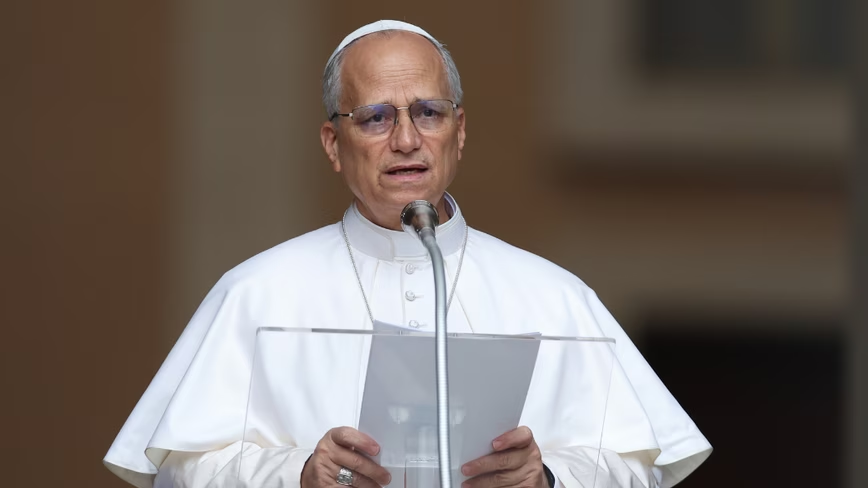
Pope Leo XIV recites the Angelus and imparts his blessing at the gates of the Apostolic Palace before thousands of faithful in Castelgandolfo.
 Credit: Marco Iacobucci via Shutterstock
AI4Peace, a symposium on artificial intelligence and conflict, opened on Monday at the Pontifical Lateran University in Rome with a message from Leo XIV. The Pope was not present in the room, and Don Andrea Ciucci, chancellor of the Pontifical Academy for Life, read the message on his behalf.
The message states that technological progress should serve the dignity of each individual and reinforce the ties which bind the human family together in a world characterized by conflict and division. No official English version has been issued; the one given is a translation from the Italian.
“In a world marked by conflicts and divisions, the development of Artificial Intelligence requires a vision inspired by wisdom and charity, so that technological progress can serve the dignity of every person and strengthen the bonds that unite the human family,” Pope Leo writes.
The greeting is of less importance than the symposium; it is the first instance of a biennial event organized by the Italian office of the UN University for Peace in association with the Pontifical Academy for Life and the Lateran, and it ends on Tuesday by formally establishing the AI4Peace International Association, which is to be a permanent organization and not a series of conferences.
Among the speakers are Jeffrey Sachs, Jeremy Rifkin and the legal scholar Antoinette Rouvroy.
On Friday, UNESCO will focus on AI, education, and peace, with a keynote speech by Leo, together with director-general Khaled El-Enany. This is the first time the Pope has visited the organization in over four decades.
The argument set out in Magnifica humanitas, the encyclical which he published in May, has the character of a set of regulations rather than that of a theological document in some places.
The main demand is that action should go beyond the drawing up of rules. This involves undermining the idea that technical power grants one the right to govern, since it is clear that merely regulating the technology is insufficient.
The details are more specific than is typical in a papal document. It states that data ownership should not remain entirely in the hands of the private sector and must be regarded as a common good rather than being sold to a small number of people.
With regard to children, it calls for legislators to set age limits and for accountability to be placed on the platforms themselves rather than on families. As for work, it cautions against excessive pay for a specialized minority while everyone else’s wages are falling.
Since the week following his election, he has been returning to the topic, for at that time he told the College of Cardinals that he had chosen his name because Leo XIII had written about the first industrial revolution, and that this is another such revolution.
On Monday at the Lateran, Francisco Rojas Aravena, who is the rector of the UN Peace University, was more direct about the symposium than the Vatican usually is: he stated that artificial intelligence is closer to war than to peace.
“Peace cannot simply be regarded as the absence of war,” explains Francisco Rojas Aravena, rector of the United Nations-mandated University for Peace and one of the conference speakers.
Get the TNW newsletter
Get the most important tech news in your inbox each week.


