TL;DR
Alex Katouzian, a 25-year Qualcomm veteran, joins Intel to run a newly merged Client Computing and Physical AI business. It is Lip-Bu Tan’s second senior Qualcomm hire of his tenure.
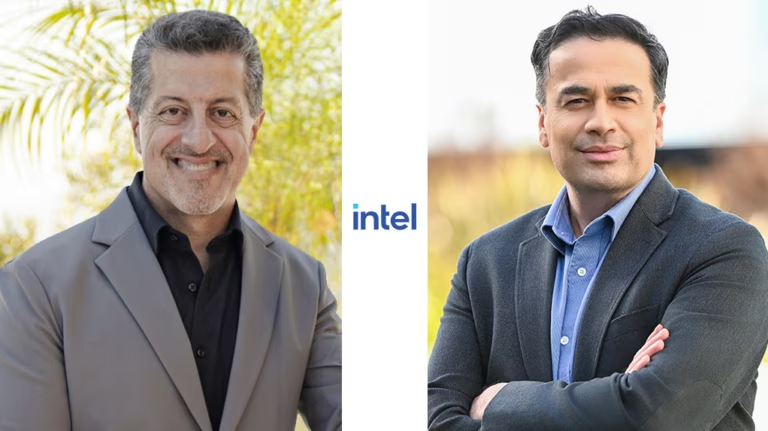
Alex Katouzian and Pushkar Ranade
 Credit: Intel
Alex Katouzian, a 25-year Qualcomm veteran, joins Intel to run a newly merged Client Computing and Physical AI business. It is Lip-Bu Tan’s second senior Qualcomm hire of his tenure.
Lip-Bu Tan’s leadership of Intel has, since the early months of his tenure, run on a single recognisable pattern: hire from rivals, restructure around the new hires, and rebuild the bench. On Monday Intel announced its latest such move. Alex Katouzian, a 25-year Qualcomm veteran most recently running its mobile, compute, and extended-reality businesses, joins Intel as executive vice-president and general manager of a newly defined Client Computing and Physical AI Group.
Reuters’ confirmation of the appointment framed it as the second senior Qualcomm executive Tan has poached in recent months, signalling a pattern of targeted talent acquisition. Tom’s Hardware described the move bluntly as Intel reaching for the operational discipline and consumer-CPU experience Qualcomm has spent two decades developing.
The structural innovation is the new “Physical AI” mandate that sits alongside Client Computing in Katouzian’s title. Intel’s traditional client-computing business, the chips that power most of the world’s PCs, is being explicitly fused with what the industry has, in 2026, started calling physical AI: chips designed for robotics, autonomous machines, edge devices, and the kinds of agentic systems that increasingly need on-device compute to function reliably.
That category is not theoretical. TNW has tracked the Siemens-Nvidia humanoid-robot factory deployments, which already use a combination of edge and cloud compute, and the broader pattern of robotics, automotive, and industrial AI demanding chips that can run inference locally rather than hauling the work back to a data centre. Intel is, in effect, reorganising its client business to compete with Qualcomm and others in that emerging category.
The hire fits Intel’s wider repositioning. Tan’s foundry strategy has been a separate but related effort, aimed at making Intel’s manufacturing operations a credible alternative to TSMC. TNW reported earlier today that Apple is in early-stage discussions with both Intel and Samsung about producing some of its M-series chips. The Katouzian hire, on the design side, complements that foundry repositioning. Intel, in the new framing, will both manufacture chips for others and produce client-compute and physical-AI silicon under its own brand, with leadership now drawn from the company that has consistently led the consumer-mobile-chip market through the past decade.
Yahoo Finance noted that this is the second senior Qualcomm executive Intel has hired in this AI-talent push, and that Tan’s strategy is now publicly visible: rather than hiring incrementally, Intel is reorganising entire business units around external senior hires whose experience matches the categories Tan wants Intel to compete in.
The success of Tan’s strategy depends on whether Katouzian can take the disciplined-margin and high-volume execution model he ran at Qualcomm and apply it to a much larger, more bureaucratic, and historically less responsive Intel. The PC business is the company’s largest revenue line; physical AI is the one most likely to determine its future. Combining both under a single executive with proven scale-execution credentials is, on paper, the right move.
On execution, the proof points will arrive over the next 18 months: whether Intel ships a credible physical-AI chip line, whether its client business holds share against AMD and ARM-based competitors in PC, and whether the foundry side, separately, books significant Apple or Google business. None of those outcomes is guaranteed. But Tan’s pattern, hire well, restructure fast, judge by output, has at least restored the appearance of strategic motion at a company that, until 18 months ago, was notable mainly for not having any.
Get the most important tech news in your inbox each week.


