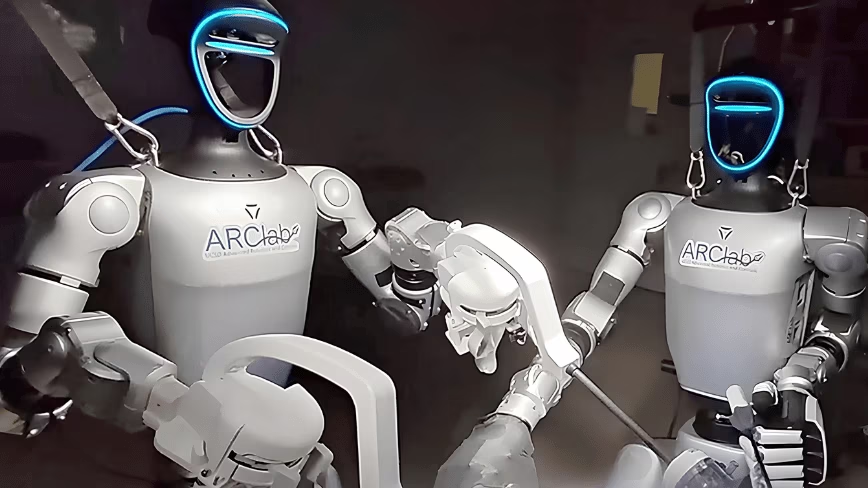
 Credit: University of California San Diego
Two robots that look roughly like people just reached inside a live animal and removed an organ. No film studio staged the scene. It happened in a lab in California, and it is a first for medicine.
Surgeons at the University of California San Diego used two teleoperated humanoid robots to remove the gallbladders from live pigs. The result was published in Nature on 8 July. It marks the first time humanoid robots have performed surgery on living subjects.
The machines did not act on their own. Human surgeons drove every movement from a console beside the operating table.
The point of the experiment was not to replace doctors. It was to test a simple question: can an off-the-shelf humanoid robot meet the precision and safety demands of real surgery? On this early evidence, the answer is a cautious yes.
Meet Surgie
The robot has a nickname: Surgie. Underneath it sits a Unitree G1, a general-purpose humanoid built by the Chinese firm Unitree, as Ars Technica reported. It stands about 1.5 metres tall and weighs roughly 27kg. It was never designed for an operating room.
That is the interesting part. Rather than build a bespoke surgical machine, the team took a mass-market robot and taught it to hold a scalpel. They made physical adapters so it could grip standard laparoscopic tools. They wrote software so a surgeon’s hand motions would map cleanly onto the instruments.
A fraction of the cost
Price is the whole argument. A base Unitree G1 starts at about $13,500. Add the dexterous hands surgery needs and the cost can climb past $67,000. That still undercuts a specialist system by a wide margin.
The market leader in surgical robotics, Intuitive’s da Vinci, can cost anywhere from half a million dollars to several million. It also weighs around 820kg and eats up much of an operating room. The Unitree, by contrast, can walk into a space built for people.
“It’s a fraction of the cost and it takes a fraction of the space in an operating room,” said Shanglei Liu, an assistant professor of surgery at UC San Diego and a senior author on the paper. “So it’s easy to deploy, anywhere from rural areas, to the battlefield, and even to space.”
How the operations worked
The surgeon sat at a console fitted with a stereo headset, which showed a 3D view from inside the animal. A foot pedal let them engage or disengage their hands from the tools. The setup borrows the logic of existing robotic surgery, but the body doing the work is humanoid.
There were two operations, and they escalated. In the first, a single robot worked with a human surgeon standing alongside as its assistant. In the second, two teleoperated robots handled the laparoscopic tools together. Both gallbladder removals were a success.
Still slow, still shaky
The robots are nowhere near ready for a human patient. The surgery ran much longer than it would on a mature system, because the team had to pause and recalibrate the machines several times.
The Unitree’s short reach did not help. Its arm span is just 450mm, against 1.6 to 1.8 metres for an adult, which cramped the operators. Latency was a worry too. These robots lag by hundreds of milliseconds, while surgeons ideally want a delay below 150. On practice drills, both trainees and veterans still worked faster with a standard surgical rig than with Surgie.
Not a robot surgeon, yet
The team is careful about what it is claiming. Michael Yip, an engineering professor and one of the senior authors, does not picture a robot replacing the surgeon. He describes an “autonomous surgical assistant” that fetches tools, preps the room, and clears up afterwards.
Full autonomy remains a long way off. Most robotics researchers agree that general-purpose machines cannot yet work safely around people without a human in the loop. A robot that can walk, see, and act like us is still mostly a lab promise, not a hospital fixture.
Unitree itself is riding that hype, with a Shanghai listing in the works.
Why it matters
The pitch is access. Many hospitals cannot staff a full surgical team, so patients go untreated. A cheap, mobile robot could carry a specialist’s skill into a rural clinic, a disaster zone, or a battlefield, with the surgeon controlling it from far away.
That vision fits a wider push to stretch scarce medical staff with machines, from AI triage in the NHS to warehouse-style robots learning to act with less human help. Surgery is a far higher bar. The da Vinci system is cleared by regulators and tested in trials; the humanoids are not.
Rivals such as a home robot from Weave and a European humanoid from UMA are chasing the same general-purpose dream. For now, the surgeon still holds the controls. The robot just holds the knife.
Get the TNW newsletter
Get the most important tech news in your inbox each week.


