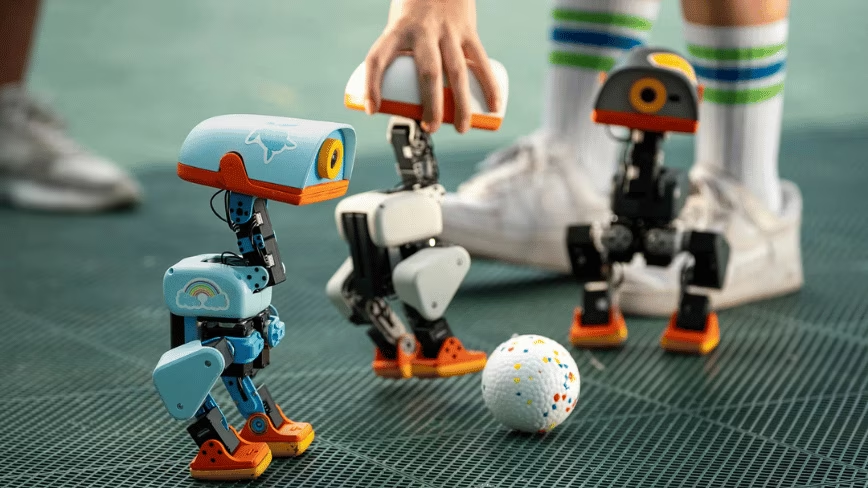
Pollen says Microduck is ten times more fun in groups, and that races and football are what made it feel alive in testing.

Pollen Robotics has unveiled a bipedal robot called Microduck, at an introductory price of $399 before taxes and shipping. The Bordeaux company is owned by the AI platform Hugging Face. Its new machine has one eye and 15 motors, stands 25cm tall, and weighs under 800g. Preorders opened on Thursday. Pollen is targeting first deliveries before Christmas 2026 in North America, Europe and the UK.
The robot walks, crouches, rights itself when it falls, and picks small objects up with its beak. Videos on the launch post show it collecting socks and a marker pen. An optional accessory pack adds wheeled feet so it can roller skate, along with a ball, an NFC chip and tags, and a laser pointer it follows with its camera.
Microduck runs on a Rockchip RK3566 with an AI accelerator, 1GB of RAM and 32GB of onboard storage, a part number first reported by The Verge. It sees through a front camera and judges distance with a compact LiDAR, an 8×8 time-of-flight matrix. One inertial measurement unit sits in the body and a second in the head. A 50Hz policy loop connects the onboard model to those sensors and decides what the robot does next, The Register reported.
It runs on a removable NP-F550 camera battery, a 2600mAh cell common in video kit, giving around an hour of runtime.
The software is open, the hardware is not
The whole software stack ships open source, and it is out already. The SDK and robot software sit in one GitHub repository, the reinforcement learning and sim-to-real tools in another, months before the first robot arrives. A developer can teach a skill in simulation, then push it onto the machine. European robotics firms increasingly work this way, and NEURA Robotics is building robot gyms.
The hardware is a different matter, and Pollen is unusually direct about it. Its press kit tells journalists that the open-source statement covers the software stack only. The mechanical and electronic design files are not open, and it asks reporters not to describe the robot as open-source hardware. A Pollen representative separately told The Register the company has no plans to open source it.
Buyers get an open stack on a closed chassis. Pollen already uses that arrangement for Reachy Mini, which it says has sold more than 10,000 units since launching last year.
Clement Delangue, Hugging Face’s chief executive, called it “a tiny $399 open-source robot you can teach new tricks with reinforcement learning”. His post on X has drawn 4.4 million views. He has spent the past year arguing that open models are winning. “Welcome to the era of open-source affordable robots to democratize physical AI and world models,” he wrote.
It cannot lift much
Santiago Pavon of Pollen Robotics put the robot’s lifting capacity at roughly 100 grams. That is about the weight of a bar of soap. The beak articulates and the camera can find an object, but Pavon accepts that grasping will stay limited on a machine this size. TechCrunch published a correction to its launch story after misstating how much the beak could carry.
Pollen is not selling a household helper. The Register called Microduck a cheap testbed for teaching people about hardware AI, machine learning and modern robotics. It is not an in-home butler or a cleaner. The framing matters in a year when robot demonstrations have outrun the machines. The humanoid that beat Usain Bolt’s record in Beijing left roboticists unimpressed.
Autonomy is left to the community
What Microduck does not have is any purpose of its own. Pollen wants owners to build voice recognition, navigation and grasping on top of the platform. It also wants simultaneous localisation and mapping. The company is asking for help rather than promising a roadmap, which makes this a bet on a user base that does not exist yet.
“Adding purpose and autonomy to the robot is something we are still working on, and we expect the community to pick up and contribute,” Pavon said. He described autonomous behaviour as a community objective, and called the idea exciting. Anyone can train new behaviours in simulation using reinforcement learning, he said.
Pollen’s own answer to what people should build is more ducks. It says the robot is about ten times more fun in groups. Races, football and robots reacting to each other are what made it feel alive internally. For developers it is a cheap way into multi-robot behaviour, without a room full of hardware.
Pollen is not the only firm trying to standardise how AI models reach real hardware. Anthropic published a standard for lab hardware on the same day Microduck went up for preorder.
Every robot gets its own voice
Microduck sings, and no two sound alike. Pollen says it “communicates through weird little sounds, closer to a creature than an assistant”, and that each robot generates its own audio identity the first time it wakes up. That voice stays with the unit for life. It comes in cream, graphite, lavender and sky.
The launch lands in the middle of a $12.9bn deal
Hugging Face bought Pollen Robotics in April 2025 to build cheap open hardware. The two launched Reachy Mini a couple of months later. That desktop robot now sells in two versions. A $499 model runs on a Raspberry Pi, and a $399 Lite runs off a Mac or a PC.
Microduck arrives in the middle of a takeover. The Information reported that Nvidia has agreed to buy Hugging Face for $12.9bn. That followed reports days earlier that put the two in talks over a sale. Business Insider put the figure above $13bn, citing a person familiar with the matter, and said the two sides had not finalised an agreement.
Nobody involved is discussing it. Pavon answered questions about Microduck but not about the Nvidia deal. Neither Nvidia nor Hugging Face replied to The Register, and both have stayed quiet since the Business Insider story broke. Nobody has said what the deal would mean for a small French robotics subsidiary.
A camera in the bedroom
Microduck carries a camera and a microphone, and Pollen expects people to put it in their homes. There is at least a light: the robot has a dedicated camera-use indicator, which Pollen says is modelled on the REC lights of old camcorders.
That is the fix Meta reached for on its smart glasses this month, after people worked out how to cover the LED. Delangue has argued before that robots running open models beat “a black box system” controlled by a handful of organisations, “especially if these organizations’ CEO is not the most stable person in the world,” he told TechCrunch.
Open source gives developers auditability, TechCrunch noted, but it does not guarantee that data stays private. Owners install applications on top of the model, and those apps can reach the camera and the microphone. What they do with it depends on how a developer builds them.
Some numbers are still soft. Pollen says camera resolution, LiDAR range, radio versions, SDK languages and any age recommendation are provisional.
Two things will show whether the pitch holds. The first is whether units ship before Christmas 2026, the date Pollen has given. The second is whether anyone outside the company publishes a behaviour worth installing, because the autonomy Pollen is promising is work it has asked other people to do.
Get the TNW newsletter
Get the most important tech news in your inbox each week.


