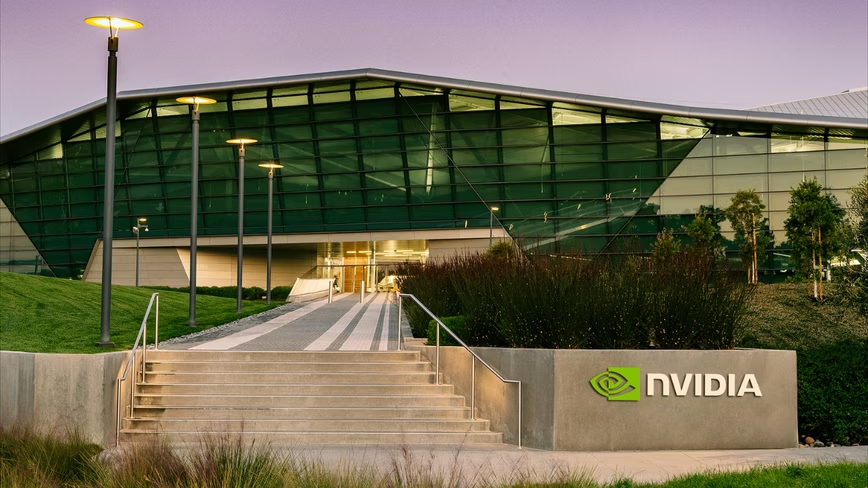
 Credit: NVIDIA
Nvidia has been in talks to acquire Hugging Face at a valuation above $13bn, according to Business Insider, days after reports that the open-model hub was exploring a sale at roughly that figure.
The Information puts the process further along than that, reporting an agreed deal at $12.9bn, and Nvidia did not respond to a request for comment.
Business Insider reports that the talks have not yet produced a signed agreement and could still fall apart, while The Information describes a deal already agreed, and neither company has confirmed either version.
Nvidia’s silence is the detail people are reading most closely. The company has moved quickly in the past to knock down reports it considers inaccurate, and it has said nothing at all about this one.
What gives the story its edge is that Hugging Face has already turned Nvidia down once. It declined a $500M investment that would have valued it at $7bn, on the reasoning that no single investor should hold that much sway over what is meant to be neutral infrastructure.
That was a governance objection rather than a haggle over price. The company’s position was that the place where everyone stores their models should not be beholden to the company that sells everyone their chips.
The valuation has roughly tripled since the $4.5bn post-money it carried out of its 2023 round, which Salesforce Ventures led with Alphabet, GV, and IBM Ventures alongside.
Chief executive Clem Delangue said this year that the company was close to profitability and had “only recently started to touch the money that [it] raised three years ago”.
Against revenue, the reported price is striking. The Information puts Hugging Face at about $150mn of annual revenue, up from roughly $100mn only two months earlier, which would make $12.9bn something in the region of 86 times sales.
He has also been unusually direct about not running the company towards an exit, saying Hugging Face prioritises “long-term sustainability” over “short-term profits or fundraising maximization”. Selling to Nvidia would be a fairly complete reversal of that framing, which is one reason to treat the reports with some care.
For Nvidia, the logic is distribution rather than revenue. Hugging Face hosts the model weights, datasets, and tooling that most of the open-source AI world runs on, and owning the shelf everyone’s models sit on is worth considerably more than the subscription business attached to it.
It would also fit a pattern that has already passed $40bn of AI equity bets this year, alongside outright acquisitions including Kumo in June. Nvidia’s most recent quarter booked $7.77bn of net gains on equity securities, so the approach is currently funding itself.
The neutrality question does not go away simply because Hugging Face has changed its mind about the buyer. Nvidia has spent the year positioning itself publicly as a defender of open models, signing an open-weights letter that OpenAI pointedly declined to join, and a repository it owns outright is a different proposition to one it merely champions.
Delangue has spent the same period arguing that open models are where the competitive action actually is, and that Chinese labs have been winning that argument. An American chipmaker owning the main distribution point for those models is a development that regulators in more than one jurisdiction will find interesting.
Antitrust is the obvious complication, and nobody has raised it publicly yet. Nvidia is already under scrutiny over its position in AI accelerators, and buying the ecosystem’s default hosting layer is the sort of vertical move enforcers watch for.
There is also the question of what happens to the community if the owner changes. Much of what makes Hugging Face valuable is voluntary, in the form of researchers uploading weights to a platform seen as unaligned with any one vendor.
For now, we only have reports and no confirmation from either side.
Get the TNW newsletter
Get the most important tech news in your inbox each week.


