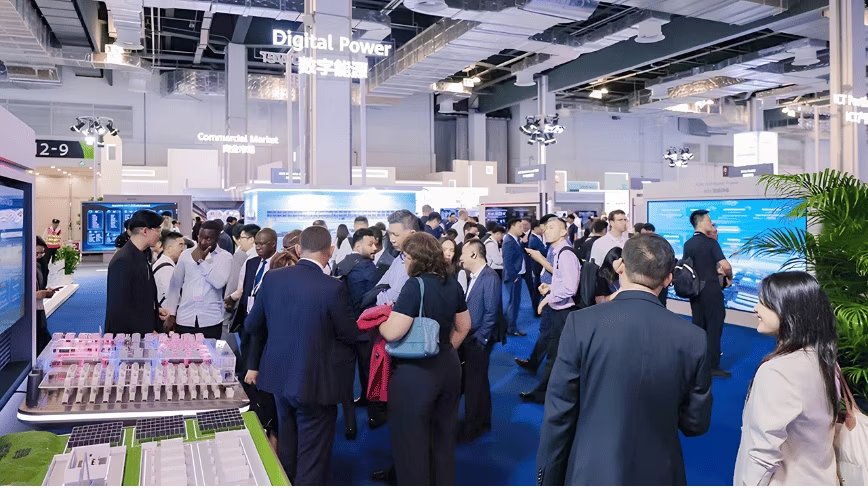
Huawei’s AIDC facility exhibition at Huawei Connect 2026

“Electricity is essential for computing,” said Zhou Jianjun, who runs global marketing, sales and services at Huawei Digital Power. “Today, in the AI era, the startup, shutdown, and load fluctuations of a large AIDC campus can all impact grid operations.”
He was unveiling Huawei’s grid-interactive AI data centre solution in Shenzhen. Days later the same kit went on stage in Shanghai. Huawei ran a facility summit there alongside its Connect 2026 conference.
The premise is unusual. Huawei wants an AI data centre to stop behaving like a passive load. It should hold the grid up instead.
AI workloads are spiky, and grids hate spikes
A traditional data centre draws a fairly steady amount of power. An AI training cluster does not. Load swings as jobs start, stop and synchronise. The swings arrive fast, and campuses are scaling from hundreds of megawatts to gigawatts.
Josh Chen, founder and chairman of Chinese operator VNET Group, put the consequences plainly at the summit. High-frequency changes in AI workloads can cause grid disconnection. They can also cause unstable wideband oscillation.
Renewables make it harder again. As their share rises, local grid strength falls and volatility climbs, Zhou said. A gigawatt-scale campus on a weaker, twitchier grid becomes a problem for everyone else on that grid.
Europe already knows the shape of this. Grid connection queues are now the binding constraint on data centre buildout. Texas alone is sitting on 474GW of requests nobody can verify.
What Huawei actually launched
Hou Jinlong, president of Huawei Digital Power, opened the summit with four claims. Liquid cooling and a new power architecture handle density. Hybrid energy storage absorbs local fluctuation. Electricity and compute get scheduled together. Prefabrication shortens build times.
Underneath sits what Huawei calls a MIMO power supply architecture. It takes multiple energy sources in and serves multiple compute types out. Huawei says it adjusts for AI load swings across timescales from microseconds to hours.
The hardware arrived with it. Huawei launched the Taishan UPS, which it calls the industry’s first megawatt-class single-cabinet uninterruptible power supply. One cabinet delivers 1,280 kVA at up to 98% dual-conversion efficiency.
Alongside it came the Hengshan DC UPS, described as the first software-defined DC UPS. A single hardware platform supports 270V, 400V and 800V systems. That flexibility matters, because nobody has settled on a voltage for the next generation of racks.
PowerPOD 5.0 cuts footprint by 40% and shortens lead time from seven days to three. SmartLi 5.0 raises storage density and is built for a move to 800V HVDC. The LUNA2000 grid-forming system handles weak-grid support at campus level.
Huawei also says both of its main AIDC power supply series have passed a grid wideband impedance field test. It claims to be the first vendor through a wideband oscillation damping test at the Shanghai Electrical Apparatus Research Institute.
Cooling becomes a control system
The thermal half is the more interesting shift. Huawei is pushing liquid cooling from coolant distribution units to what it calls a thermal management unit.
The difference is that the unit does not only move heat. It uses AI to detect micro leaks and predict the health of the working fluid. It also coordinates cooling with electrical load, so the system reacts as compute demand changes.
Huawei says the unit is natively compatible with its Ascend servers. That is the whole argument for buying the stack rather than the parts. The company was selling chips, pods and interconnect at the same conference.
Tokens per watt replaces PUE
The metric is quietly the biggest change here. Data centre efficiency has run for years on power usage effectiveness. PUE compares total facility power with the power that reaches the IT kit.
It says nothing about whether that kit produced anything useful. Huawei and its customers are pushing tokens per watt instead. That figure ties electricity consumed directly to model output.
Lin Hai, who runs SenseTime’s intelligent computing centre business, said the company has improved its tokens-per-watt figure by 80%. He credited end-to-end optimisation across power plants, grids, racks, cloud services and models.
He also said SenseTime’s facility in Lingang was the first to receive a compute-power synergy certification from China’s state telecoms research academy. Huawei frames the same idea as maximising tokens per watt and minimising cost per token.
On that measure a compute campus is a factory. Electricity is its raw material, and tokens are the product. David Wang’s opening keynote listed breaking power and thermal limits as one of ten directions to 2035.
Why this lands differently in Europe
Making data centres flexible is not a Chinese idea. Google and Nvidia launched an energy management alliance this week aimed at exactly that. OpenAI has been pitching US utilities on grid defence.
The difference is what Huawei is selling. Google and OpenAI want operators to flex demand. Huawei is selling inverters, storage, transformers, cooling and chips as one system, from generation through to token.
Bob He, a vice president at Huawei Digital Power, described that advantage as horizontal and vertical. Horizontally it runs from green generation and grids through storage, power supply, thermal management and chips. Vertically it runs from infrastructure up to models and applications.
That integration is the pitch. In much of Europe it is also the problem. Brussels has spent this year arguing about Huawei in telecoms networks, and a grid is more sensitive infrastructure than a radio mast.
Meanwhile the queues keep growing and South Korea is counting reactors. Nobody in Europe has a finished answer to what a gigawatt AI campus does to a local grid. Huawei has turned up with one, which is the uncomfortable part.
Get the TNW newsletter
Get the most important tech news in your inbox each week.
Also tagged with


