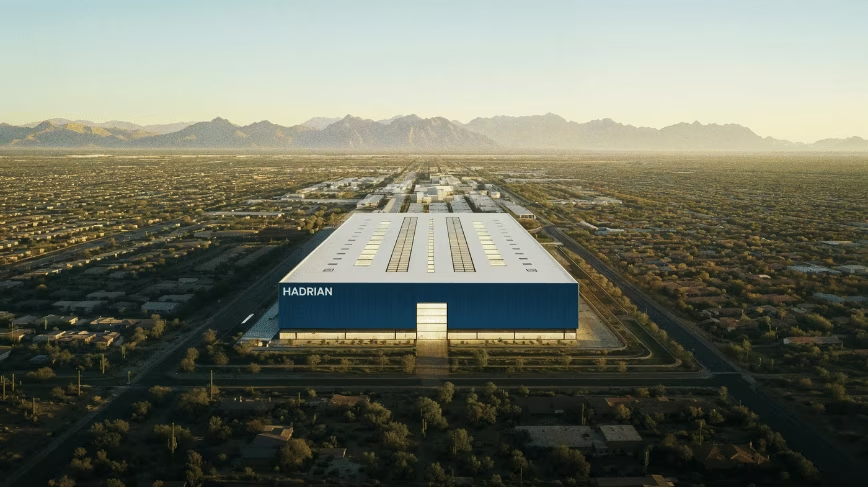

The defence-tech boom has a new marker. Hadrian builds automated factories for the Pentagon and its contractors. Founded in 2021, it has announced a $1.37bn Series D that values it at $7.87bn. In January the same company was worth $1.6bn.
Bloomberg first flagged the talks in June, at a mooted $7.5bn, and reported the close.
What is striking is who wrote the cheques. JPMorgan’s Strategic Investment Group anchored the round, alongside Baillie Gifford, T. Rowe Price accounts, Morgan Stanley Wealth Management and funds run by Apollo. These are mainstream institutions, not the niche defence funds that seeded the sector.
Founders Fund, Andreessen Horowitz and 1789 Capital, where Donald Trump Jr. is a partner, also joined.
Factories as software
Hadrian’s pitch is that manufacturing is a software problem. It runs highly automated plants under a “factories-as-a-service” model. A defence prime can buy production capacity without building its own plant. Its system, Opus, handles scheduling, tool routing and inspection, and the company says it cuts lead times from months to days.
The work is real, not a slide deck. Hadrian supplies Lockheed Martin, RTX and Anduril. The US Navy has tapped it to mass-produce submarine parts in Alabama. It runs almost three million square feet across four sites. Its founder, Chris Power, told Axios the company was “early.” It was a five-year slog, he said, before Washington woke up to factories.
The money funds people and reach. Power plans to nearly triple the workforce to 2,000 within a year. He also wants teams in Australia, Asia and Europe by December, to make parts for NATO. The equity will not build the factories themselves. Hadrian is arranging a separate line of credit for that, a split it means to repeat.
A boom, or a bubble
Hadrian is riding a wave. Defence-tech startups pulled in about $35bn from private investors in the first half of 2026, the strongest six months on record. Anduril is now worth more than $60bn, Shield AI $12.7bn. The money is chasing President Trump’s plan to spend up to $1.5tn rebuilding the US military.
That backdrop cuts both ways. The same rush that lifted Hadrian’s price almost fivefold in months is the kind of surge that later invites a correction. Power does not plan to test public markets until 2029 at the earliest. That buys him room, but the valuation rests on private rounds for years yet.
The wider thesis is reindustrialisation. The West must relearn how to build at scale, with physical AI and robotics as the tools. Power frames it as a race with China, which he says is betting heavily on industrial dominance. Hadrian is the sharpest wager yet that weapons production is where that contest gets tested first. Its founder puts it plainly. “Production is now the frontline of deterrence,” Power said.
Get the TNW newsletter
Get the most important tech news in your inbox each week.


