
Bloomberg says defense-factory startup Hadrian is in talks to raise as much as $1bn at a $7.5bn valuation. Hadrian calls that “inaccurate”. Either way, the rumour shows how hot physical AI and US reindustrialisation have become.
Here is a number, and a denial, in the same breath. Hadrian Automation has discussed a new funding round that would more than quadruple its valuation to about $7.5bn, Bloomberg reported. The company has discussed raising as much as $1bn, the people said, and several existing investors are expected to take part.
Then the caveats. The details are not final and could change, and the figure excludes any debt Hadrian might raise on top. A company spokesperson went further. The information is “inaccurate”, she told Bloomberg, declining to comment beyond that. So treat the exact numbers with care.
The precise figure is not really the point. The signal is.
A five-month markup
In January, Hadrian raised at a $1.6bn valuation, in a round led by T. Rowe Price. A move to $7.5bn would more than quadruple that in barely five months. Valuations only travel that fast when a whole theme is running hot. Investors are racing not to miss it.
The theme has a name: physical AI. The idea is that the next wave of artificial intelligence shows up not in chatbots but in factories, robots and machines. Add a second hot trade, the reindustrialisation of American manufacturing, and you have the exact crossroads Hadrian sits on. That is why even a disputed number is worth recording. It marks where the money wants to go.
What Hadrian actually does
Founded in 2020 by Chris Power, Hadrian builds AI-powered factories that make mission-critical parts for aerospace and defence. It sells production three ways: precision components to spec, dedicated manufacturing capacity, and entire factories it designs and runs for a customer, a model it brands “Factories as a Service”.
The engine underneath is software the company calls Opus, which it describes as an operating system for factory autonomy. Opus reads legacy part designs, then automates the manufacturing and inspection around them. The aim is to run a plant at world-class speed and quality with far fewer specialist hands than the legacy defence industrial base needs.
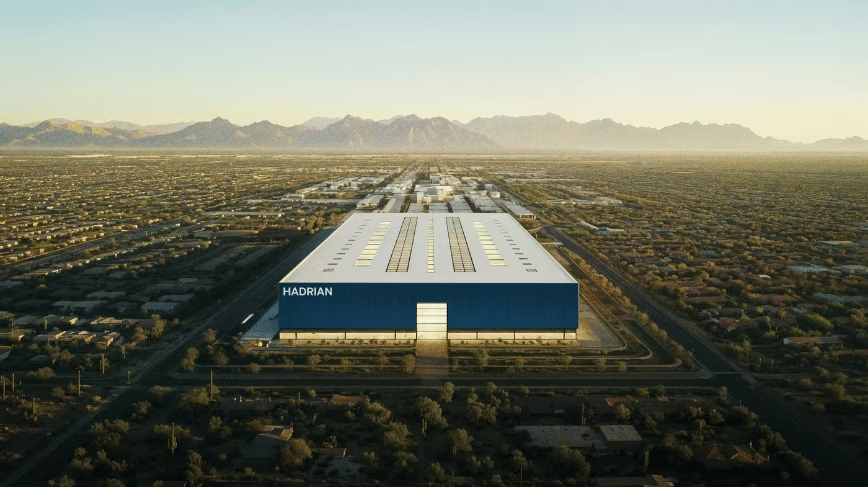
The hardware is real. Hadrian runs four plants. The newest opened in Cherokee, Alabama, in March to feed a $2.4bn contract with the US Navy to build submarine components. Two of the others sit in Torrance, California, and Mesa, Arizona. That Navy deal matters. It separates a physical-AI pitch from a physical-AI business with revenue behind it.
Hadrian is not alone. A wave of venture money has poured into startups that promise to rebuild American factories, part of what Bloomberg has called Silicon Valley’s multibillion-dollar gamble on defence manufacturing. Most are long on ambition and short on customers. Hadrian’s edge is a marquee government contract that turns the thesis into actual orders.
Why investors are leaning in
The pitch rests on a genuine crisis, not just a trend. American defence manufacturing has been hollowed out for decades, and the gap is now measurable. The Virginia and Columbia-class submarine programmes alone run about 50 million workforce hours short every year, according to Hadrian backer Altimeter. That is one set of programmes.
Hadrian throws automation and fresh labour at the problem. Close to 100% of its factory workers had never set foot in a factory before, the company says. It trains them in about 30 days, drawing from hospitality, retail and nursing, and pays above local rates in regions starved of this kind of investment.
That training pitch carries a political charge. Hadrian, like its backers, argues that physical AI will create factory jobs rather than destroy them, an unusual claim in an industry braced for automation. The US shed a large share of its defence-manufacturing jobs over decades, by Altimeter’s reckoning, and a skills gap that took 40 years to open will not close on software alone. Hadrian’s wager is that automation is exactly what makes hiring at scale possible again.
The economics are the hook. Altimeter says Hadrian runs its factories at 65% to 80% utilisation, against an industry baseline closer to 10%. Keep the machines busy and the returns start to look less like heavy industry and more like software. Altimeter frames it as an internal-rate-of-return story too strong to ignore, and suggests the securitisation of factory output may only be getting started. That is the maths that lets investors discuss a defence supplier at $7.5bn.
The cap table shows the appetite. The January round drew Founders Fund, Andreessen Horowitz, Lux Capital, Altimeter, D1 Capital, StepStone and RTX Ventures, among others. Crossover funds, frontier-tech VCs and defence money all crowded into the same deal.
The case for caution
The denial deserves weight. A more-than-quadrupling in five months is also the kind of mark that flags the top of a cycle, not just the strength of a company. Physical-AI valuations are running well ahead of the revenue underneath them. A disputed report is a thin thing to hang a $7.5bn price on.
The model is hard, too. Building factories is slow, capital-hungry work, a long way from the asset-light software businesses these multiples were invented for. Bloomberg’s note that the round excludes additional debt hints at how much money this growth swallows. Utilisation can fall as fast as it climbed if contracts slip.
None of that makes the reindustrialisation thesis wrong. It does mean the gap between the story investors tell and the businesses beneath it keeps widening, and Hadrian is now a test case for whether it closes.
So the open question is not really the $7.5bn. It is whether physical AI can turn a real industrial crisis, and a few marquee contracts, into the durable, profitable manufacturing the valuations already assume. Hadrian says the talks are inaccurate. The appetite behind them plainly is not.
Get the TNW newsletter
Get the most important tech news in your inbox each week.


