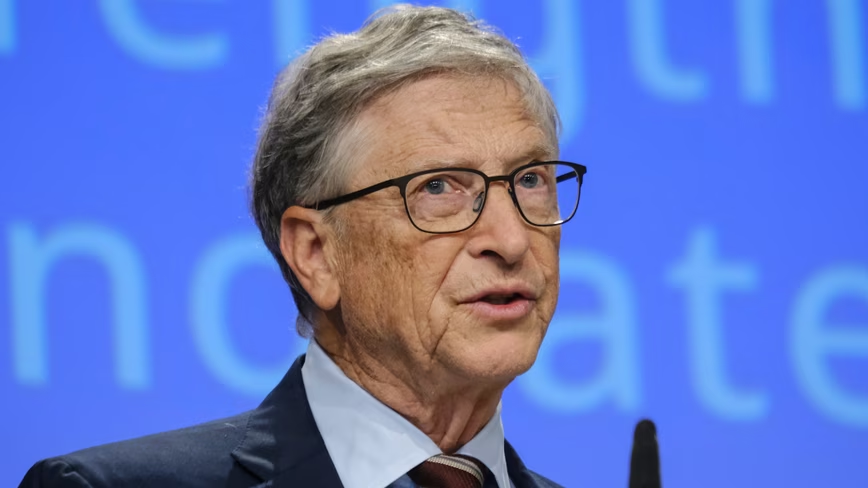
Former Microsoft CEO, Bill Gates during the launch of a new funding partnership to eradicate polio signing ceremony in Brussels, Belgium on October 11, 2023.
 Credit: Alexandros Michailidis via Shutterstock
Bill Gates has committed the Gates Foundation to spending at least $1bn over the next two years on expanding access to AI, and paired the announcement with a blunt assessment of the people who are supposed to be regulating it.
“I don’t think any government is nearly as deep on this as they have to be,” he told Reuters in an interview published on Tuesday. “Governments are way behind on this one.”
The money goes to partners working in education, healthcare and agriculture, and to something less obvious: building the data foundations that would let large language models function across all languages rather than the handful they currently serve well.
That second item is the substantive one, and it is far harder than it sounds. English accounts for roughly 49 percent of web content.
Chinese, spoken by more than a billion people, accounts for 1.3 percent, which is enough of a constraint that Beijing’s National Data Administration is building validated training datasets to fix it.
Spanish sits at 6 percent and Japanese at 5. The languages the foundation is aiming at are further down than any of those, and for most of them the text does not exist in a form anyone can train on.
In August he proposed Human Reserved jobs, occupations deliberately closed to automation, capped at around 40 percent of all work, alongside a tax on AI tokens and robots that he called a bigger change to the tax system than any in his lifetime.
His concerns now run to employment, security and addiction, which is a considerable distance from where he started on this technology.
On geopolitics, he reaches for a film. Gates compared AI to an alien arrival, the kind where the United States and China and everyone else set aside their differences because the problem is larger than any of them, and said:
“AI is kind of like this alien intelligence”.
He has raised his concerns with Donald Trump’s team and hopes to meet Xi Jinping later this year.
Cooperation of that sort is not the direction of travel. Trump dismissed the case for slowing AI last week and told Jensen Huang by phone on Monday that fear of it is a hoax.
Beijing has spent the summer pitching cheap models abroad through a proposed global AI cooperation organisation while the G7 debated restricting access to American ones.
The claim that governments are behind it is also doing more work than it appears. In the Senate, Thune, Cruz and Klobuchar are negotiating a bill that would impose a duty of care on developers and let Washington block model releases.
Whether that counts as being deep enough depends on what you think the alternative is, and Gates’s alternative is a private foundation spending its own billion on the parts the market has not reached.
No timetable, country list, or named partner has been published, and the foundation has not said how the $1bn splits between the three sectors and the language work.
Get the TNW newsletter
Get the most important tech news in your inbox each week.


