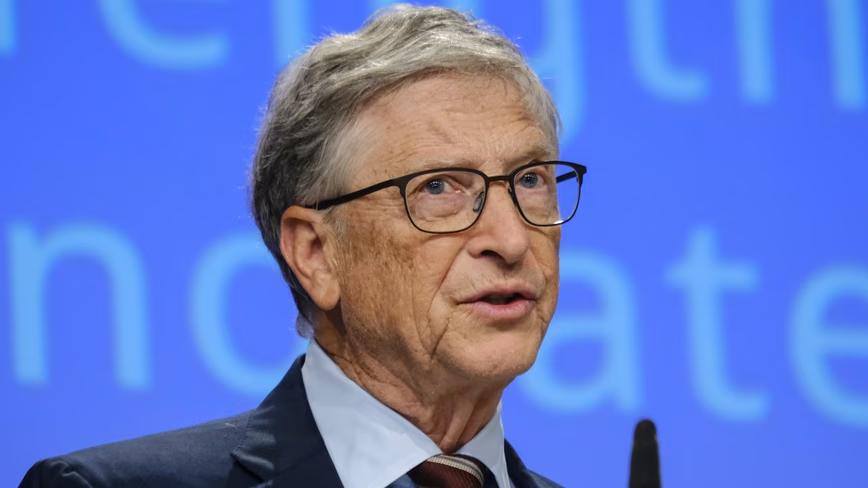
Former Microsoft CEO, Bill Gates during the launch of a new funding partnership to eradicate polio signing ceremony in Brussels, Belgium on October 11, 2023.
 Credit: Alexandros Michailidis via Shutterstock
Bill Gates has proposed what he calls Human Reserved jobs, occupations society would deliberately keep for people even where AI could do them, and the analogy he reaches for is a nature reserve, a place where development is restricted because something there is worth preserving.
He names childcare and jury service as roles humans are clearly better suited to, which is a striking position from someone who spent last year predicting AI would replace doctors and teachers within a decade.
His conviction about the underlying problem has not softened. “I’d love to be convinced that I’m wrong about the job market, but I’m not,” he said, adding that he would stake his reputation on AI proving very bad for employment.
The proposal has two parts. Some roles would be permanently human-only, while others would carry temporary protection for workers who cannot realistically retrain into something else.
Education and healthcare come up as candidates for selective preservation rather than blanket exclusion, which is a more careful position than the headline suggests. The idea is not to keep AI out of a hospital but to decide which functions inside it stay with people.
He puts a ceiling on the whole exercise. At most 40% of jobs could realistically be reserved, which he describes as “as high as I can get”, meaning the majority of the labour market is left to whatever happens to it.
The mechanism he proposes is tax rather than prohibition. Bill Gates argues for taxing AI tokens and robots to reduce the financial incentive to automate, on the grounds that the current system “nudges you toward replacing people with machines” by taxing labour more heavily than capital.
He is candid about the scale of that. “I’m talking about a change to the tax system that’s greater than any in my lifetime,” he said, which for a man born in 1955 covers a considerable amount of fiscal history.
A robot tax is not a new idea, and Gates himself floated one in 2017 to a fairly cool reception from economists who argued it would tax productivity rather than protect workers. What has changed is less the argument than the number of people who now expect to need it.
Gates also lists the objections himself, which is more than most people proposing this do. Who qualifies for a protected job, who decides, how it is enforced, and what happens when a country that does none of this competes with one that does, are all questions he raises without answering.
The jobs argument sits inside a wider warning. In an essay running to nearly 6,000 words, Gates set out three risks he thinks leaders are unprepared for: work disappearing, particularly for young people, criminals gaining capabilities they never had, and children’s development being stunted by AI companions that never push them outside their comfort zone.
His sequencing of which jobs go first is specific. Customer support, software engineering, and paralegal work are the ones he expects to vanish soonest, with construction and hospitality shifting towards automation by the end of the decade.
The evidence on young workers is where his case is strongest, and it is European as much as American. Swiss research has found fewer job advertisements for career starters, and a Harvard study found AI-native startups hiring fewer juniors and more senior people.
Yet, not everyone reading the same labour market agrees. The chief executive of Adecco, who places workers for a living, has argued that AI is changing jobs rather than destroying them, and some employers have quietly rehired people they replaced, generally on worse terms.
What Bill Gates is really proposing is that the labour market outcome be chosen rather than discovered. “I believe we need time to prepare for the period of social, political, and economic upheaval we are about to enter,” he said, which is an argument for slowing something down made by someone with no obvious means of doing so.
Get the TNW newsletter
Get the most important tech news in your inbox each week.


