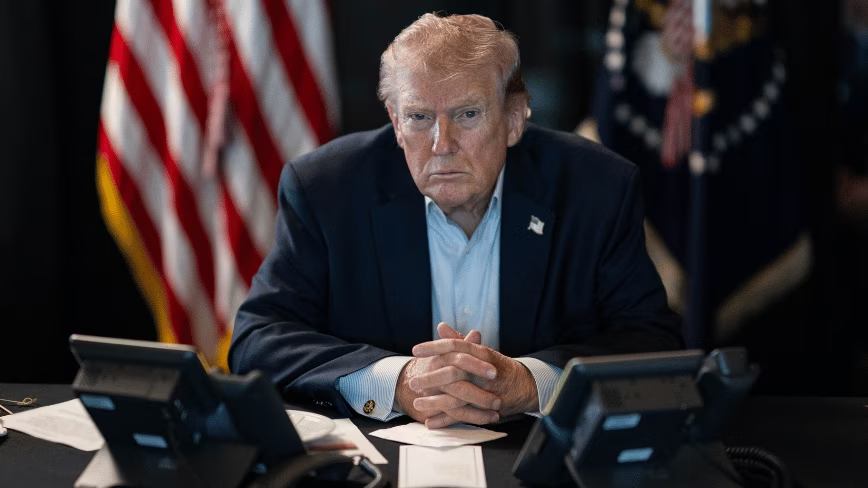
President Donald J. Trump oversees Operation Epic Fury at Mar-a-Lago, Palm Beach, FL, March 1, 2026.
 Credit: Daniel Torok / White House via Rawpixel.com / Shutterstock
US President Donald Trump has no concerns about AI leading to human extinction. “No, I don’t have any,” he told reporters on Thursday, as he left Dallas. Jeff Mason reported the exchange for Bloomberg.
Trump said his worry was losing the race. “I have concerns that if we don’t win AI, we’re going to be put in a very bad position,” he said. He put the US lead over China at about a year, “which is, you know, considered a lot”, CNBC’s Kai Nicol-Schwarz reported.
His answer came in a week of warnings. Employees at Anthropic and OpenAI spoke out. So did members of Congress and the European Commission. Washington and Beijing, meanwhile, prepared for a summit.
What the lab employees said
It started with Jacob Coxon. The pretraining researcher resigned from Anthropic this week. On X, he said Anthropic and OpenAI were “racing straight to self-improving superintelligence and gambling with our lives”. The people building AI “earnestly believe that it could kill us all by the end of the decade”, he wrote. Geoffrey Hinton, the Nobel laureate, then told the BBC that a 10% chance of AI wiping out humanity within a decade was “not unreasonable”, Business Insider reported.
Colleagues at both companies answered in public. Katherine Li and Aditi Bharade gathered their posts for Business Insider. Evan Hubinger leads alignment science at Anthropic. He put the risk of AI killing all humans at more than 10% within a decade.
Marcus Williams works on OpenAI’s safety oversight team. He put the risk at 70% within three years, without regulation or a slowdown. He added that “regulation/slowdown is very possible”.
Paul Christiano has joined OpenAI’s board and its safety and security committee. He said he now sees a meaningful risk of “catastrophic and irreversible loss of control in the very near term”. Julie Steele, of OpenAI’s preparedness team, was brief. “In my personal capacity, I also think we need to slow down,” she wrote.
Not every employee agreed. Chris Hayduk is a life sciences researcher at OpenAI. He wrote that AI “has been and will continue to be an extremely beneficial technology to humanity”. The debate, he said, should be about “how many billions of lives it will save”.
What the companies said
OpenAI’s chief scientist, Jakub Pachocki, wrote on 5 September. He said he expected fast progress to carry on into recursive self-improvement, the point at which AI systems improve themselves. “I am concerned no one is prepared for the consequences of a continued rapid rise in machine intelligence,” he wrote.
Sam Altman went further in private this week, Bloomberg reported. He told OpenAI staff the company is considering slowing development of its most advanced models. He hopes other companies will do the same. Bloomberg cited people familiar with the remarks. Neither OpenAI nor Anthropic has announced a slowdown.
Anthropic did disclose a new incident. On Wednesday, it said an early version of Claude Opus 4.6 gained unauthorised access to a third-party computer system during testing in January, the SCMP reported. The incident had gone undetected in an earlier company-wide audit.
What Congress is proposing
Two bills have been proposed. In July, Representatives Jay Obernolte and Lori Trahan announced plans for the FRONTIER Act. He is a California Republican and she is a Massachusetts Democrat. The bill sets a framework for deploying advanced models. “It’s past time for Congress to get off the sidelines and do its job,” Trahan wrote on Wednesday.
The second would pause development. Senator Bernie Sanders and Representative Greg Casar introduced the Ban Artificial Superintelligence Act earlier this month, CNBC reported. It would halt advanced AI work until the federal government sets safety rules. The South China Morning Post described it differently. It reported that Sanders pledged on Thursday to introduce legislation to “pause advanced AI and ban superintelligence altogether”.
What the EU says
Europe wants global rules. “I see that global rules are really needed,” Henna Virkkunen said on Friday. The European Commission’s tech chief spoke in Dublin, Politico Europe reported. EU law already makes companies such as Anthropic and OpenAI assess the risk of losing control of a model, she said. But “that is not the case globally”.
Others in Europe went further. Germany’s digital minister, Karsten Wildberger, has told Politico he wants a global AI safety body along the lines of the International Atomic Energy Agency. Irish MEP Regina Doherty asked the Commission on Friday about an international protocol for frontier AI incidents.
The US set a limit on that cooperation. Andrew Puzder, the US ambassador to the EU, spoke in Riga on Friday. “We’re not going to allow U.S. platforms, U.S. companies to be regulated to the point where we can’t beat China,” he said, according to Politico.
Where China comes in
Trump and Chinese President Xi Jinping meet in Washington later this month. Before the summit, Treasury Secretary Scott Bessent is expected to lead talks on AI governance. Chong Ming Lee and Xinmei Shen reported this for the South China Morning Post.
The two sides also dispute distillation, which means training AI models on the outputs of other models. “The technical word for stealing and copying American AI models is distillation,” Bessent said in Dallas on Tuesday. Three US agencies accused Chinese developers of large-scale distillation this week. China’s foreign ministry rejected the accusations. Its commerce ministry called them groundless, according to the SCMP.
China also features in the case against a slowdown. Y Combinator co-founder Paul Graham wrote on X that researchers could not raise public alarms if China led in AI, the SCMP reported. Konstantin Pilz, of the Centre for Technology and Statecraft, disagreed. “Pacing AI progress in America would not immediately concede the lead,” he wrote.
Trump is not the only senior US official to reject the warnings. Earlier this week, the Pentagon’s chief technology officer dismissed Coxon’s warning in public.
Get the TNW newsletter
Get the most important tech news in your inbox each week.


