TL;DR
Fujikura is raising fibre-optic cable prices as nearly every US hyperscaler places orders and supply stays tight. The CEO says the company will beat its forecast despite shares falling 40% from their May peak.
Fujikura supplies fibre-optic cables to “almost all US hyperscalers” and says it will push prices higher as demand outstrips production capacity.
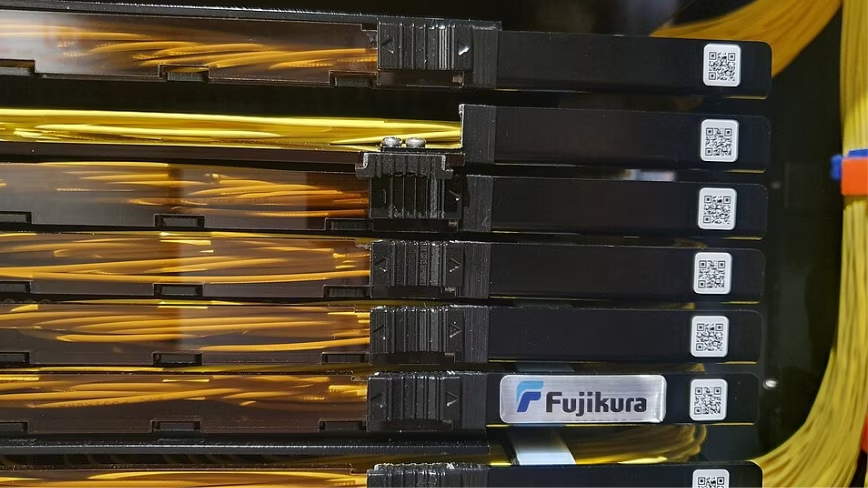
 Credit: Syced
Fujikura is raising fibre-optic cable prices as nearly every US hyperscaler places orders and supply stays tight. The CEO says the company will beat its forecast despite shares falling 40% from their May peak.TL;DR
Fujikura, the Tokyo-based fibre-optic cable manufacturer, is raising prices on the cables that connect servers inside AI data centres. CEO Naoki Okada told Bloomberg the company is on track to beat its own forecast thanks to sustained demand from nearly every major US hyperscaler.
“We supply a valuable product,” Okada said. “We will raise prices a little more.”
An AI data centre requires far more fibre-optic cable than a conventional cloud facility. The tiny glass strands transmit data via pulses of light between GPUs, and the sheer volume of data that AI training and inference produce has made cabling a structural constraint on how fast new clusters can come online.
Fujikura, along with Japan’s Sumitomo Electric and Furukawa Electric, dominates the high-end segment of this market. The supply squeeze has given them pricing power that few component suppliers in the AI stack enjoy.
US rival Corning signed a $6 billion supply agreement with Meta and a separate $500 million stock deal with Nvidia. Those contracts, both announced in recent months, confirm that the hyperscalers view fibre-optic supply as critical enough to lock in years of capacity at premium prices.
Okada said Fujikura is fielding orders from almost all US hyperscalers. Some customers have already agreed to higher prices for the company’s topline products, though Okada did not name specific clients or disclose the size of the price increases.
Fujikura’s shares are down more than 40% from a record high set in May. The selloff was triggered by annual and three-year profit forecasts that fell well below analyst expectations, raising concerns about production capacity bottlenecks, growing competition, and supply chain disruptions.
Okada said the forecast was deliberately conservative and factored in worst-case scenarios including the risk of hydrogen shortages, which are used in the manufacturing of fibre-optic preforms, the glass rods from which cables are drawn. “There is no way we will miss our annual forecast,” he said.
The AI buildout’s most visible beneficiaries are chipmakers like Nvidia and memory firms like SK Hynix. But the physical layer, cables, connectors, cooling systems, power distribution, is where many of the tightest constraints sit.
Fujikura’s ability to raise prices while losing 40% of its stock value tells a specific story: demand is real, but the market does not trust the company’s ability to scale capacity fast enough to capture it. If Okada’s price hikes and optical component expansion plans deliver, “the results will be very positive,” he said. The gap between that confidence and the stock price is where the bet sits.
Get the most important tech news in your inbox each week.


