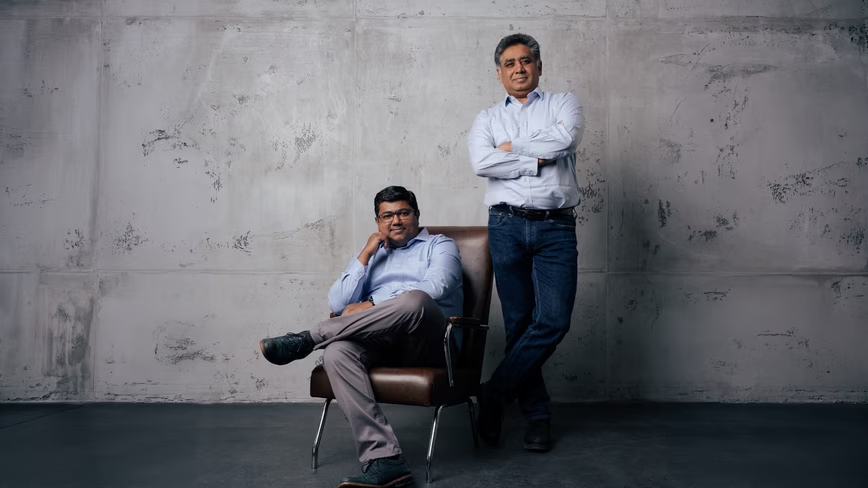
The Cologne startup’s simulation-first approach trains robots in virtual greenhouses before deploying them in real ones, aiming to crack a deployment problem that has frustrated the industry for years.
The market for greenhouse automation has accumulated a graveyard of credible-sounding startups. The engineering problem is genuinely hard: harvesting tomatoes or cucumbers requires handling irregular, delicate, densely-packed fruit in a humid environment where every plant is slightly different and the layout changes seasonally.
Several companies have shipped robots that work in controlled demos and then fail at commercial scale. The gap between “works in the lab” and “works reliably at 22 hours a day in a real grower’s greenhouse” has proved extremely difficult to close.
Renji John has attempted this problem before. He co-founded Honest AgTech, a Dutch startup building autonomous greenhouse robots, which was declared bankrupt by the District Court of Noord-Holland in July 2023 after running into a liquidity shortage.
He is now back with a second attempt. eternal.ag, the German agritech startup he co-founded with Sherry Kunjachan in 2025, announced on Thursday that it has raised €8 million from Simon Capital, Oyster Bay Venture Capital, EquityPitcher Ventures, and Backbone Ventures. The company is headquartered in Cologne with an office in Bengaluru.
The key technical distinction John is making this time is the development methodology. Eternal.ag uses simulation-first development, building and validating robots inside virtual greenhouses powered by NVIDIA Isaac Sim before deploying hardware in real ones.
The claim is that this compresses iteration cycles from months to days, allowing the company to test failure cases cheaply in software rather than expensively in steel and tomatoes.
Once robots are deployed, every action feeds data back into the system for continuous improvement. Both the 22-hours-a-day operating figure and the compression of iteration cycles are company claims that have not been independently verified, though the underlying approach is consistent with how leading robotics companies manage hardware development risk.
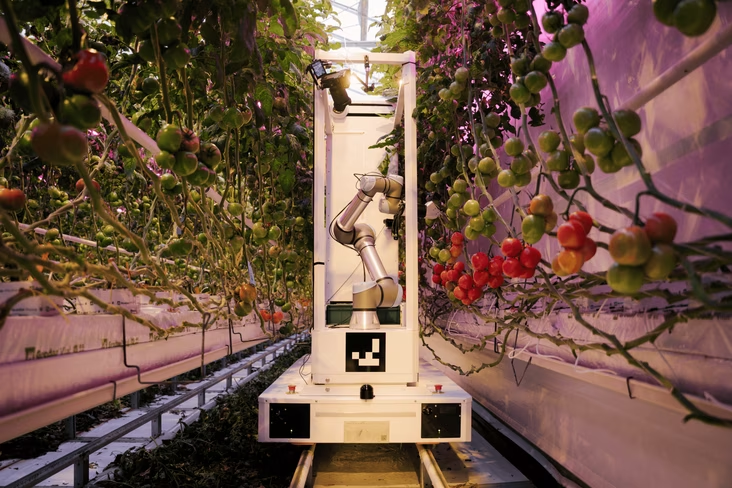
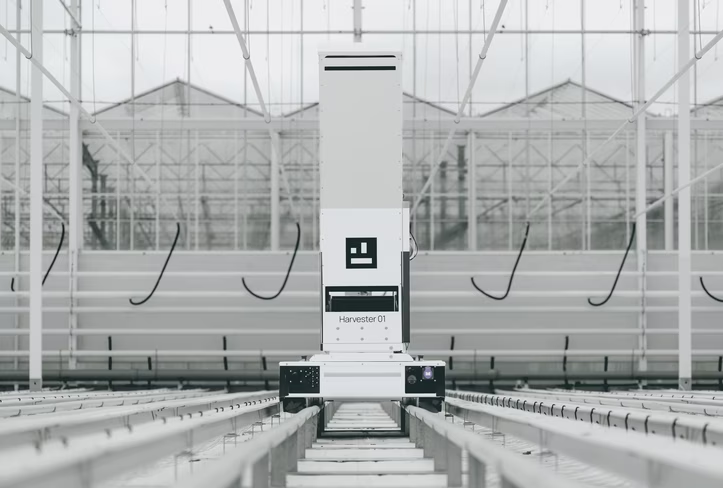
The company’s first commercial product is Harvester, an autonomous tomato harvesting robot designed to run as part of an AI-powered system that manages cut quality and produce consistency. The product is designed as a modular platform intended to expand to other greenhouse tasks over time. Eternal.ag’s stated ambition is fully autonomous greenhouse operations by 2040, requiring no human operators.
John’s background includes a stint at the Boston Consulting Group working on technology strategy, an INSEAD MBA, and earlier career experience at Tata Consultancy Services. Sherry Kunjachan, the co-founder and CTO, does not have independently documented prior roles beyond the press release materials.
The investor group is well-aligned with the sector. Oyster Bay Venture Capital is a Hamburg-based Food and AgTech fund whose second vehicle manages more than €100 million and is backed by the European Investment Fund and KfW. The firm typically leads rounds with initial investments of €1 to 5 million. Simon Capital, based in Düsseldorf, is an early-stage fund whose portfolio includes waterdrop and Just Spices. EquityPitcher Ventures and Backbone Ventures are Swiss and Germany-based early-stage funds.
“Greenhouse horticulture is one of the most efficient and sustainable ways to grow fresh produce year-round,” said Niklas Leske, Principal at Simon Capital, in a statement. “Labour shortages put the industry at risk, and robotics is the only future-proof solution to build a decentralised, resilient food supply chain for the next generation.”
The labour problem Leske is describing is structural. European greenhouse growers have depended for decades on seasonal workers, predominantly from Eastern Europe and beyond. As that pool has shrunk, the press release cites a 30% decline since 2010, though that figure has not been independently confirmed, growers face a genuine operational constraint.
Greenhouses, unlike outdoor farms, run year-round and require consistent labour for tasks that are physically demanding and repetitive. That combination makes the automation case genuinely compelling, even if the execution has repeatedly proved difficult.
The €8 million will go towards accelerating product development, expanding commercial deployments across Europe, and extending the platform to additional crop types beyond tomatoes. For John, the second attempt carries the weight of knowing exactly how the first one failed.
The simulation-first approach, the modular design, the step-by-step crop expansion, all of it reads as a deliberate effort to build more slowly and more carefully than a startup that raised pre-seed capital and tried to do too much too fast. Whether that discipline holds at commercial scale is what the next few years will answer.
Get the TNW newsletter
Get the most important tech news in your inbox each week.


