A family-run east London recycling firm is training a Chinese-built humanoid robot to sort waste on its conveyor belts, where staff turnover runs at 40 per cent and the fatality rate is eight times the national average. The robot is not yet operational, but the industry’s labour crisis is making automation inevitable.
The recycling industry has a labour problem that no amount of recruitment can solve. Staff turnover at waste sorting facilities runs at 40 per cent annually. The fatality rate is eight times the national average across all industries. Work-related injury and ill-health runs 45 per cent higher than other sectors. The work involves standing beside a conveyor belt moving at speed, pulling shoes, concrete blocks, VHS cassettes, and occasionally firearms out of a stream of mixed waste, in conditions so dusty and loud that the humans doing it rarely last long enough to get good at it. The industry has tried higher pay, shift rotation, and agency staffing. None of it has changed the fundamental calculation: the work is dangerous, unpleasant, and physically exhausting, and the people who do it leave as soon as they find something else. In an east London skip yard, a family-run waste firm has concluded that the answer is not a better recruitment strategy. It is a humanoid robot trained by the workers it is designed to replace.
The robot
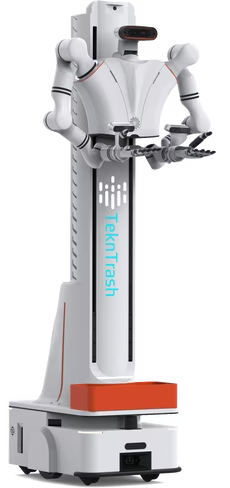
Sharp Group processes 280,000 tonnes of mixed recycling per year at its facility in Rainham, east London, using 24 agency workers on rapid conveyor belts. The company, founded by Tom Sharp and now run by the third generation of the family, has deployed a humanoid robot called Alpha, built by RealMan Robotics in China and adapted for recycling operations by the British startup TeknTrash Robotics.
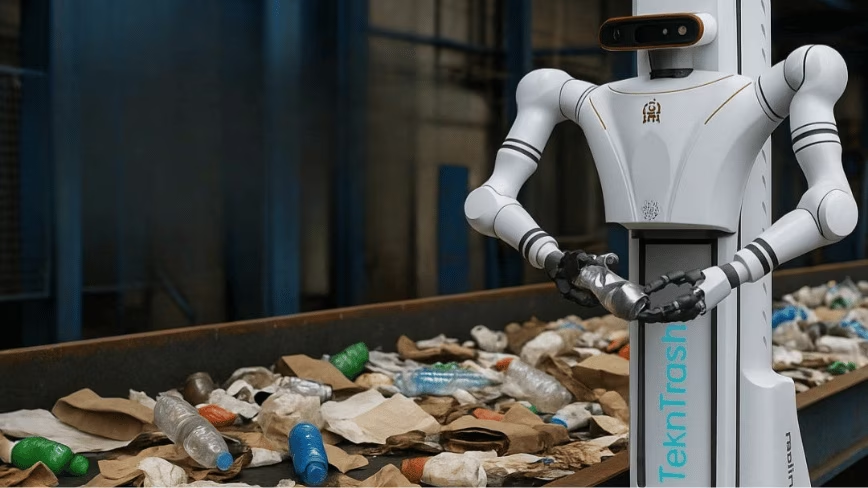
Alpha stands at the line like a human worker. That is the point. TeknTrash founder Al Costa argues that a humanoid form factor allows the robot to slot into existing plant layouts without requiring the facility to be redesigned around it. The alternative, which companies like Colorado-based AMP and California-based Glacier have pursued, is purpose-built sorting systems using robotic arms, air jets, and AI vision. Those systems work, but they require either new facilities or expensive retrofits. A humanoid that can stand where a human stood and do what a human did is, in theory, a cheaper and faster path to automation for the hundreds of smaller recycling plants that cannot afford to rebuild.
Alpha is not yet operational. When the BBC visited, it was on a training programme, being guided through arm movements while a plant worker beside it wore a Meta Quest 3 VR headset, recording his own sorting motions to demonstrate what successful picking looks like. TeknTrash’s HoloLab system feeds data from multiple cameras to train the robot in two parallel tasks: identifying what is on the belt and physically lifting it. Thousands of items pass through the system daily, generating millions of data points. Costa is candid about the timeline. “The market thinks these robots are ready to wear, that all you need to do is plug them into the mains and they will work flawlessly. But they need extensive data in order to be effectively useful.” The training will take months. TeknTrash plans to deploy the same system across 1,000 plants in Europe, all connected to the cloud, but that ambition depends on Alpha learning to sort reliably in one plant first.
The competition
The humanoid approach is unusual. The recycling automation market is dominated by companies that have taken a different path. Sereact raised 110 million dollars in April to scale AI that makes any industrial robot adaptable across logistics and manufacturing, reflecting a broader investment thesis that the value is in the software layer, not the physical form. AMP, the Colorado-based sorting company, raised 91 million dollars in its Series D and now operates three of its own plants while supplying AI-powered sorting equipment to more than 100 facilities worldwide. Its system uses air jets to guide items into chutes at eight to 10 times the pace of a human worker. CEO Tim Stuart, a former chief operating officer at Republic Services, describes the approach as fundamentally different from trying to replicate human movement: build the sorting intelligence into the system and design the physical infrastructure around it.
Glacier, the Amazon-backed California startup co-founded by Rebecca Hu-Thrams, has taken a middle path: mounted robotic arms controlled by AI vision systems that can be installed in existing facilities without a full rebuild. The company raised 16 million dollars in 2025, processes recycling for nearly one in 10 Americans, and was named to TIME’s Best Inventions list. Hu-Thrams emphasises that Glacier’s system is designed to work for semi-rural facilities on tight budgets, not just large urban plants. The AI learns from more than a billion sorted items, improving continuously. The variability of waste is the core technical challenge. “Sometimes a beer can will be spraying liquid everywhere, threatening machinery,” Hu-Thrams says. Her customers have also encountered hand grenades and firearms on the sorting line.
The industrial logic
Siemens deployed an Nvidia-powered humanoid robot in a live factory environment in January, picking totes from storage stacks and moving them to conveyor belts over a two-week trial. The test demonstrated that humanoid robots can function in real industrial settings, but also revealed the gap between controlled demonstrations and sustained production use. The recycling environment is harder. Factory floors are structured and predictable. A recycling conveyor belt carries a random assortment of objects at variable speeds, many of them wet, broken, or tangled together. A humanoid robot that can sort waste reliably would, by definition, be capable of performing most factory picking and sorting tasks. The recycling line is, in engineering terms, one of the hardest possible environments to automate.
Tesla is targeting mass production of its Optimus humanoid robot from its Shanghai Gigafactory, with over 1,000 Gen 3 units already deployed across Tesla’s own facilities and production-scale manufacturing planned for 2026 to 2028. Chinese robotics companies like Linkerbot are reaching multi-billion-dollar valuations on the promise of dexterous manipulation, the ability to pick up, rotate, and place objects of varying shapes and weights. That capability is exactly what recycling demands. Alpha’s manufacturer, RealMan Robotics, is part of the same Chinese robotics ecosystem that is producing humanoids at price points Western manufacturers cannot match. The geopolitics of humanoid robotics mirrors the geopolitics of semiconductors: the hardware is increasingly Chinese, the software layer is contested, and the deployment environments are global.
The economics
The financial case for automation in recycling is straightforward. A human worker on a sorting line costs roughly 25,000 to 30,000 pounds per year in the UK including agency fees, and leaves after an average of 30 months at current turnover rates. The cost of constantly recruiting, training, and replacing workers accumulates into a structural drag on margins in an industry where margins are already thin. A robot that works 24 hours a day, seven days a week, with no holidays, no sick days, and no injury risk, changes the unit economics of every tonne processed. “The attraction of a humanoid is that you can put it here and it stays here,” says Chelsea Sharp, the plant’s finance director and granddaughter of the founder. “It will pick all day, 24 hours a day, seven days a week.”
Accenture has invested in General Robotics to orchestrate factory robots with unified AI, part of a broader pattern in which the consulting and technology industries are building the software infrastructure to manage fleets of industrial robots across multiple sites. The recycling industry is a natural early adopter because its labour economics are the worst in manufacturing: the highest turnover, the highest injury rates, and the least desirable working conditions. If automation works here, it works almost anywhere. Professor Marian Chertow of Yale University describes the shift as both inevitable and necessary: robotics and AI-driven vision systems offer the greatest potential for improving material recovery, worker safety, and economic competitiveness in recycling.
The workers
The question that automation always raises, and that the recycling industry cannot avoid, is what happens to the people whose jobs the robots take. Sharp Group employs 24 agency workers on its sorting lines. If Alpha and its successors can match human sorting rates, which AMP’s systems already exceed by a factor of eight to 10, those 24 positions become maintenance and oversight roles. Chelsea Sharp says the plan is to upskill existing staff to maintain and supervise the robots, moving them away from the dust, noise, and physical danger of the conveyor belt. The narrative is familiar from every industry that has automated: the dangerous jobs are eliminated, the workers are retrained, and the new roles are better. Whether that happens in practice depends on whether the company invests in retraining and whether the workers have the skills and desire to transition into technical maintenance roles. In an industry with 40 per cent annual turnover, many of the current workers will have left before the robots are fully operational.
What is happening in Rainham is a small version of a transformation that is arriving across every industry where the work is too dangerous, too unpleasant, or too poorly paid to retain human workers. The recycling sector processes the material that the rest of the economy discards, and it has done so for decades using the cheapest available labour in the worst available conditions. The humanoid robot on Sharp Group’s sorting line is not yet capable of replacing the human beside it. But the human beside it will not stay. The industry’s 40 per cent turnover rate is not a recruitment failure. It is a signal that the work was never suitable for humans in the first place, and the technology to acknowledge that is finally arriving.
Get the TNW newsletter
Get the most important tech news in your inbox each week.


 Credit: TeknTrash